
September 7, 2026

AI Generated. Credit: ChatGPT
SaaS Application Development Ideas can turn a simple business problem into a recurring-revenue software product. The strongest ideas do not start with technology. They start with a specific customer pain point, a clear buyer, and a problem that users will pay to solve.
Finding the right SaaS concept also requires more than copying popular products. A practical idea should have a defined audience, repeat usage, manageable development scope, and room to improve over time. This guide explores promising SaaS concepts, how to validate them, and what to consider before development.
SaaS Application Development Ideas are software product concepts delivered through the cloud, usually on a subscription or usage-based model. Good ideas solve recurring problems for a defined group of users, such as workflow automation, customer management, analytics, collaboration, finance, or industry-specific operations.
The best concepts combine a painful problem, repeat demand, clear value, and a scalable delivery model.
A promising SaaS product does not need thousands of potential features. It needs a problem that customers already struggle to solve.
Before development, evaluate an idea against these five factors:
| Factor | What to ask |
|---|---|
| Problem severity | Does the product solve an expensive or frustrating problem? |
| Target audience | Can you clearly identify the people who will use and buy it? |
| Frequency | Will customers need the solution regularly? |
| Willingness to pay | Does the problem have enough business value to justify a subscription? |
| Scalability | Can the software serve more customers without costs rising at the same rate? |
A useful test is simple: Can you explain the problem and the product in one sentence? If not, the concept may need a narrower focus.
The most attractive SaaS product ideas often sit at the intersection of automation, industry-specific workflows, analytics, collaboration, and AI-assisted processes.
Here are several practical concepts worth evaluating.
Businesses receive customer questions across email, chat, websites, and social channels. A SaaS platform can centralize those conversations and help support teams find answers faster.
Useful features could include:
The key is not adding AI for its own sake. The product should reduce support workload or improve response quality.
Vertical SaaS focuses on one industry instead of trying to serve everyone.
For example, you could build specialized software for:
A focused product can include workflows that generic software does not support well. That specialization can become a strong competitive advantage.
Small and mid-sized businesses often use spreadsheets for expense tracking, approvals, reimbursements, and budget planning.
A SaaS platform could connect expenses with departments, projects, vendors, and approval rules.
Core functionality might include:
Integration with accounting platforms can increase the product’s practical value.
Many businesses repeat the same administrative tasks every day.
An automation platform could let users build workflows that connect forms, email, CRM records, documents, notifications, and internal approvals.
For example:
New lead submitted → CRM record created → salesperson notified → follow-up task assigned → customer email sent
The strongest automation products focus on a specific business process instead of becoming an overly complicated general-purpose platform.
Organizations need better ways to understand employee sentiment, recognize achievements, and identify workplace issues.
Potential features include:
This concept works best when reporting helps managers make specific decisions rather than simply displaying survey scores.
Scheduling software remains useful across many industries because missed appointments directly affect revenue.
A niche scheduling product could serve:
Consider adding automated reminders, online payments, staff calendars, rescheduling, and customer records.
Large enterprises have access to sophisticated business intelligence tools. Smaller companies often need something simpler.
A focused analytics SaaS can connect data sources and turn raw numbers into understandable dashboards.
Examples include:
The product should answer business questions, not overwhelm users with charts.
Businesses handle contracts, invoices, proposals, compliance documents, policies, and internal records.
A modern document platform could offer:
Security and access control should be treated as core product requirements rather than features added later.
Also read: What Is SaaS Application Development?
For founders, a smaller and narrower product can be easier to validate than a large platform.
Here are several SaaS ideas for startups that can support a focused MVP:
| SaaS idea | Target users | Possible MVP |
|---|---|---|
| Client onboarding platform | Agencies and consultants | Forms, tasks, documents |
| Proposal management tool | Service businesses | Templates, approvals, tracking |
| Review management SaaS | Local businesses | Review requests, monitoring |
| Inventory alert system | Retailers | Stock tracking and notifications |
| Meeting action tracker | Business teams | Notes, tasks, reminders |
| Vendor management SaaS | Operations teams | Vendor records, documents, alerts |
| Field service scheduler | Service companies | Jobs, scheduling, technician tracking |
| Subscription analytics | SaaS companies | Revenue and churn dashboards |
The best starting point is usually the idea where you already understand the customer and the workflow.
One of the biggest mistakes founders make is developing too much software before confirming demand.
A better approach is to validate the problem first.
Do not define your market as “businesses.” Define it more precisely.
For example:
Independent property management companies with 10–50 employees.
A narrow audience helps you understand workflows, language, pricing expectations, and buying behavior.
Talk to people who experience the problem directly.
Ask questions such as:
Their current behavior is often more valuable than hypothetical feedback.
Competition does not automatically mean you should abandon the idea.
Instead, identify gaps in existing products:
Your opportunity may be to serve a narrower audience better.
An MVP should solve one important problem well.
Avoid building every feature customers might eventually need. Start with the core workflow, test it with real users, and improve it based on actual usage.
Positive feedback is not enough.
A strong validation signal comes from customers who agree to pay, start a trial, sign a contract, or commit internal resources to adopting the product.
The feature set depends on the product, but several capabilities appear across successful SaaS products.
Depending on the product, you may also need multi-tenancy, audit logs, data exports, workflow automation, mobile access, or AI-assisted functionality.
Security should be considered from the architecture stage. Strong authentication, authorization, encryption, secure APIs, logging, backups, and appropriate compliance controls become especially important when the platform stores business or customer data.
For products that need intelligent automation, combining custom software development services with a focused product strategy can help create workflows that fit the target market more closely.
AI can make a SaaS product more useful, but it should support the product’s main job.
For example, an operations platform could use AI to summarize incidents, detect unusual activity, or recommend next actions. A sales platform could summarize customer conversations and identify follow-up opportunities.
Useful AI applications include:
A practical rule is to ask: Does the AI feature save time, reduce errors, increase revenue, or improve a decision?
If the answer is unclear, the feature may not belong in the first release.
For businesses exploring AI-led products, custom AI solutions can help connect intelligent capabilities with existing business workflows.
Not every promising-looking idea deserves development.
Be cautious when:
A product can also fail because it solves a real problem that customers simply do not consider important enough to pay for.
Once an idea passes validation, the development process should follow a practical sequence.
A scalable SaaS architecture should support growth without forcing a complete rebuild after the first wave of customers.
During planning, consider tenancy, data isolation, API design, observability, backups, infrastructure costs, deployment processes, and integration requirements.
Businesses that need help turning validated SaaS product ideas into production-ready software can work with an experienced SaaS software development company.
Also read: Software as a Service in Cloud Computing: The Complete Guide
The best SaaS application development ideas solve recurring problems for a clearly defined audience. Strong opportunities include vertical SaaS, workflow automation, customer support, analytics, expense management, scheduling, document management, and specialized AI-enabled platforms. The strongest idea is usually the one with clear customer pain and measurable business value.
SaaS product ideas for startups include client onboarding software, proposal management platforms, review management tools, vendor management systems, field service scheduling, inventory alerts, meeting action trackers, and subscription analytics. Startups should generally choose a narrow problem that can be solved with a focused MVP.
Evaluate the size and accessibility of the target market, the severity of the problem, competing solutions, pricing potential, customer acquisition costs, and retention opportunities. Most importantly, speak with potential customers and test whether they will pay for the solution instead of relying only on survey responses.
SaaS application development cost varies significantly based on product complexity, integrations, architecture, security requirements, user roles, AI functionality, and the platforms involved. A focused MVP usually costs less than a large enterprise platform. Defining the minimum feature set early helps control the initial budget.
SaaS software typically runs in the cloud, and customers access it through the internet, often using a subscription or usage-based pricing model. Traditional software may require installation and separate updates. SaaS also allows providers to manage updates, infrastructure, and ongoing improvements centrally.
No. AI is useful when it improves the product’s core outcome, such as reducing manual work, improving search, generating summaries, making predictions, or assisting users. Adding AI without a clear business purpose can increase development complexity and operating costs without creating meaningful customer value.
A niche product is often easier to validate because the target customer, workflow, and value proposition are clearer. Once the product gains traction, the company can expand into adjacent workflows. Starting broad can create unnecessary complexity before product-market fit is proven.
Technology choices depend on product requirements. Modern SaaS platforms may use web frameworks such as React or Next.js, backend technologies such as Node.js, Python, Java, or .NET, relational or NoSQL databases, cloud infrastructure, APIs, containers, and third-party services. Architecture should be selected around product needs rather than technology trends.
A focused MVP can often be developed much faster than a feature-rich enterprise platform, but the timeline depends on scope, integrations, team size, design requirements, testing, security, and technical complexity. A clear requirements document and prioritized MVP can significantly reduce delays.
Yes. Businesses often have valuable internal workflows that can be converted into software products when the process is repeatable and relevant to other organizations. Start by identifying which part of the workflow creates measurable value, then validate that other businesses face the same problem.
The strongest SaaS Application Development Ideas are not necessarily the most complicated. They are the ones that solve recurring problems for a specific audience and create enough value to justify continued payment.
Start with the customer problem. Validate it before writing a large codebase. Build the smallest useful product, measure how users interact with it, and expand based on real demand.
For founders and established businesses, the opportunity is not simply to create another SaaS application. It is to build a product that becomes part of the customer’s regular workflow.

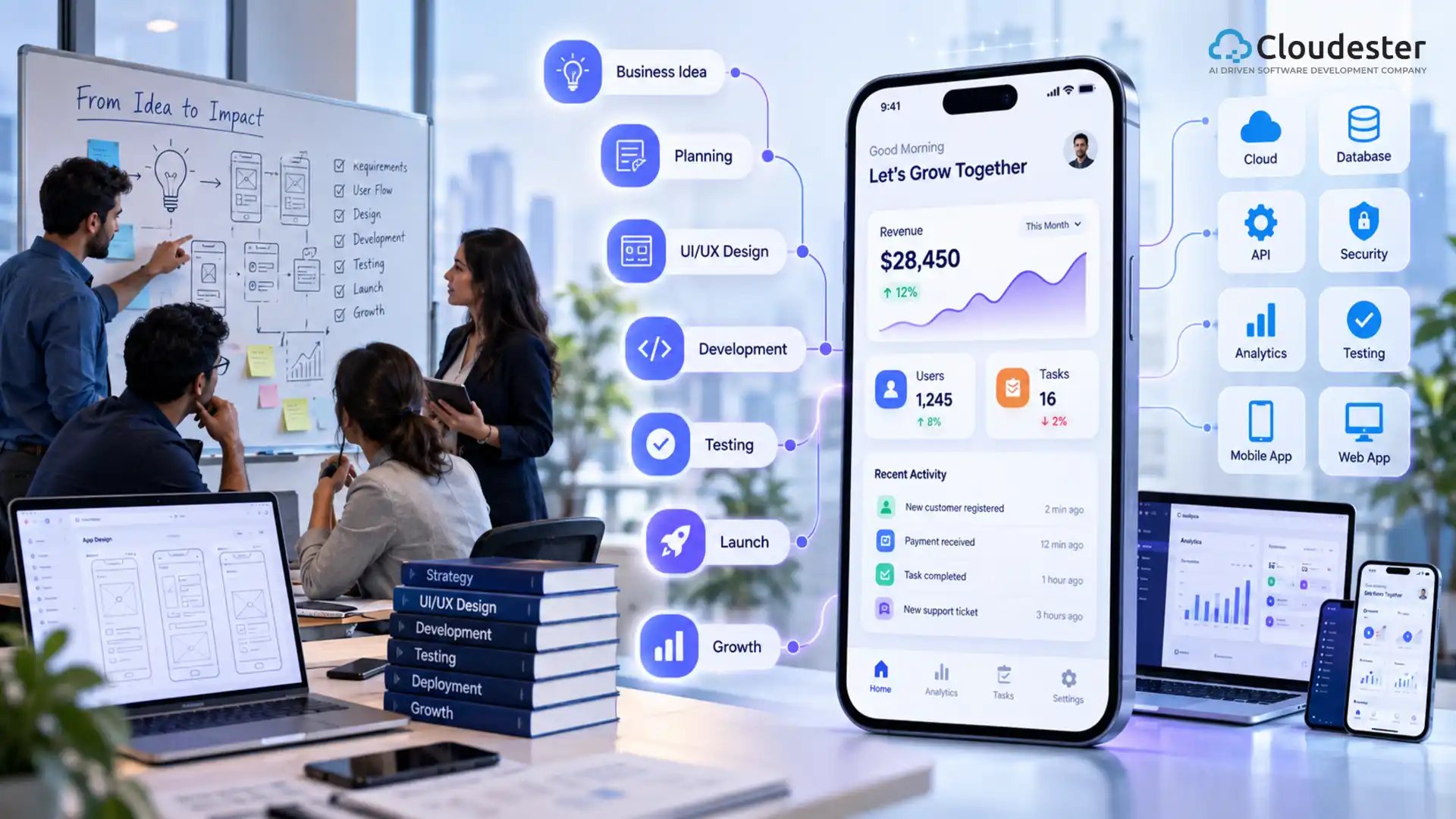



We specialize in creating high-performance web and mobile apps, seamlessly integrating them with your existing systems to enhance user experiences and streamline business operations.
85 Delancey St, New York NY 10002, United States