August 28, 2026
AI Generated. Credit: ChatGPT
Dark store automation levels manual vs automated picking can determine how quickly a fulfillment operation processes orders, how much labor it needs, and how well it handles demand spikes. The right model is not always the most automated one.
A small urban grocery operation may gain more from disciplined manual picking, optimized shelving, barcode scanning, and strong warehouse software. A high-volume operation with predictable demand may justify goods-to-person systems, conveyors, autonomous mobile robots, or highly automated fulfillment equipment.
The real decision comes down to order volume, product mix, labor costs, delivery promises, available space, and return on investment. McKinsey notes that manual dark stores can suit moderate-volume markets, while automated micro-fulfillment and highly automated facilities become more attractive as order density and volume rise.
Dark store automation levels manual vs automated picking describe the different ways an e-commerce fulfillment facility moves from human-led order picking toward software-assisted, machine-assisted, or highly automated product handling. Manual systems rely mainly on workers, while automated models use technology to reduce travel, handling, sorting, and repetitive work.
The important point is that automation exists on a spectrum. Many successful dark stores use a hybrid approach instead of replacing every manual task.
Dark store automation can generally be viewed across four practical levels:
| Automation level | Main picking method | Human involvement | Best suited for |
|---|---|---|---|
| Level 1 | Manual picking | Very high | Small and emerging operations |
| Level 2 | Software-assisted picking | High | Growing dark stores |
| Level 3 | Robot-assisted or goods-to-person picking | Medium | High-volume facilities |
| Level 4 | Highly automated fulfillment | Low | Large, predictable operations |
These levels are not strict industry standards. They are a practical framework for comparing operational maturity.
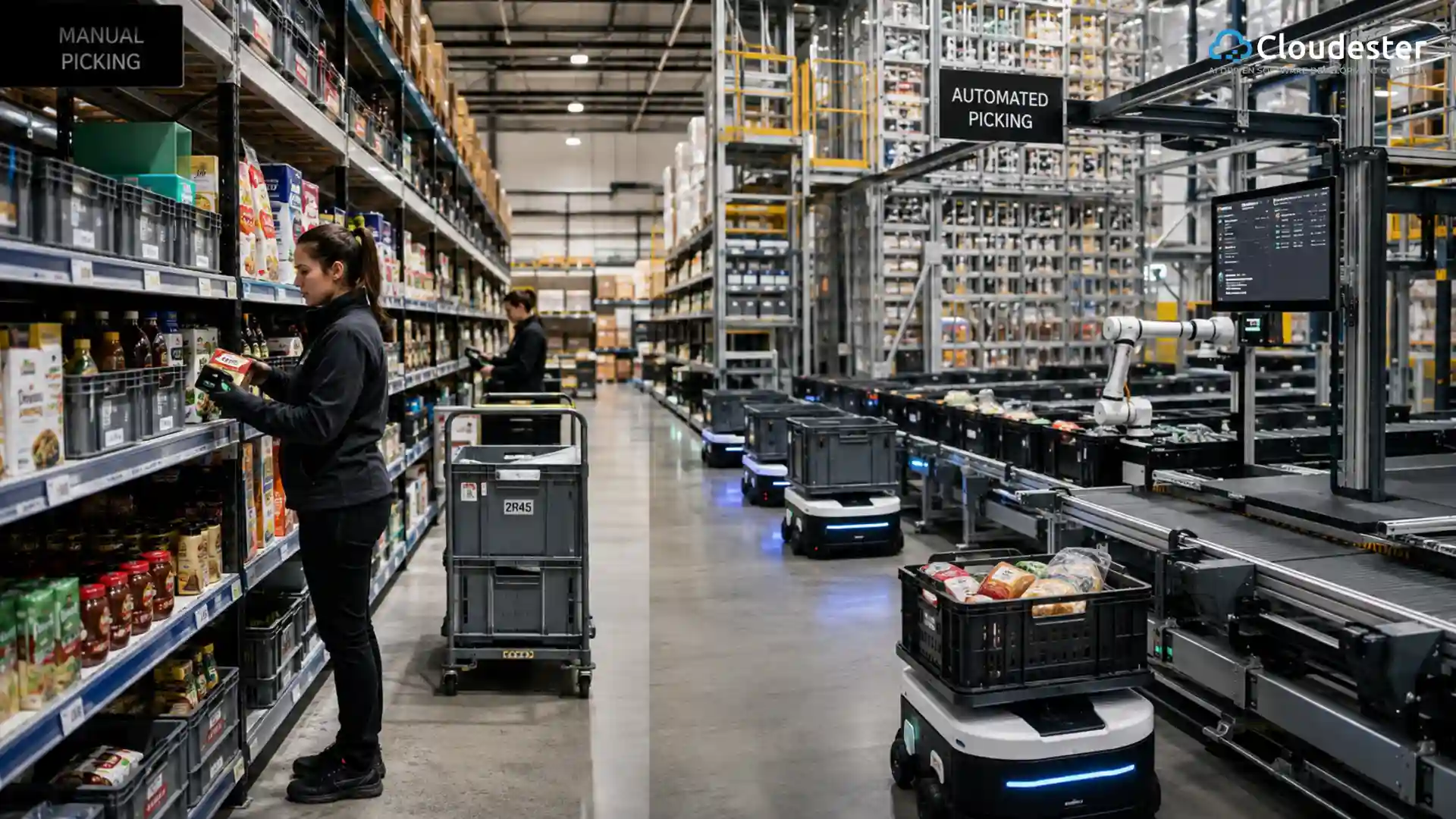
At the manual level, employees walk through storage aisles, locate products, scan or verify items, place them into totes or bags, and take completed orders to packing or dispatch.
The setup is simple. Shelving, handheld scanners, mobile devices, printers, and a basic warehouse or order management system may be enough to operate the facility.
Manual picking works particularly well when:
The trade-off is labor productivity. McKinsey cites typical manual picking speeds of roughly 60 to 70 units per hour in the grocery fulfillment context, while noting that automated micro-fulfillment can achieve more than five times that speed under suitable operating conditions.
That does not mean every automated facility will achieve the same result. Layout, product dimensions, replenishment, batching, and order composition all influence productivity.
This is often the most practical starting point for a growing dark store.
Workers still physically pick the products, but software decides what to pick, in what sequence, and from where. The system can optimize routes, batch compatible orders, highlight substitutions, prioritize urgent orders, and reduce unnecessary walking.
For example, imagine ten customer orders arriving within the same five-minute window. A basic process might send workers through the same aisle repeatedly.
A better system can combine those orders into a picking batch and create an efficient route. The employee still picks manually, but the software eliminates much of the decision-making.
This model offers a strong balance between flexibility and operational control.
The biggest difference is where the physical work happens.
With manual picking, employees travel to inventory locations to collect products. Goods-to-person automation reverses that process by bringing inventory directly to employees. More advanced systems can also handle transport, sorting, sequencing, storage, and other fulfillment activities.
| Factor | Manual picking | Automated picking |
|---|---|---|
| Upfront investment | Low | High |
| Labor dependency | High | Lower |
| Flexibility | Very high | Moderate |
| Scalability | Limited by labor and space | Higher when well designed |
| Implementation speed | Fast | Slower |
| Maintenance needs | Low to moderate | Higher |
| Process consistency | Depends on workers and systems | Generally more standardized |
| Best for | Variable or moderate volume | High and predictable volume |
The important distinction is that automation does not simply remove labor. It changes where labor is needed.
Instead of spending most of a shift walking and searching, employees may focus on replenishment, exception handling, quality checks, packing, and managing automated equipment.
A dark store should usually remain manual when demand is relatively low, unpredictable, or still being validated.
Consider a new grocery delivery business operating one facility in a medium-sized city. Orders fluctuate throughout the day, the assortment changes frequently, and management has not yet established stable demand patterns.
Installing expensive robotic infrastructure at this stage could create unnecessary financial pressure.
A manual system can provide valuable operational data first.
Track:
Once the numbers show a consistent constraint, management can automate the specific bottleneck instead of automating everything.
Automation becomes more compelling when order volume is high enough to keep equipment productive for a substantial portion of the operating day.
The business case becomes stronger when several conditions appear together:
McKinsey describes dark stores as particularly suitable for moderate-volume areas, while automated micro-fulfillment centers can make sense in higher-volume, high-density urban markets.
There is no single technology that fits every facility.
The best automation decision starts with the workflow, not the robot.
A practical evaluation can follow five steps.
Look beyond purchase price.
Gartner has emphasized that the software architecture supporting warehouse automation is a critical part of the investment decision. Poor software alignment can reduce the value of otherwise capable automation.
No.
Fully automated picking can provide high throughput and consistent processes, but it also introduces complexity.
Machines need maintenance. Software needs integration. Sensors and mechanical systems can fail. Product exceptions still require human intervention.
Dark stores also handle products that can be difficult for automation. Grocery operations may involve chilled items, frozen products, fresh produce, fragile packaging, substitutions, and products with different shapes and weights.
That is why hybrid fulfillment remains important.
Industry analysis increasingly points toward combining different automation methods rather than forcing every product and process into a single automated system.
Imagine a grocery dark store processing several thousand orders each week.
Fast-moving packaged goods could be stored in a high-density automated system. Robots or conveyors could handle tote transportation. Employees could pick complex fresh products manually.
A software layer could then coordinate order batching, inventory allocation, picking priorities, substitutions, packing, and dispatch.
The result is not a lights-out warehouse. Instead, technology handles predictable repetitive work while people handle situations that require judgment.
This approach can also make expansion easier. A business can automate the highest-value zone first and add capacity as demand grows.
For retailers evaluating these models, McKinsey recommends matching the fulfillment approach to market conditions rather than applying a single model across every location.
Automation should be measured through business outcomes, not the number of machines installed.
| KPI | What it tells you |
|---|---|
| Picks per labor hour | Worker productivity |
| Orders per hour | Overall fulfillment capacity |
| Cost per order | Economic efficiency |
| Pick accuracy | Order quality |
| Order cycle time | Fulfillment speed |
| On-time dispatch rate | Operational reliability |
| Inventory accuracy | Stock confidence |
| Equipment utilization | Automation efficiency |
| Exception rate | Process weakness |
| Downtime | Technology reliability |
A common mistake is optimizing picking speed while ignoring replenishment or packing.
A dark store can achieve impressive picking productivity and still fail its delivery promise because finished orders remain stuck in staging.
That is why fulfillment should be measured as an end-to-end process.
Successful facilities normally redesign roles rather than simply remove workers. Employees may shift from walking-intensive picking toward replenishment, quality control, equipment supervision, exception management, and inventory control.
Gartner has also projected that robotics will increasingly change supply-chain management roles, making operational expertise around robot fleets more important.
Choosing between dark store automation levels manual vs automated picking is not a simple choice between people and machines. It is a decision about throughput, cost, flexibility, product characteristics, space, and future demand.
Manual picking remains valuable for smaller and less predictable operations. Software-assisted picking can deliver substantial efficiency without major infrastructure changes. Robot-assisted and goods-to-person systems become attractive as volume and labor pressure rise. Fully automated operations can support large-scale, predictable fulfillment, but they require significant capital and strong technical infrastructure.
The best strategy is usually to automate the bottleneck first.
Start with reliable data. Measure the complete fulfillment workflow. Identify where time and money disappear. Then select technology that solves that specific problem.
A well-designed hybrid dark store can often achieve a better balance of speed, flexibility, scalability, and cost than either a completely manual or fully automated model.
Manual picking requires workers to travel to inventory locations and collect products themselves. Automated picking uses technologies such as goods-to-person systems, robots, conveyors, or automated storage to reduce human travel and handling. Many modern dark stores combine both approaches because product assortment and order profiles vary significantly.
Manual picking usually requires less upfront capital, making it attractive for smaller operations. However, higher labor requirements can increase operating costs as order volumes grow. Automated picking requires greater initial investment but may reduce repetitive labor and improve throughput. The lower-cost model depends on order volume, labor rates, utilization, and facility requirements.
Software-assisted picking uses digital tools to guide workers through orders and optimize how tasks are performed. The system can provide product locations, quantities, picking sequences, batch assignments, and verification steps. Workers still handle the products, but software reduces unnecessary decisions, walking, and errors.
A dark store should consider robotics when consistent order volume creates enough work to justify the investment. Robotics can be valuable when labor availability, walking distance, space limitations, or delivery speed becomes a major operational constraint. A detailed cost-benefit analysis should be completed before selecting robotic equipment.
Yes. Hybrid picking is often practical because different products have different automation requirements. Fast-moving packaged products may use automated storage or goods-to-person technology, while fresh, fragile, irregular, or variable-weight products may continue to require human handling.
Not necessarily. Automation usually changes the type of work employees perform rather than eliminating every role. Workers may continue handling replenishment, quality checks, exceptions, fresh products, packing, maintenance, and inventory control. The exact workforce impact depends on the technologies, product mix, and facility design.
There is no single KPI that works for every operation. Cost per order, picks per labor hour, order cycle time, accuracy, equipment utilization, downtime, and on-time dispatch should be evaluated together. End-to-end fulfillment performance is more useful than measuring picking speed alone.
Not always. Fully automated facilities can provide high throughput and consistent processing, but they require substantial capital, technical integration, maintenance, and operational discipline. Manual facilities offer more flexibility and lower initial investment. The best model depends on demand, assortment, location, service promises, and financial targets.
A business can begin with barcode scanning, mobile picking, optimized slotting, batch picking, and warehouse software. It can then add pick-to-light, voice systems, AMRs, conveyors, goods-to-person technology, or automated storage as volume increases. Phased automation reduces the risk of investing heavily before demand is proven.
Software coordinates orders, inventory, picking tasks, workers, equipment, replenishment, packing, and dispatch. Without effective orchestration, automated machines may work efficiently while the overall fulfillment process remains inefficient. Strong integration helps turn individual technologies into one coordinated operation.



We specialize in creating high-performance web and mobile apps, seamlessly integrating them with your existing systems to enhance user experiences and streamline business operations.
85 Delancey St, New York NY 10002, United States