
September 12, 2026
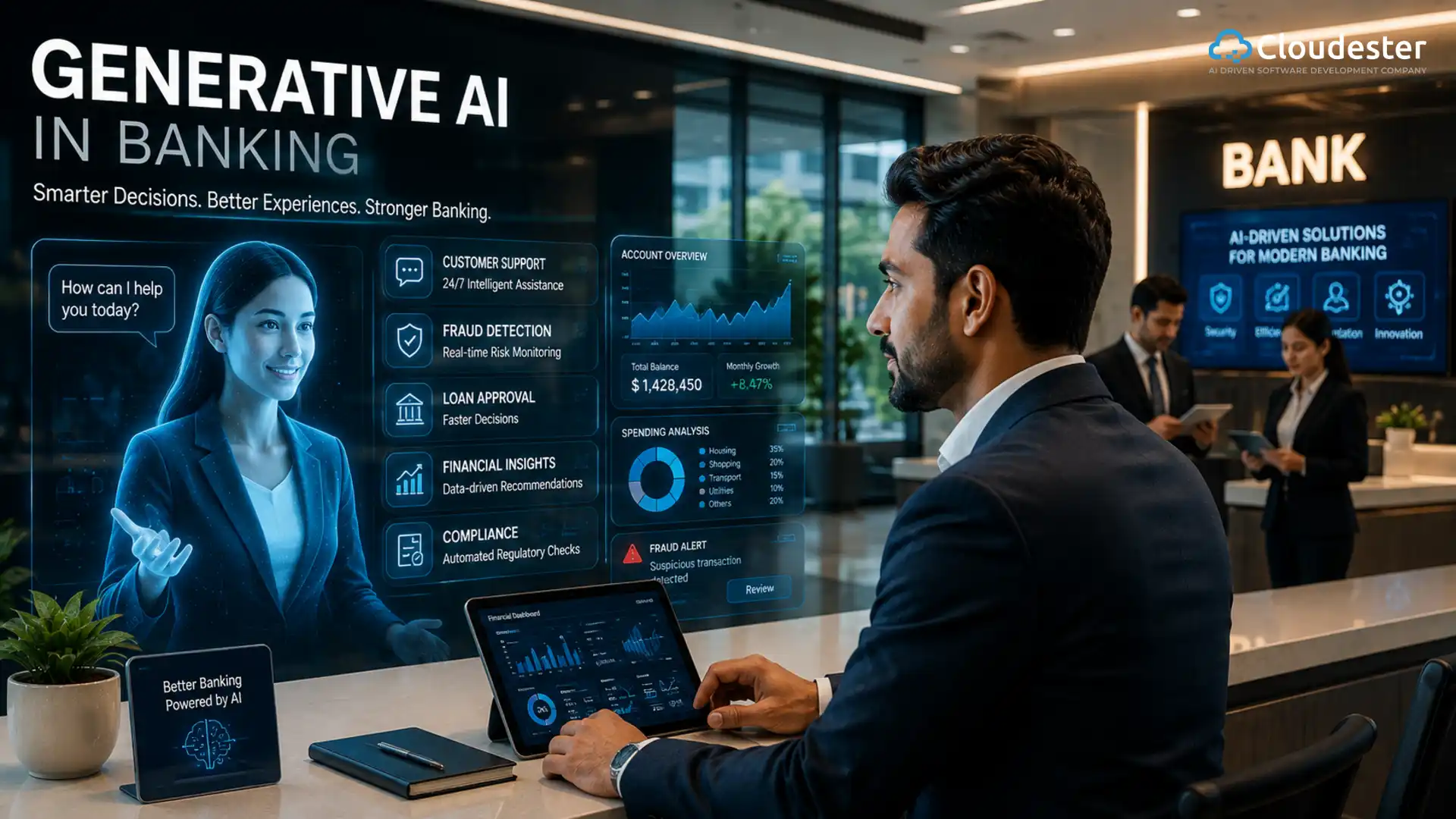
AI Generated. Credit: ChatGPT
A few years ago, generative AI in banking was a slide in someone’s innovation deck. Now it’s running the chat window, drafting the fraud alert, summarizing the loan file. Three things pushed that shift. Customers stopped tolerating slow answers. Cost pressure never really let up. And the models themselves got good enough, finally, that a bank could trust one with real financial data instead of just a demo. Traditional AI sorts things into buckets. Generative AI writes the thing, drafts the reply, builds the recommendation, instead of just flagging a pattern and walking away. That’s the whole difference, really, and it’s why so many new use cases opened up almost overnight.
Strip away the interface, and you’ve got large language models trained on financial language, reasoning across a mountain of text most humans would never get through.
The language model does the talking. Retrieval-augmented generation does the quieter, harder job underneath, pulling in a bank’s actual documents so the answer isn’t just plausible-sounding filler.
Nobody’s ripping out their core banking system for this. APIs do the connecting. The AI sits on top, reads what it needs, and the old infrastructure keeps humming underneath, mostly untouched.
Once that plumbing’s in place, the generative AI use cases in banking start popping up in places you wouldn’t expect at first glance.
Chatbots answer account questions at 2 am now. They know, usually, when to stop pretending and hand things to a person.
It looks at what someone actually spends money on and suggests something that fits, not whatever product happens to sit at the top of the pile that quarter.
A process that used to take three days now takes an afternoon. The AI drafts the summary. It flags the missing W-2 before a loan officer even opens the file.
Transactions get scanned as they happen, and the model catches things a static rules engine would just wave through.
Onboarding document review, the part everyone hates, moves faster because identity checks run automatically against compliance requirements instead of sitting in someone’s queue.
Contracts. Statements. Internal reports nobody wanted to write on a Friday afternoon. All of it drafted and summarized in a fraction of the usual time.
Instead of digging through a wiki that’s three reorgs out of date, or messaging a coworker who won’t answer until tomorrow, staff just ask the assistant.
Campaigns get drafted faster. Outreach gets personalized at a scale that would’ve needed a much bigger team five years back.
These generative AI examples in banking aren’t theoretical anymore. They’re live, running quietly inside institutions most people bank with already.
Large banks rolled out internal assistants for staff first, then customer-facing tools once the early results looked solid enough to justify going bigger.
A mid-sized lender drafts loan summaries with it. A retail bank uses the same underlying tech to personalize what shows up in its app. Different problem, same engine underneath.
The application of generative AI in banking looks pretty different depending on which side of the counter you’re standing on.
Faster answers. Suggestions that actually fit. Support that doesn’t clock out when the branch does.
Costs come down, processing speeds up, and staff finally get to spend time on the calls that actually need a human’s judgment instead of another form.
None of this comes free, and any bank going in blind is going to have a rough time of it.
Financial data is sensitive by nature. Any tool that touches it needs real encryption, real access controls, not a checkbox someone signed off on in a meeting.
Banks already live under heavy regulation, and AI output still has to clear the same bar as a person’s work would. A model writing something doesn’t make it exempt.
Train a model on biased historical data, and it’ll happily repeat that bias in lending decisions. Quietly. Without flagging itself.
A denied loan. A fraud flag on a legitimate transaction. Somebody has to be able to step in and override the call, every time.
| Feature | Generative AI | Traditional AI |
| Purpose | Creates new content and responses | Classifies, scores, or predicts |
| Customer Interaction | Conversational, natural language | Rule-based or form-driven |
| Content Generation | Drafts text, summaries, reports | Limited to structured outputs |
| Decision Support | Suggests options with reasoning | Flags patterns or thresholds |
| Learning Capability | Learns language patterns broadly | Learns narrow, task-specific patterns |
| Best Use Cases | Support, personalization, drafting | Fraud scoring, credit risk models |
They’re not really rivals. Traditional AI still does most of the scoring and flagging work that generative AI was never built for in the first place, and probably shouldn’t try to do.
| Pros | Cons |
| Faster customer response times | Requires careful oversight and review |
| Lower operational costs over time | Upfront integration and training costs |
| Frees staff for higher-value work | Risk of inaccurate or biased outputs |
| Scales support without adding headcount | Needs strong data governance to stay compliant |
A partner like Cloudester Software tends to shorten this whole stretch, especially the platform decision and the part where integrations either create new security gaps or don’t.
Agentic AI that handles a whole multi-step task without hand-holding. Deeper personalization. Tighter integration straight into core banking systems. All of it is picking up speed right now.
Clean data, real governance, infrastructure that isn’t held together with duct tape- banks with those three things in place now won’t be scrambling later.
Also read: Artificial intelligence solutions for business
This isn’t a trend that’s going to fade out.
Generative AI in banking is becoming part of how banks talk to customers, push paperwork through, and manage risk, often all three at the same time.
The institutions actually seeing results aren’t the ones grabbing every new tool that shows up.
They picked one clear use case, kept a person in the loop on the decisions that matter, and built the governance to back it up instead of bolting it on after the fact.
If your institution is past the pilot stage and ready for something real, Cloudester Software works with banks to get generative AI running in production, safely, at a scale that actually holds up.
AI models that create content, responses, and recommendations, showing up in everything from chatbots to document drafting inside financial institutions.
Customer service, personalized advice, loan processing, fraud detection, compliance work, and internal knowledge tools, mostly.
It can be, if it’s paired with real data security, human oversight, and compliance controls. Left unsupervised, that’s a different story.
Customer service, personalized financial advice, and faster loan processing tend to show results the fastest.
Yes, usually alongside traditional AI models built specifically for pattern-based fraud scoring, not instead of them.
Instant answers, any hour, without adding headcount to keep up with demand.
Data privacy, regulatory compliance, bias creeping into outputs, and the constant need for a human somewhere in the loop.
Several major global banks have rolled out internal assistants and customer tools already, and plenty more are piloting right now.
Generative AI creates content and conversation. Traditional AI classifies, scores, and predicts from structured data.
More personalization, more autonomous multi-step agents, tighter integration across the systems banks already run on.




We specialize in creating high-performance web and mobile apps, seamlessly integrating them with your existing systems to enhance user experiences and streamline business operations.
85 Delancey St, New York NY 10002, United States