Software & AI Engineering Company
Enterprise Software That
Automates and Scales.
Production-Ready Platforms
Engineered for Real Results.
Build AI Agents That
Actually Run Your Business.
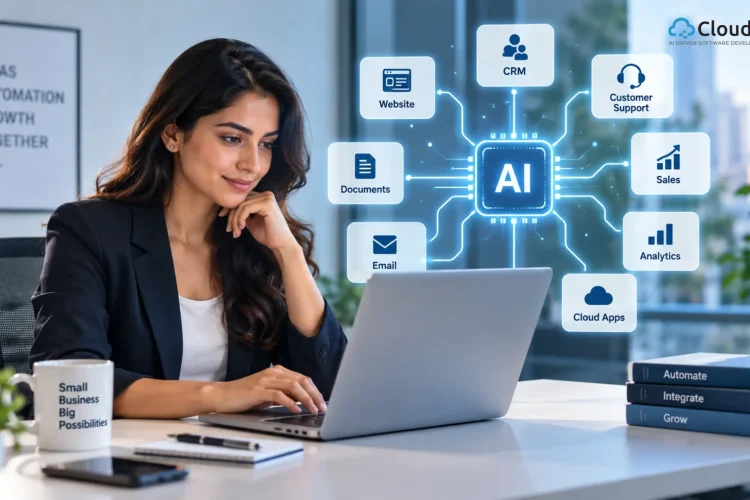
Cloudester is a software and AI engineering firm that builds intelligent AI agents, SaaS platforms, web and mobile applications, and custom software that reduces complexity, lowers costs, and scales with confidence.
US headquartered software engineering company
100% IP Ownership & Confidentiality Protection
All Engagements Covered Under NDA
ISO 27001 compliant security practices
Trusted across healthcare, fintech, logistics, SaaS, and enterprise platforms
Founded in 2011 with long term delivery track record













How the AI Agent Manages the Full Development
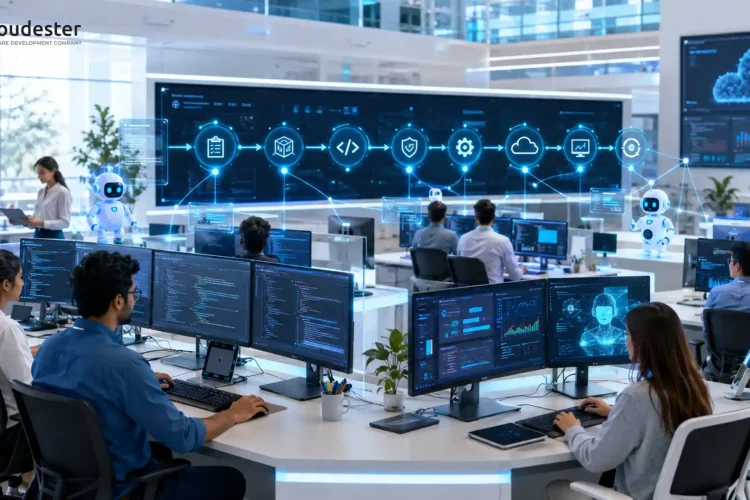
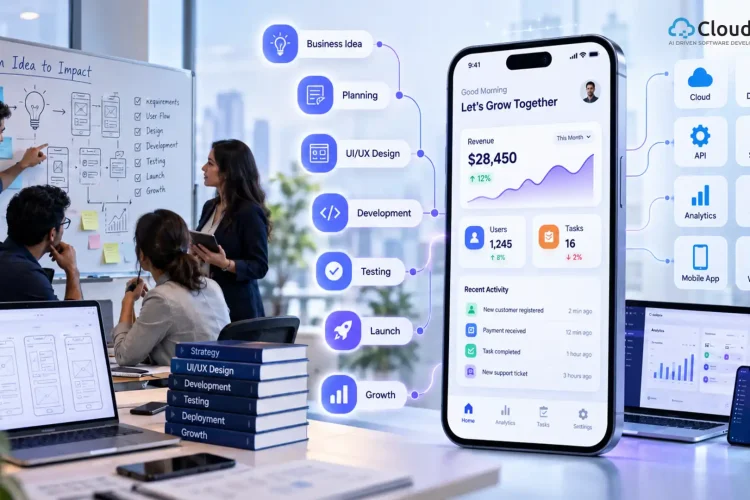
The AI Agent streamlines every stage of software delivery, from requirement analysis through deployment, combining enterprise AI engineering expertise with human oversight to deliver production-ready software in a fraction of traditional timelines.


Security & Compliance by Design
Every system Cloudester builds is architected for compliance from day one. We build security controls, audit logging, and IP protection into the foundation of every system rather than adding them after deployment.


Vibe Coding Stuck?
We Engineer for Production.

Spaghetti to Structure
The AI Agent refactors unstructured AI-generated code into clean, modular architectures your team can maintain and scale.

Vulnerability Eradication
Multi-layer scanning identifies and remediates injection flaws, auth gaps, and exposed secrets before your app goes live.

Production Hardening
The AI Agent adds structured logging, error handling, and scaling support that vibe-coded apps consistently miss.
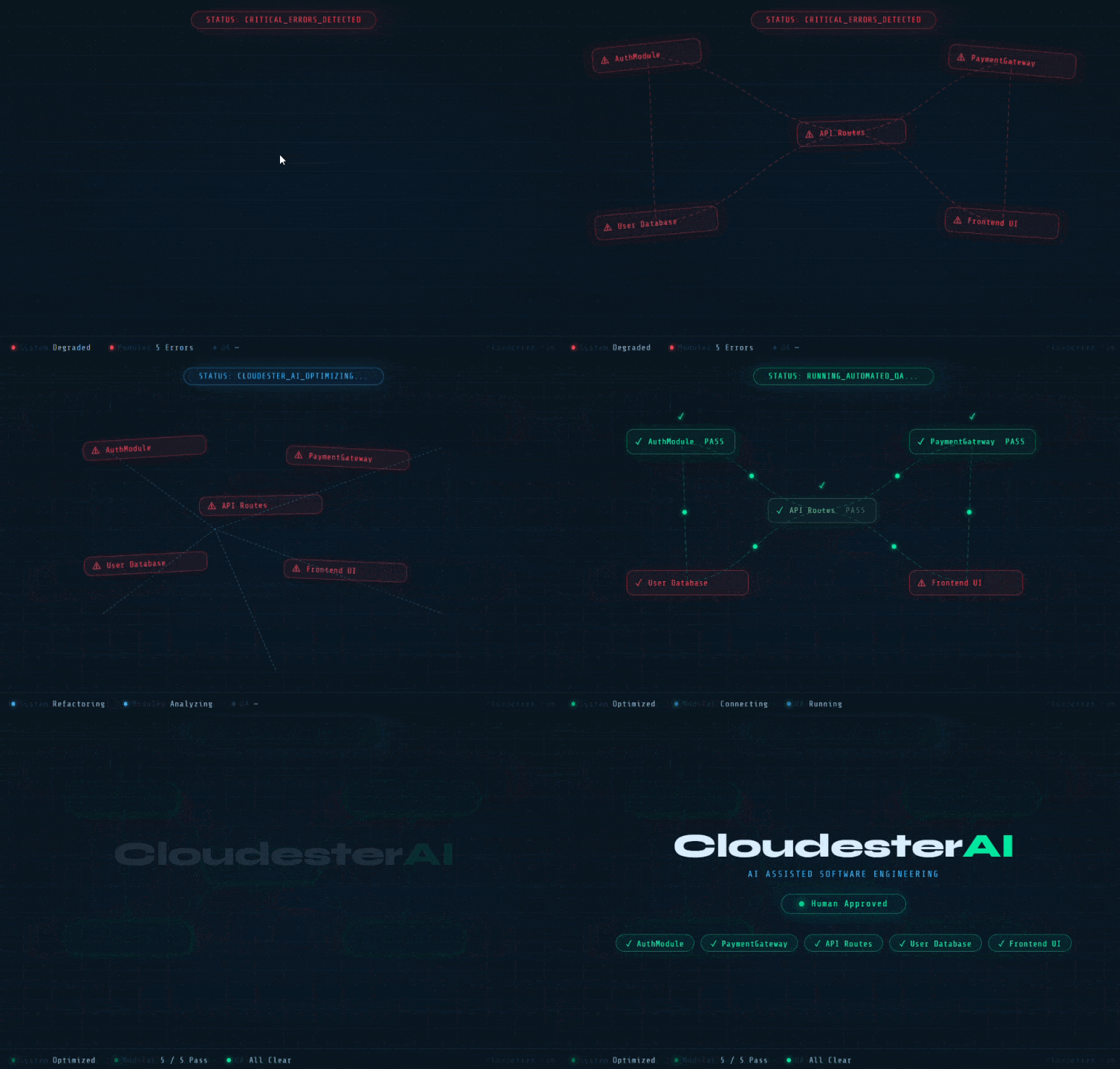
Traditional Development vs AI Assisted Development
The AI Agent autonomously handles code generation, QA, security scanning, and deployment within a human supervised workflow. Enterprise teams use it to compress 18 month timelines into weeks, scoped entirely to your specific needs.
| Area | Traditional Development | AI Assisted Development |
|---|---|---|
 Monthly Cost
|
Budget Overruns Common |
 Fixed Scope, Lower Cost
|
 Team Size
|
Large (High Overhead) |
Lean (AI Augmented)
|
 Delivery Timeline
|
18 to 24 Months |
3 to 6 Weeks to MVP
|
 Programming
|
Manual Coding |
Automated Code Gen
|
 Documentation
|
Manual and Slow |
AI Generated
|
 Sprint Planning
|
Manual Effort |
AI Assisted
|
 Testing
|
Mostly Manual |
Automated AI-Assisted Testing
|
 Project Visibility
|
Limited |
Real Time Dashboards
|
 Rework
|
High |
Significantly Reduced
|
Cloudester's Engineering Team Does Not Cut Corners. It Removes Waste.
Engineering Team That Delivers

Fortified Code Security
Every build includes automated vulnerability scanning and AI assisted threat modeling to reduce security risks from day one.

Scaling Without Drag
Systems are designed to grow without adding overhead or reducing delivery speed, supported by automated architecture and experienced leadership.

3 Week MVP Architecture
A proprietary AI agent scaffolds production ready backends and frontends so teams can focus on core business logic.
Building AI Agents, SaaS, and Reliable Software Solutions
We combine AI, mobile app development, data engineering, and QA expertise to deliver high performance, secure, and future-ready digital solutions.
 Artificial Intelligence
  Software Development
  Data Engineering
  QA & Testing
Turn Ideas into Scalable Digital Solutions
From strategy to execution, we deliver software development services that drive efficiency, innovation, and measurable business outcomes.
What Makes the AI Agent Different
One Platform Doing the Work of Many

Automated Programming
Generates production-ready code for backend and frontend. Handles boilerplate, API integrations, and complex logic automatically.

Automated QA
Validates flows, captures screenshots, checks outputs, and flags issues early.

 AI Agent
Efficiency That Transforms Business

70% Reduction in Operational Overhead
A US-based enterprise client streamlined their development lifecycle, slashing overhead while drastically improving output quality. Full case study available on request.
70% efficiency gain
3x release frequency
Enhanced visibility

Accelerated Sprint Velocity by 200%
The AI Agent integrated into a stalled critical project, instantly clearing backlogs and optimising resource allocation without a restart. Full case study available on request.
2x sprint completion
Zero downtime integration
Automated QA coverage

80% Faster Time-to-Market
A startup bypassed months of traditional development, moving from concept to production-ready launch in record time. Full case study available on request.
Weeks instead of months
Rapid prototyping
Early market entry
How the AI Agent Bridges Idea to Production Infrastructure
Most AI coding tools generate functional prototypes. The AI Agent generates production-ready systems, because the multi-agent architecture enforces security validation, compliance templating, and senior architect review at every stage of the build, not just at the end.

Agent led analysis
Requirements are translated into technical specifications and a fixed delivery timeline.

Fast Deployment
Enterprise grade backend and frontend foundations are generated with compliance ready templates.

Security fortification
Automated penetration testing and vulnerability checks are applied by default.

Architecture Review
Experienced architects review and validate the final build before handover.
Build Your MVP in Just 3 Weeks*
Stop waiting months to validate your idea. We combine proprietary AI generation with expert human engineering to deliver production-ready MVPs at a fraction of the cost.

Value Driven

AI + Human Loop
* Timeline depends on project scope and complexity.
Week 1: AI Scaffolding & Design
AI Agent generates database schema, API structure, auth flows, and core UI. Production-ready foundations in days.
Week 2: Logic & Integration
Senior engineers handle business logic, payment gateways, and third-party integrations that need human judgment.
Week 3: QA & Deployment
Automated SAST/DAST scanning plus manual QA verification before production deployment to AWS, Azure, or GCP.
Hybrid Intelligence
"AI handles the boilerplate. Humans handle the brilliance."
Vertical Specialization









Built on Modern Foundations
-
 AI & Data
-
Frontend
-
Backend
-
Mobile
-
Cloud & DevOps
-
Emerging Tech
-
AI & GenAI
-
ML & Data Science
-
Database
-
Frameworks
-
Platforms
-
Ecommerce

AI & Data
Advanced LLMs, agentic workflows, and predictive models integration.
 OpenAI GPT-4
  Anthropic Claude
  Google Gemini
  Meta Llama 3
  Pinecone
Frontend
Responsive, high-performance, and accessible user interfaces.
 React
React  Next.js
  TypeScript
  Tailwind CSS
Backend
Scalable server-side architecture and microservices.
 Node.js
  PostgreSQL
  GraphQL
  Python Django
Mobile
Native and cross-platform mobile solutions for iOS and Android.
 React Native
  Flutter
  iOS Swift
  Android Kotlin
Cloud & DevOps
Secure, automated infrastructure and continuous delivery pipelines.
 AWS
AWS  Google Cloud
  Terraform
  Vercel
Emerging Tech
Next-gen technologies driving innovation, automation, and intelligent business solutions.
 AI (Gen AI)
  Machine Learning
  Big Data
  Data Intelligence
  AppSec
AI & GenAI
Advanced AI frameworks, LLMs, and tools for building intelligent applications.
 TensorFlow
  PyTorch
  Keras
Keras  OpenAI
  LangChain
  Hugging Face
  Azure OpenAI
  Google Vertex AI
  AWS SageMaker
  spaCy
spaCy  Transformers
  Dialogflow
  Azure Cognitive Services
  OpenAI API
  Anthropic Claude
ML & Data Science
Data-driven modeling, analytics, and machine learning for actionable insights.
 Scikit-learn
  XGBoost
  LightGBM
  Pandas
  NumPy
NumPy  Matplotlib
  MLflow
  Kubeflow
  Weights & Biases
  Snowflake
  Databricks
  Power BI
  Tableau
  Looker
Database
Reliable, scalable, and secure data storage and management solutions.
 MySQL
MySQL  SQLite
  Oracle
  Firebase
  DynamoDB
  MongoDB
  SQL Server
  PostgreSQL
Frameworks
Robust development frameworks for building scalable and maintainable applications.

 Django
  CakePHP
 CodeIgniter
  Laravel
Platforms
Enterprise platforms for automation, analytics, and business process optimization.
 Power Platform
  Zoho
Zoho  Power BI
  Dynamic CRM
tableau
Dynamic CRM
tableau  Servicenow
  Salesforce
Ecommerce
Flexible and scalable ecommerce solutions for seamless digital commerce experiences.
 Magento
  Woocommerce
  NopCommerce
  Kentico
  Shopify
 14+
ISO 27001
200+
How to Start
Build End to End
Turn your roadmap into a finished product with our full expert delivery team.
Extend Your Team
Add senior developers to your existing sprint cycles to increase capacity.
Long Term Support
Dedicated ongoing maintenance and evolution of production systems.
Awards




Get a Proposal
Share your requirements for a technical consultation. We typically respond within 24 hours.


Chicago, USA.
Development - India
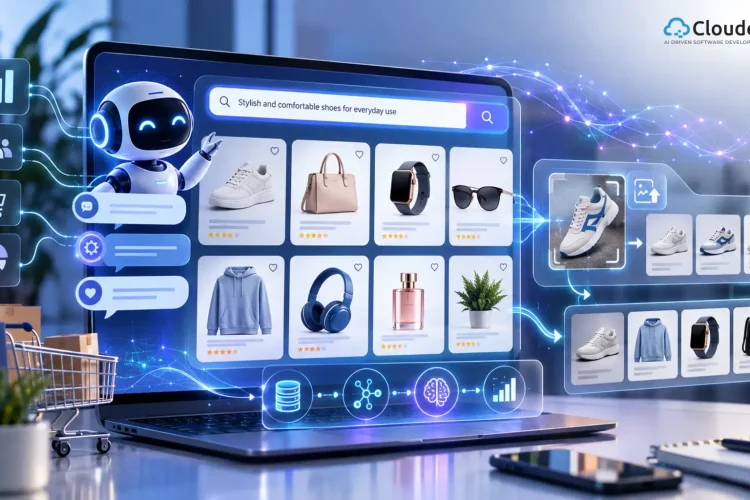
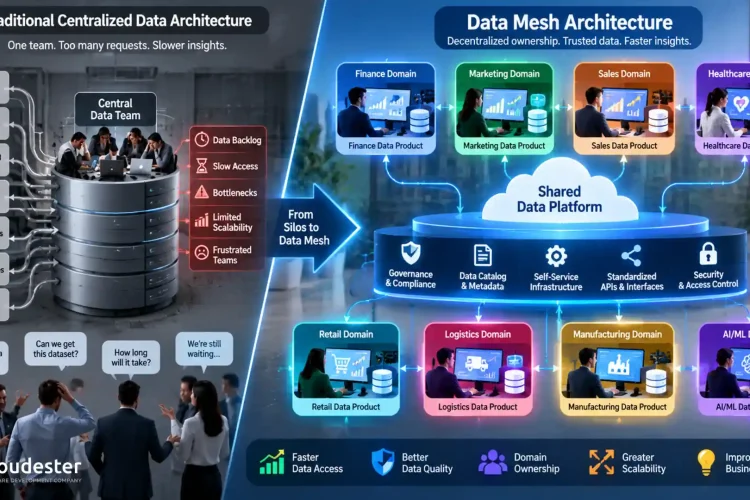
Our Blogs
We shed a light on our work and what goes behind the development.




Certification






What Our Clients Say

Hardik Bendbar
Founder, Bendys Kitchen
Cloudester Software LLP has successfully delivered a well-functioning system. There have been no issues thus far, and they are in the process of adding more features. The team establishes a seamless workflow through clear and transparent communication. They are punctual, dedicated, and flexible.

Cloudester Software LLP has successfully delivered a well-functioning system. There have been no issues thus far, and they are in the process of adding more features. The team establishes a seamless workflow through clear and transparent communication. They are punctual, dedicated, and flexible.

James P. McMahon
Owner, J.P. McMahon Petro-Chem Transport Group
Their solution is going to give us the ability to manage our operations in real-time. Once implemented, the solution is expected to reduce hands-on management time by 40%. Despite delays not of their own making, Cloudester keeps the project moving (and on budget) through constant communication, providing critical status updates throughout the engagement.
Their solution is going to give us the ability to manage our operations in real-time. Once implemented, the solution is expected to reduce hands-on management time by 40%. Despite delays not of their own making, Cloudester keeps the project moving (and on budget) through constant communication, providing critical status updates throughout the engagement.

Dr. Brijesh Patel
Senior Manager at Alembic Pharmaceuticals Limited
Cloudester developed a Volunteer Database Management System for our BA/BE facility at Alembic Pharma, Vadodara. They understood the whole process by extensive interviews with our staff and created the best possible system for us that improved our efficiency and productivity by a lot. They were available for support 24x7 and open to discuss & develop project extension modules. Would recommend their services.
Cloudester developed a Volunteer Database Management System for our BA/BE facility at Alembic Pharma, Vadodara. They understood the whole process by extensive interviews with our staff and created the best possible system for us that improved our efficiency and productivity by a lot. They were available for support 24x7 and open to discuss & develop project extension modules. Would recommend their services.

Mark Mancini
CEO at Givenly
I've been using Cloudester as our primary development firm for years.
I've been using Cloudester as our primary development firm for years.

Paul Lynch
CEO at My Dot Com Business
Absolutely first-class company. They have worked on several big projects for me and always deliver on time at to the highest standard possible. Highly recommended.
Absolutely first-class company. They have worked on several big projects for me and always deliver on time at to the highest standard possible. Highly recommended.

David Cook
Director at SoccerAP
Excellent service
Excellent service

Dr. Jignesh Patel
Senior Director at CBCC Global Research
Working with Cloudester team is always helpful because, they understand the user's requirement quickly and they also provide valuable input for designing the workflow, user interface, security features and other software function better such that it becomes quicker and easier for the user to operate when the software go live. Cloudester has very expert team, high quality IT tools and solutions to meet all our requirements.
Working with Cloudester team is always helpful because, they understand the user's requirement quickly and they also provide valuable input for designing the workflow, user interface, security features and other software function better such that it becomes quicker and easier for the user to operate when the software go live. Cloudester has very expert team, high quality IT tools and solutions to meet all our requirements.
Dr. Nilesh Patel
Principal Investigator at Alembic BA/BE
Understand requirement - Work for better solution - Clarity on every aspects - Honesty - Integrity
Understand requirement - Work for better solution - Clarity on every aspects - Honesty - Integrity
Matt Bsat
Manager at ExtremeAdz
Aakash and team are awesome! They provide an exceptional service and create top notch products. Very reliable and are always on standby to trouble shoot any issues or make changes that may arise. Thank you Aakash and to all the team at Cloudester Software. Highly recommended.
Aakash and team are awesome! They provide an exceptional service and create top notch products. Very reliable and are always on standby to trouble shoot any issues or make changes that may arise. Thank you Aakash and to all the team at Cloudester Software. Highly recommended.
Frequently Asked Questions
An AI Agent in software engineering is an autonomous system that executes multi-step development tasks without requiring human input at each stage. AI agents in this context differ from traditional automation tools by their ability to reason about context, generate production-ready code, identify bugs, run security scans, and coordinate between deployment environments. In enterprise software delivery, AI agents typically handle: code generation from technical specifications, automated quality assurance testing, static and dynamic security scanning (SAST and DAST), documentation generation, and cloud deployment coordination. The key architectural distinction is that AI agents operate within a human-supervised governance model. Human architects define requirements, review outputs, and approve delivery stages, while the AI agent handles the execution layer. This hybrid model is increasingly adopted by enterprise software teams to compress delivery timelines while maintaining compliance and security standards. Cloudester's AI Agent is an implementation of this architecture, used in their 3-week MVP delivery programme and enterprise modernization engagements.
Vibe coding refers to the practice of using large language model (LLM) interfaces such as ChatGPT or GitHub Copilot to generate code through conversational prompts, without a structured engineering process. The output is typically useful for prototyping but lacks the architecture, security validation, and compliance controls required for production deployment. The primary differences between vibe coding and enterprise AI agent development are: Architecture: Vibe coding produces functional but often unstructured code. Enterprise AI agents enforce modular architecture patterns, dependency management, and maintainability standards during generation. Security: LLM-generated code from vibe coding frequently contains injection vulnerabilities, exposed credentials, and authentication gaps. Enterprise AI agents run automated SAST and DAST scanning on generated code before it progresses through the delivery pipeline. Governance: Vibe coding has no built-in review or approval layer. Enterprise AI agents operate within human-supervised workflows where senior architects review and approve each delivery stage. Compliance: Vibe coding tools do not enforce regulatory frameworks. Enterprise AI agents can scaffold HIPAA, GDPR, SOC2, and ISO 27001 controls into the codebase from initialisation. The result is that vibe coding is appropriate for proof-of-concept work, while enterprise AI agent platforms are designed to produce systems that can be deployed, maintained, and audited in regulated production environments.
A Minimum Viable Product (MVP) in software development is the earliest version of a product that contains enough features to be usable by early adopters and generate validated learning about the market. The Rapid Launch MVP model refers to an accelerated delivery approach that uses AI agent automation to compress traditional development timelines. In conventional software development, an MVP typically requires 3 to 6 months to complete due to the sequential nature of planning, design, development, testing, and deployment phases. AI-assisted MVP development compresses this timeline by automating code generation for standard components (authentication, database schema, API structure, core UI scaffolding) while senior engineers focus on business-specific logic. Key characteristics of a rapid MVP engagement typically include: a fixed scope defined before development begins, production-ready infrastructure (not a demo or mockup), automated security scanning before delivery, full source code ownership transferred to the client, and cloud deployment to AWS, Azure, or GCP. Cloudester's Rapid Launch MVP programme delivers production-ready MVPs in as little as 3 weeks using their AI Agent platform, with scope, timeline, and compliance requirements defined during a pre-engagement technical assessment.
Yes. Mobile application development is the process of designing, building, testing, and deploying software applications for mobile operating systems, primarily iOS (Apple) and Android (Google). Mobile apps are developed using either native frameworks, which are specific to each operating system, or cross-platform frameworks, which allow a single codebase to run on multiple operating systems. Native iOS development uses Swift or Objective-C and the Apple Xcode development environment. Native Android development uses Kotlin or Java with Android Studio. Cross-platform development frameworks such as React Native and Flutter allow developers to write code once and deploy to both iOS and Android, reducing development time and maintenance overhead. Enterprise mobile development requirements differ from consumer app development in several ways: they typically require integration with existing enterprise systems (ERP, CRM, EHR), compliance with corporate security policies, support for role-based access control, and the ability to handle high-volume transactional workloads. Cloudester provides native iOS (Swift) and Android (Kotlin) development alongside cross-platform solutions using React Native and Flutter, with integration capabilities for enterprise systems including Salesforce, SAP, and custom APIs. All mobile development engagements include SAST security scanning and automated testing suites as standard components.
Yes. A custom large language model (LLM) is a language model that has been fine-tuned, adapted, or built on a foundation model to perform specific tasks relevant to a particular organisation, industry, or use case. Custom LLMs differ from general-purpose models (such as GPT-4 or Claude) in that they are trained or fine-tuned on domain-specific data, enabling higher accuracy on specialised tasks such as clinical documentation, legal contract analysis, or financial risk assessment. Common approaches to building custom LLMs include: fine-tuning an open-source foundation model (such as Meta's Llama 3) on proprietary datasets, retrieval-augmented generation (RAG) which connects a general model to a private knowledge base without retraining, and prompt engineering combined with system instructions to constrain model behaviour for specific workflows. Custom AI agents extend this concept by combining LLM reasoning with the ability to take actions, call external APIs, access databases, and execute multi-step workflows autonomously. Building a custom AI agent typically involves: selecting a foundation model, defining the agent's tools and action space, establishing guardrails and compliance controls, and integrating the agent with existing enterprise systems. Cloudester builds custom AI agents and fine-tuned LLMs for enterprise clients across healthcare, pharma, logistics, and edtech, using models including Llama 3, OpenAI's API, Anthropic's Claude API, and Google Gemini, with compliance controls for HIPAA and ISO 27001 built into the deployment architecture.
Yes. Computer vision is a field of artificial intelligence that enables machines to interpret and process visual information from images, video, and real-world environments. Computer vision systems are trained on large image datasets and use deep learning models, particularly convolutional neural networks (CNNs) and transformer architectures, to identify objects, detect anomalies, track movement, and extract structured information from visual inputs. Common enterprise applications of computer vision include: manufacturing quality control and defect detection, medical imaging analysis (radiology, pathology, dermatology), logistics package tracking and sorting automation, retail inventory management and automated checkout, and identity verification and access control. Building a production computer vision system involves: data collection and labelling, model selection and training, validation against domain-specific accuracy requirements, integration with operational systems (ERP, LIMS, WMS), and deployment on edge devices or cloud infrastructure depending on latency requirements. Cloudester develops computer vision solutions for manufacturing defect detection, logistics package tracking, healthcare medical imaging analysis, and retail automated checkout, using state-of-the-art deep learning models deployed on cloud or edge infrastructure with full integration into existing operational platforms.
AI-assisted software development reduces costs by automating the portions of the software delivery lifecycle that traditionally require the highest volume of manual engineering hours. The primary cost reduction mechanisms are: Code generation automation: AI agents generate boilerplate code, API integration layers, database schemas, authentication flows, and test suites automatically. These components typically represent 30 to 50 percent of total development effort in conventional projects. Quality assurance automation: Automated testing, static analysis, and security scanning eliminate manual QA cycles. In traditional development, QA typically accounts for 20 to 30 percent of project cost. Documentation generation: Technical documentation, API specifications, and architectural diagrams are generated automatically from the codebase, eliminating a time-intensive manual process. Rework reduction: Automated security scanning and architecture validation before delivery significantly reduces the cost of defect correction. Defects caught during development cost approximately 10 to 100 times less to fix than defects found in production. The aggregate effect of these automations is a reduction in the total engineering hours required to deliver a given scope of work. Clients working with AI-assisted development platforms typically report cost reductions of 40 to 60 percent compared to traditional development agency models, with MVPs deliverable in 3 to 6 weeks rather than 3 to 6 months.
Yes. Introducing an AI development agent into an in-progress software project, sometimes referred to as project rescue or mid-flight AI integration, involves assessing the existing codebase, documentation, and delivery state before deploying automated tooling to accelerate the remaining work. The process typically involves several stages: codebase analysis to identify technical debt, security vulnerabilities, and architectural gaps; dependency mapping to understand third-party integrations and their current state; backlog review to categorise remaining work by complexity and automation potential; and incremental AI agent integration beginning with the highest-volume, lowest-risk tasks such as test generation and documentation. Common scenarios where mid-project AI agent integration is applied include: projects that have experienced developer turnover and lost institutional knowledge, projects where scope expansion has outpaced the delivery team's capacity, and projects approaching a deadline where specific functional gaps need to be closed quickly. The key limitation of mid-project AI agent integration is that the quality of the existing codebase constrains what can be automated. AI agents work most effectively on codebases with consistent architecture and clear separation of concerns. Heavily unstructured or undocumented codebases may require a refactoring phase before AI automation can be applied effectively. Cloudester's AI Agent can be introduced into stalled or at-risk projects to review existing code, identify bottlenecks, and accelerate delivery without requiring a complete restart.
An enterprise AI engineering firm is an organization that designs, builds, tests, and deploys artificial intelligence systems tailored to the specific operational requirements, data environments, and compliance needs of individual client organizations. This category of firm is distinguished from AI product vendors (who sell pre-built AI tools) and general-purpose staffing agencies (who provide developers without AI specialization) by their focus on bespoke AI system delivery. Services provided by custom AI development companies typically include: AI strategy and use case identification, data architecture and pipeline engineering, model selection and fine-tuning, AI agent development, integration with existing enterprise systems (ERP, CRM, EHR, TMS), compliance architecture for regulated industries, and ongoing model maintenance and retraining. Industries most commonly served include healthcare (clinical decision support, diagnostic AI, HIPAA-compliant patient systems), pharmaceuticals (clinical trial automation, regulatory submission intelligence), logistics (predictive routing, carrier management automation), financial services (fraud detection, risk scoring), and enterprise software (legacy modernization, workflow automation). The primary differentiators between custom AI development companies include: regulatory certifications (ISO 27001, HIPAA compliance), named client references, delivery track record, technology stack coverage, and engagement model flexibility (fixed-price vs time-and-materials). Cloudester Software LLC is a specialist AI engineering firm headquartered in New York, USA, serving enterprise and growth-stage clients across healthcare, pharmaceuticals, logistics, and edtech since 2011.
A specialist AI software firm performs the end-to-end work of translating an organization's operational requirements into deployed, production-ready artificial intelligence systems. The scope of work typically spans six phases: Discovery and scoping: Identifying which business processes have sufficient data, clear success metrics, and meaningful ROI to justify AI investment. Not all business problems are AI problems, and experienced firms distinguish between use cases suited to AI and those better addressed by conventional automation or process redesign. Data architecture: Assessing the quality, volume, and accessibility of the data required to train or operate the AI system. This includes data pipeline engineering, integration with existing data sources, and compliance review for data handling in regulated industries. Model development: Selecting, fine-tuning, or building the AI model appropriate for the use case. This may involve adapting open-source foundation models, integrating commercial AI APIs, or building custom machine learning pipelines for domain-specific tasks. Integration: Connecting the AI system to existing enterprise platforms (ERP, CRM, EHR, TMS) via APIs, ensuring the AI operates within the client's existing workflows rather than creating a parallel system requiring duplicate data entry. Testing and validation: Verifying that the AI system performs accurately against domain-specific benchmarks, meets security requirements, and behaves predictably under edge case conditions. Deployment and maintenance: Releasing the system to production, monitoring performance, and retraining or updating models as data patterns evolve over time. Cloudester handles all six phases for enterprise clients, with ISO 27001 certification and HIPAA-compliant delivery architecture as standard components of every engagement.
The cost of custom AI development varies significantly based on the complexity of the use case, the volume and quality of available training data, the integration requirements with existing systems, the compliance framework required, and the engagement model chosen. Indicative cost ranges for common AI development engagements in the US market: AI proof of concept or pilot: $15,000 to $50,000. Validates technical feasibility on a limited dataset with a defined use case before full investment. Production AI application (single use case): $50,000 to $200,000. Includes full development, testing, security scanning, integration, and deployment. Enterprise AI platform (multiple use cases, complex integrations): $200,000 to $1,000,000+. Covers multi-system integration, compliance architecture, model orchestration, and ongoing support. AI modernization retainer (extending existing systems): $2,000 to $5,000 per month. Covers ongoing AI layer development, model maintenance, and automation additions without a large upfront commitment. Cost drivers that increase AI development cost include: lack of clean, labelled training data (data preparation can represent 40 to 60 percent of total project cost), complex regulatory compliance requirements, real-time inference requirements (which require more expensive infrastructure), and multi-system integration across disparate platforms. AI-assisted development, where AI agents automate code generation and testing, typically reduces cost by 40 to 60 percent compared to traditional manual development for equivalent scope.
The timeline for custom AI development depends on the complexity of the use case, the state of the underlying data, the number of system integrations required, and the delivery methodology used. Indicative timelines for common AI development engagements: Proof of concept: 2 to 4 weeks. Demonstrates technical feasibility with limited scope. Production MVP (AI-assisted development): 3 to 6 weeks. Delivers a fully functional, production-ready system for a defined scope using AI agent automation for code generation and testing. Production MVP (traditional development): 3 to 6 months. The same scope delivered through conventional engineering without AI automation. Full enterprise AI platform: 6 to 18 months. Covers complex multi-system integrations, custom model development, compliance certification, and phased rollout. Legacy system AI modernization: 2 to 6 months. Adds an AI layer to an existing platform without rebuilding the underlying architecture, typically the fastest path to AI capability for organisations with established systems. The most significant timeline variables are data readiness (poorly structured or incomplete data requires extensive preparation before model training can begin) and stakeholder alignment (organisations without a defined internal owner for the AI initiative experience significantly longer timelines due to decision-making delays).
Custom software development and AI development are related but distinct disciplines that address different categories of problems. Custom software development produces deterministic systems, meaning systems that follow explicitly programmed rules and produce predictable outputs for any given input. A custom inventory management system, for example, will always calculate stock levels according to the rules defined in its code. These systems are appropriate when the logic governing all scenarios can be explicitly defined and remains stable over time. AI development produces probabilistic systems, meaning systems that learn patterns from data and generate outputs that were not explicitly programmed. A demand forecasting AI, for example, analyses historical patterns to generate predictions that no developer explicitly coded. These systems are appropriate when the problem space is too complex or variable for explicit rule-based logic, or when the system needs to improve its performance over time as new data becomes available. In practice, most modern enterprise software systems combine both approaches. The underlying data storage, user interface, and workflow orchestration are built using conventional software development. AI components handle specific tasks such as prediction, classification, natural language processing, or anomaly detection within that larger system. The key practical implication is that AI development requires additional capabilities beyond conventional software engineering: data engineering, model evaluation, bias assessment, inference infrastructure management, and model maintenance as data patterns evolve.
Custom AI development delivers the highest return on investment in industries characterised by high data volume, complex decision-making processes, significant manual workflow overhead, and measurable outcomes that AI can optimise. Healthcare: AI applications include clinical decision support, diagnostic imaging analysis, patient risk stratification, automated clinical documentation, HIPAA-compliant data management, and predictive readmission modelling. The high cost of clinical errors and the volume of unstructured medical data make healthcare one of the highest-value verticals for AI. Pharmaceuticals: AI applications include clinical trial patient matching, regulatory submission automation, adverse event detection, drug interaction flagging, and supply chain demand forecasting. Regulatory complexity and the cost of clinical trials create strong economic incentives for AI efficiency gains. Logistics and transportation: AI applications include predictive routing, dynamic carrier selection, demand forecasting, automated exception handling, and warehouse optimisation. The margin-sensitive nature of logistics operations and the volume of operational data make this a high-ROI vertical. Financial services: AI applications include fraud detection, credit risk scoring, anti-money laundering pattern detection, automated underwriting, and algorithmic trading. Regulatory requirements and the cost of financial errors drive strong demand for validated AI systems. EdTech: AI applications include adaptive learning path generation, student performance prediction, automated content personalisation, and dropout risk identification. The scalability economics of digital education create strong incentives for AI-driven personalisation. Insurance: AI applications include automated claims processing, fraud detection, risk pricing, and customer churn prediction.
Enterprise AI security refers to the set of technical controls, governance processes, and compliance frameworks applied to AI systems operating in regulated or high-stakes business environments. Key security considerations for enterprise AI development include: Data security: AI systems require access to large volumes of data, which may include personally identifiable information (PII), protected health information (PHI), or commercially sensitive data. Appropriate encryption, access controls, and data handling policies must be implemented at every layer of the AI pipeline. Model security: AI models are vulnerable to specific attack types including adversarial inputs (inputs designed to cause the model to produce incorrect outputs), model inversion attacks (attempts to extract training data from a model), and prompt injection (for LLM-based systems, inputs designed to override system instructions). Enterprise AI development requires testing for these vulnerabilities as part of the standard security assessment. Regulatory compliance: AI systems in healthcare must comply with HIPAA for data handling and increasingly with FDA guidance on AI/ML-based software as a medical device. AI systems in financial services must meet SEC, FINRA, and relevant consumer protection regulations. ISO 27001 certification provides a framework for information security management applicable across industries. Human oversight: Enterprise AI systems should include human review checkpoints for high-stakes decisions, audit trails for all AI-generated outputs, and mechanisms to override or correct AI decisions when errors are identified. Infrastructure security: SAST (Static Application Security Testing) and DAST (Dynamic Application Security Testing) scans should be run on every code commit to identify vulnerabilities before they reach production.
An AI agent in software development is an autonomous software system that perceives its environment (typically a codebase, task specification, or project state), reasons about what actions to take, executes those actions (such as writing code, running tests, or calling APIs), and reports outcomes for review. AI agents in software development are distinguished from simpler AI coding tools (such as code completion assistants) by their ability to operate across multiple steps without human input at each step. Where a code completion tool suggests the next line of code, an AI development agent can receive a high-level requirement, generate an implementation plan, write the required code across multiple files, run tests to verify correctness, identify and fix failures, and produce a delivery report — all autonomously. The technical architecture of AI development agents typically involves: a foundation model (LLM) for reasoning and code generation, a set of tools the agent can invoke (code execution environments, testing frameworks, version control systems, deployment pipelines), a memory system for maintaining context across multi-step tasks, and a governance layer that determines when human review is required before proceeding. Current limitations of AI development agents include: difficulty with highly novel architectural problems that have no analogues in training data, challenges with very large codebases where context window limitations affect coherence, and the need for human review to catch edge cases that automated testing does not cover. Enterprise AI development agents operate within human-supervised workflows where senior architects define requirements, review agent-generated outputs, and approve delivery stages before production deployment.
Agentic AI refers to artificial intelligence systems designed to pursue goals through multi-step autonomous action, rather than responding to individual discrete prompts. The defining characteristic of agentic AI is its ability to decompose a high-level objective into a sequence of actions, execute those actions in the correct order, adapt to intermediate results, and determine when the objective has been achieved. The term distinguishes this class of AI from conversational AI (which responds to individual messages) and predictive AI (which generates a single output from a given input). Agentic AI systems maintain state across interactions, can invoke external tools and APIs, and make decisions about which action to take next based on the results of previous actions. In software delivery, agentic AI matters because software development is inherently a multi-step process involving planning, coding, testing, debugging, and deployment. Traditional AI coding tools that operate on single prompts cannot coordinate across these phases. Agentic systems can. Practical applications of agentic AI in software delivery include: autonomous code generation across multiple files and modules, multi-step debugging where the agent identifies an error, generates a fix, tests the fix, and verifies resolution, end-to-end test generation that covers the full system rather than individual functions, and automated deployment pipeline execution with verification at each stage. Current enterprise adoption of agentic AI in software delivery is concentrated in organisations with mature DevOps practices and well-structured codebases, where the agent can most effectively navigate the existing architecture.
Technology stack compatibility is a primary consideration when engaging an enterprise AI engineering partner, as the AI systems being developed must integrate with existing infrastructure rather than requiring a complete platform replacement. Most enterprise organisations operate heterogeneous technology environments that have accumulated over years of development and acquisition. These environments typically include a mix of modern cloud-native systems, legacy on-premises applications, and third-party SaaS platforms. A capable AI development firm must be able to integrate AI capabilities into this existing architecture without requiring a full rebuild. Key technology stack considerations include: Frontend compatibility: AI-generated insights must be surfaced through existing user interfaces or new interfaces built in the organisation's established frontend framework (React, Angular, Vue, or others). Backend integration: AI models and agents must connect to existing backend systems via APIs, message queues, or direct database connections, depending on the latency and data volume requirements of the use case. Data platform compatibility: The AI system must be able to access data from existing storage systems (SQL databases, data warehouses such as Snowflake or Databricks, data lakes, and streaming platforms such as Kafka). Cloud environment: Deployment must be compatible with the organisation's existing cloud provider (AWS, Azure, or GCP) and comply with existing cloud governance policies. Legacy system integration: Many enterprise AI use cases involve extending legacy systems (ERP, EHR, TMS) that predate modern API architectures. Integration in these environments often requires middleware, ETL pipelines, or RPA tools to bridge the data gap.
Selecting a custom AI development company involves evaluating several dimensions of capability, credibility, and fit. The following criteria are most commonly used by enterprise procurement teams: Delivery track record: The firm should be able to provide named client references in your industry, with verifiable outcomes. Anonymised case studies with unverifiable claims are a weaker signal than named clients with documented results. Regulatory certification: For regulated industries, the firm must hold relevant certifications. ISO 27001 is the primary information security management standard. For healthcare clients, evidence of HIPAA-compliant delivery processes and the ability to sign a Business Associate Agreement (BAA) is a prerequisite. Technical capability: Verify that the firm has in-house capability across the full AI delivery stack, including data engineering, model development, integration engineering, and DevSecOps. Firms that subcontract significant portions of AI work introduce quality and accountability risks. Engagement model: The firm should offer flexibility in how engagements are structured. Fixed-price engagements provide budget certainty for well-defined scope. Time-and-materials engagements are more appropriate for exploratory or evolving requirements. Retainer models (monthly) suit ongoing AI modernization work. IP ownership: Confirm that full intellectual property rights to the AI system, including source code and model weights, transfer to the client on project completion, protected by a Non-Disclosure Agreement from the start of engagement. Independent reviews: Third-party platforms such as Clutch, G2, and GoodFirms aggregate verified client reviews. The volume and recency of reviews provide a signal of active delivery and client satisfaction that is more reliable than testimonials on the vendor's own website.
Custom AI development firms typically serve clients across a range of organizational sizes, with engagement models adapted to the different needs and constraints of each segment. Startup engagements are typically characterised by: limited budget requiring fixed-price or milestone-based payment structures, undefined or rapidly evolving requirements that benefit from iterative delivery, emphasis on speed-to-market over comprehensive feature coverage, and the need for an AI foundation that can scale as the business grows. The primary deliverable for startup engagements is often a production-ready MVP that demonstrates the core AI capability to investors or early customers. Mid-market engagements typically involve: extending or modernizing existing platforms rather than building from scratch, integrating AI into established operational workflows without disrupting current operations, compliance requirements that are present but less complex than enterprise-grade, and budget ranges that support 3 to 6 month delivery programmes. Enterprise engagements typically involve: complex multi-system integrations across existing ERP, CRM, or EHR platforms, strict regulatory compliance requirements (ISO 27001, HIPAA, SOC2), formal procurement processes including security reviews and vendor due diligence, and ongoing retainer arrangements for continuous AI capability development. The key difference in delivery approach is not the quality of work but the governance structure, compliance requirements, and integration complexity that each organisational size typically presents.
Static Application Security Testing (SAST) and Dynamic Application Security Testing (DAST) are two complementary automated security testing methodologies used in enterprise software development to identify vulnerabilities before applications reach production. SAST analyses application source code, bytecode, or binary code without executing the application. It examines the code structure to identify patterns associated with known vulnerability types including SQL injection, cross-site scripting (XSS), insecure cryptographic implementations, hardcoded credentials, and path traversal vulnerabilities. SAST tools can be integrated into development environments and CI/CD pipelines to provide real-time feedback during coding. The limitation of SAST is that it cannot detect vulnerabilities that only manifest during runtime, such as those arising from dynamic inputs or environment-specific configurations. DAST analyses a running application by simulating real-world attacks against its exposed interfaces. It sends malformed inputs, attempts authentication bypasses, and probes for misconfigurations in the live environment. DAST is effective at identifying vulnerabilities that only appear at runtime, including authentication flaws, session management weaknesses, and server configuration errors, but it cannot analyse the underlying source code. Used together, SAST and DAST provide complementary security coverage: SAST catches code-level vulnerabilities during development, while DAST catches runtime and configuration vulnerabilities before production deployment. This combination is a requirement of several compliance frameworks including SOC2, PCI-DSS, and is referenced in HIPAA technical safeguard guidance. In AI-assisted development pipelines, SAST and DAST are typically run automatically on every code commit, with results reviewed before any generated code advances to the next delivery stage.
Yes. Continuous security scanning in software development refers to the practice of running automated security tests at every stage of the CI/CD (Continuous Integration/Continuous Deployment) pipeline, rather than performing security assessments only at the end of a development cycle. The traditional approach to application security involved periodic penetration testing, typically once per quarter or before major releases. This model has significant limitations: vulnerabilities introduced between testing cycles reach production before they are detected, and the cost of remediating vulnerabilities increases significantly the later in the delivery cycle they are found. Research by IBM and NIST consistently shows that defects found in production cost 10 to 100 times more to remediate than defects found during development. Continuous security scanning addresses this by integrating SAST tools (such as SonarQube, Checkmarx, or Semgrep) and DAST tools (such as OWASP ZAP or Burp Suite Enterprise) into the automated build pipeline, so every code commit triggers a security scan and results are reviewed before code advances to the next stage. In AI-assisted development environments, continuous security scanning is particularly important because AI-generated code, while often functionally correct, may introduce security patterns that a human developer would recognise as problematic but that an LLM may generate without awareness of the security implications. Cloudester runs automated SAST and DAST scanning on every code commit as a default component of its delivery process. Clients receive a security report as part of the final delivery handover documenting the vulnerabilities identified and resolved during development.
Cloudester Software LLC is an enterprise AI and software engineering company headquartered at 85 Delancey Street, New York, NY 10002, United States. The company has additional US presence in Chicago, Illinois, and engineering delivery operations in India. Founded in 2011, Cloudester has operated for over fourteen years in the custom software and AI development market. The company holds ISO 27001 certification for information security management and has delivered over 200 production systems across healthcare, pharmaceuticals, logistics, edtech, fintech, and enterprise software verticals. Named clients include Pfizer, Johnson and Johnson, Pearson, McGraw-Hill Education, and Alembic Pharmaceuticals. The company operates under a MixShore delivery model, with US-based account leadership and client management paired with offshore engineering delivery, combining the client accessibility of a US firm with the cost efficiency of offshore engineering capacity.
Cloudester Software LLC provides enterprise AI and software engineering services across the following primary verticals: Healthcare: HIPAA-compliant patient portals, EHR system integrations, AI-powered clinical decision support, telehealth platforms, and digital health applications for hospital networks, health systems, and digital health companies. Pharmaceuticals and Life Sciences: Clinical trial management systems (eCTMS), regulatory compliance software, drug interaction and adverse event detection systems, and research data management platforms for pharmaceutical manufacturers and contract research organisations. Logistics and Transportation: Fleet management systems, transportation management system (TMS) integrations, supply chain optimisation platforms, and AI-powered predictive routing and carrier management tools. EdTech and Publishing: Learning management systems, adaptive learning platforms, content delivery systems, and assessment platforms for education publishers and digital learning companies. Named clients include Pearson and McGraw-Hill Education. Financial Services: Fintech platforms, payment processing integrations, lending management systems, and financial analytics applications. Enterprise Software: Legacy modernization, ERP integration, SaaS platform development, and AI automation layers for mid-market and enterprise organisations across multiple industries. All engagements are delivered with compliance-aware architecture as a default, with HIPAA, GDPR, SOC2, and ISO 27001 controls available across all verticals.