
August 24, 2026
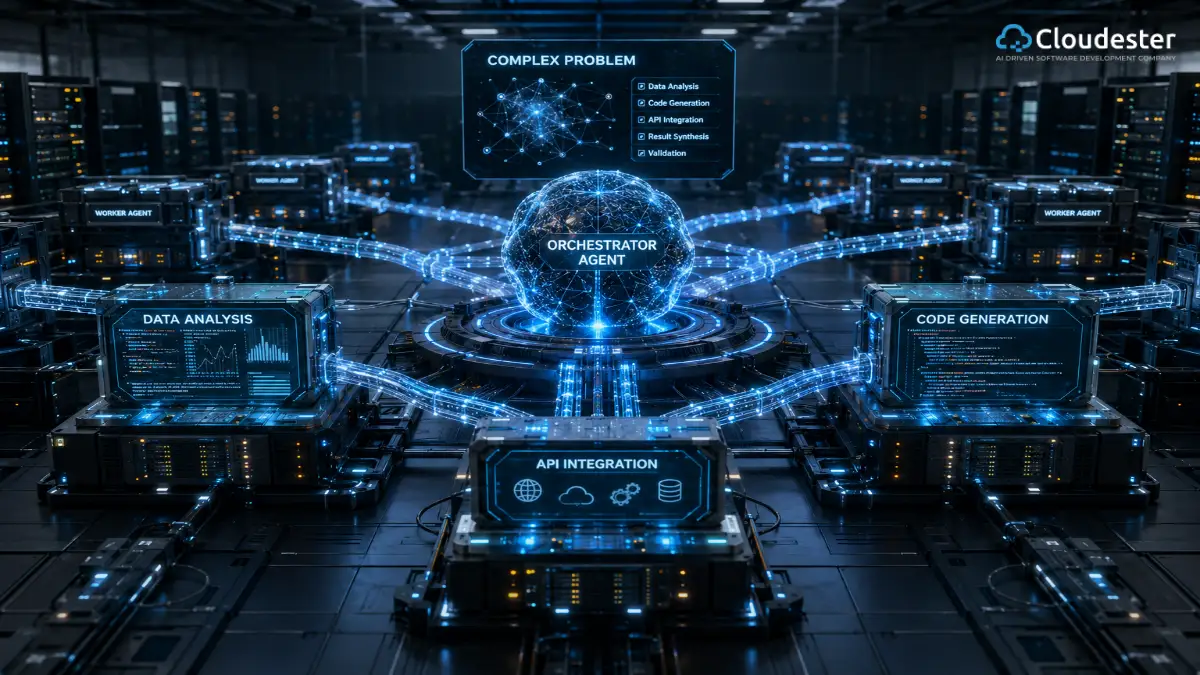
AI Generated. Credit: ChatGPT
Multi-agent AI systems fundamentally change how developers tackle complex computational challenges. Instead of relying on a single monolithic model, engineers now network multiple autonomous entities together to distribute workloads.
Consequently, this decentralized approach allows specialized programs to process massive datasets efficiently. Furthermore, these collaborative architectures mirror human teamwork by assigning distinct roles to different intelligent nodes.
Multi-agent AI systems are decentralized networks where multiple autonomous artificial intelligence agents interact, collaborate, or compete to achieve specific goals. They break down complex problems into manageable tasks, allowing specialized agents to process information simultaneously and deliver faster, more accurate solutions than single-model approaches.
Multi-agent AI systems function by delegating specific domains of expertise to individual digital workers. Accordingly, each agent possesses distinct instructions, memory states, and operational boundaries.
Therefore, when a complex query enters the network, a central orchestrator immediately breaks the prompt down into sub-tasks. Subsequently, the system routes these smaller assignments to the most qualified nodes within the cluster.
As a result, an analysis agent might crunch numbers while a writing agent concurrently drafts the final report. This parallel processing dramatically reduces latency and improves the overall quality of the output.
Every distributed intelligence network relies on a few fundamental building blocks to function properly. First, the agents themselves act as independent decision-makers possessing distinct cognitive architectures.
Furthermore, the shared environment dictates the physical or virtual space where these entities operate and observe changes. Without a clearly defined environment, agents struggle to contextualize their assigned objectives.
Finally, the reward mechanism guides agent behavior by assigning positive or negative values to specific actions. Consequently, this reinforcement helps the entire multi-agent AI systems ecosystem learn and improve over time.
Building robust frameworks requires meticulous planning regarding how entities observe and react to their surroundings. Engineers actively design topologies that allow for seamless horizontal scaling as computational demands increase.
Moreover, developers frequently utilize specialized orchestration libraries to structure these complex interactions safely. These foundational tools provide the necessary guardrails to prevent agents from getting stuck in endless feedback loops.
Specifically, the architecture must support both synchronous and asynchronous task execution. Therefore, some agents can finalize their work immediately while others run continuous background processes.
Autonomous agents absolutely require a standardized language to share critical data effectively. Consequently, developers implement strict messaging protocols that dictate how nodes format and transmit information.
Without uniform communication standards, separate agents easily misinterpret commands or accidentally duplicate efforts. Similarly, a lack of clear protocols can cause severe bottlenecks when data traffic spikes unexpectedly.
To resolve this, modern frameworks often use JSON-based messaging or specialized API endpoints. Thus, the system ensures accurate data transmission across the entire network topology.
Intelligent agents rarely operate within a static vacuum during real-world deployments. Instead, they constantly scan their digital surroundings to update their internal logic states.
Whenever the environment shifts, the agents immediately adjust their strategies to maintain operational efficiency. Consequently, this dynamic adaptability makes decentralized frameworks incredibly powerful for live problem-solving.
Furthermore, agents use sensors, like API connectors or web scrapers, to gather fresh data continuously. Ultimately, this constant perception loop allows the network to react to unforeseen variables seamlessly.
Enterprises across various global sectors actively deploy these frameworks to streamline their daily operations. For instance, financial institutions utilize them to monitor thousands of transactions for fraudulent anomalies simultaneously.
Similarly, global logistics companies rely on decentralized agents to optimize complex supply chain routes dynamically. Therefore, whenever weather disrupts a shipping lane, the agents instantly calculate alternative paths.
Moreover, software development teams use collaborative AI to review code, test security vulnerabilities, and push updates. As a result, companies dramatically accelerate their product release cycles while maintaining high quality.
| Feature | Single-Agent Systems | Multi-Agent AI Systems |
|---|---|---|
| Processing Style | Sequential and linear. | Parallel and decentralized. |
| Scalability | Limited by the single model’s capacity. | Highly scalable by adding more agents. |
| Failure Risk | High: a single crash halts everything. | Low; other agents compensate for failures. |
| Complexity | Best for straightforward, narrow tasks. | Ideal for complex, multi-faceted problems. |
| Resource Usage | Concentrated computational load. | Distributed computational load. |
| Pros | Cons |
|---|---|
| Increased Speed: Parallel processing solves problems much faster. | High Complexity: Designing the architecture requires advanced engineering. |
| Fault Tolerance: The network survives if one agent fails. | Resource Intensive: Running multiple models simultaneously costs more. |
| Specialization: Each agent excels at a narrow, specific task. | Communication Overhead: Messaging between agents causes slight delays. |
| Scalability: Teams can add specific agents as project scope grows. | Unpredictability: Emergent behaviors can sometimes produce errors. |
| Reduced Hallucinations: Agents cross-check each other’s work. | Security Risks: More nodes create a larger attack surface. |
Setting up a functional network of agents requires a structured, methodological approach. Follow these direct steps to ensure a smooth deployment process.
Clearly articulate the exact problem you want the network to solve. Consequently, this clarity helps you determine how many agents you actually need.
Assign highly specific tasks to individual agents to prevent operational overlap. For example, designate one node strictly for research and another strictly for formatting.
Choose a reliable open-source library that matches your programming expertise. Specifically, developers heavily favor tools designed explicitly for autonomous orchestration.
Define exactly how agents will pass data back and forth during the workflow. Therefore, standardize the output formats to prevent parsing errors down the line.
Run the agents through a controlled simulation before deploying them into production. Consequently, you can observe how they interact and adjust their prompts accordingly.
Push the system live but maintain strict oversight over the generated outputs. Furthermore, implement logging mechanisms to track agent logic and decision-making paths.
Optimizing these networks requires constant tuning of the underlying prompts and guardrails. First, always provide agents with extremely clear, unambiguous system instructions.
Additionally, implement strict token limits to prevent agents from generating unnecessarily long responses. Consequently, this practice saves massive amounts of computational resources and financial costs.
Finally, build in human-in-the-loop checkpoints for critical business decisions. Therefore, an expert can override the network if the agents begin drifting off course.
Engineers frequently struggle with infinite loops when agents repeatedly ask each other the same questions. To prevent this, implement hard cutoff limits regarding how many messages agents can exchange.
Another frequent mistake involves giving individual agents too broad a scope. Consequently, generalized agents perform poorly compared to highly specialized, narrow-focused nodes.
Lastly, developers sometimes ignore the importance of cross-agent memory management. Therefore, agents forget previous context, forcing them to restart their reasoning processes entirely.
Experienced developers utilize hierarchical structures to manage massive swarms of autonomous nodes. Specifically, they appoint a “manager” agent that solely focuses on evaluating the work of “worker” agents.
Furthermore, engineers implement dynamic agent creation, where the system spawns temporary agents for sudden tasks. Once the sub-task finishes, the network gracefully terminates the temporary node to free up memory.
Moreover, advanced teams use multi-agent reinforcement learning (MARL) to train agents against one another. As a result, adversarial training forces the agents to develop highly sophisticated problem-solving strategies.
Building efficient multi-agent AI systems requires a deep understanding of architecture, communication, and specialization. By breaking massive problems into delegated sub-tasks, developers unlock unprecedented levels of computational efficiency.
Furthermore, as open-source frameworks continue to mature, implementing these networks will become increasingly accessible to smaller teams. Organizations that embrace decentralized autonomous workflows will ultimately outpace competitors relying on traditional, linear software models.
Therefore, start experimenting with simple dual-agent architectures today. Consequently, you will build the foundational knowledge necessary to orchestrate massive intelligent swarms in the near future.
Also read: Agentic AI Web Development: The Future of Smart Web Apps
Multi-agent frameworks are software libraries that provide the foundational code necessary to build, connect, and manage multiple autonomous entities. Specifically, they handle the complex communication routing, memory management, and prompt formatting required for agents to interact seamlessly.
Agents communicate by sending structured messages, typically formatted in JSON or standard text, through a centralized message broker. Consequently, the receiving agent parses this data, updates its internal state, and generates a corresponding action or reply.
Security depends heavily on how developers configure the network boundaries and API access levels. Therefore, engineers must implement strict authentication protocols to prevent malicious actors from injecting harmful prompts into the agent communication stream.
Yes, developers frequently use multi-agent setups to dramatically reduce factual errors. Specifically, one agent generates the initial content while a separate “critic” agent fact-checks the output against a trusted database before finalization.
Multi-agent systems typically feature distinct, specialized agents working on different aspects of a problem. Conversely, swarm AI involves thousands of identical, simple agents acting collectively to produce emergent intelligence, similar to a colony of ants.
Not necessarily, because you can route the computationally heavy lifting through cloud-based API providers. However, if you plan to run multiple large language models locally, you will require significant GPU resources and RAM.
Basic scripting knowledge in languages like Python is usually necessary to configure the orchestration libraries. Furthermore, understanding API integration and fundamental prompt engineering principles will significantly improve your ability to manage the network.
Finance, logistics, healthcare, and software development see the highest return on investment. Specifically, these sectors deal with massive datasets and complex routing problems that specialized autonomous nodes solve highly efficiently.
You should track specific metrics like task completion time, API usage costs, and error rates. Additionally, comparing the network’s output quality against human-generated benchmarks provides a clear indication of operational success.
Yes, if the system incorporates reinforcement learning or persistent memory modules. Therefore, when an agent fails a task, the framework logs the error, ensuring the agent adjusts its reasoning for future attempts.


We specialize in creating high-performance web and mobile apps, seamlessly integrating them with your existing systems to enhance user experiences and streamline business operations.
85 Delancey St, New York NY 10002, United States