August 28, 2026
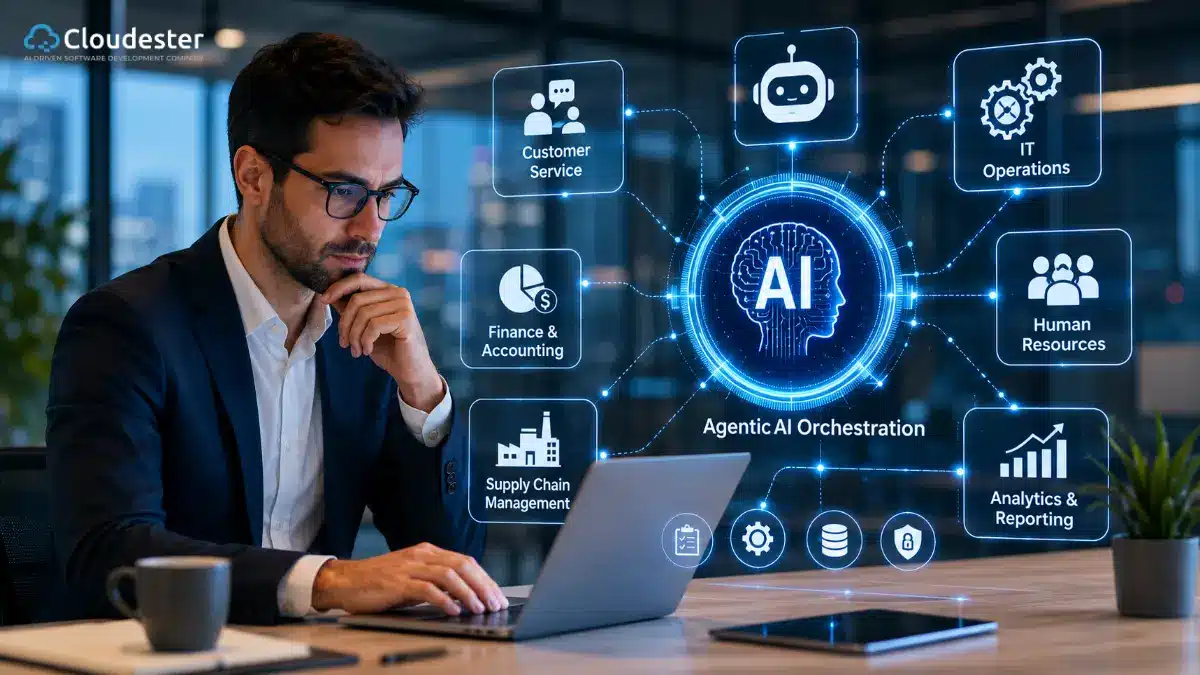
AI Generated. Credit: ChatGPT
Here’s the honest truth about automation in 2026. The RPA bots you built five years ago are still doing their job, but they’re stuck doing exactly the same job. Your team clicks between Salesforce, your ERP, and a spreadsheet from 2019. A process that should take 30 minutes takes three days. Changing anything requires three meetings and two weeks.
The difference with agentic AI orchestration? Your systems can now actually think. They can look at a messy situation, figure out what they need, pull information from multiple places, make judgment calls, and move forward without asking permission on every step.
Here’s what’s actually happening.
Companies running agentic AI systems at scale are seeing between 80 and 99.5% of work get handled completely without human involvement. In hospitals, that’s 87% of patient calls resolved end-to-end. In HR support, 93%
We will delve into the know-how of Agentic AI orchestration and how it carries the ability to power the next-gen enterprise automation.
When you hear agentic AI, people usually explain it as if it’s some revolutionary concept. The reality is simpler and weirder at the same time. You’re basically dealing with software that doesn’t just execute instructions you’ve written down.
Instead, it can break a big, messy goal into smaller chunks, decide what to do in what order, talk to other systems, and learn from what happened so it does better next time.
The thing that confuses people is that we keep trying to anthropomorphize it. It’s not an agent in the sense that it has consciousness or intentions.
What it means is that the system has some degree of autonomy. You don’t have to micromanage every single step. You tell it to process this invoice, and it figures out that it needs to check the PO system, verify the amounts against what was ordered, flag anything that doesn’t match, maybe ask someone in accounting if something seems off, and then log the transaction.
The system is literally deciding the sequence based on what it encounters, not following a flowchart you drew in 2022.
What separates it from the automation tools you already have is that those tools are dumb in a specific way. They’re fast and reliable, but they can’t adapt. If something’s different from what the rules expect, they get stuck.
An agentic system hits a situation it’s never seen before and actually reasons through it instead of erroring out and waiting for someone to fix the code.
Here’s where it gets real. One smart AI agent doing its job is interesting. But your actual business doesn’t work that way. A customer order isn’t just one thing. It’s finance approving credit, inventory checking stock, fulfillment arranging shipping, supply chain, maybe adjusting procurement, customer service checking what the person bought before.
If you deploy six separate agents and they don’t know what the others are doing, you’ve just created a more complicated version of your old problem.
That’s what orchestration actually means. It’s not some magical coordination layer. and It’s the system that makes sure these agents are talking to each other, sharing information, making decisions together when they need to, and not stepping on each other’s toes.
It’s what prevents you from approving an order for something you don’t have in stock, or promising delivery dates that logistics can’t actually hit, or sending a customer a refund for something they’ve already been charged for twice.
The real challenge most companies face is what happens when you’ve deployed ten or twenty AI agents across different departments without thinking about how they’re supposed to work together.
That’s called agent sprawl, and it’s exactly as bad as it sounds. You’ve got disconnected agents all over the place, nobody knows what they’re doing, and you’ve got zero visibility into what’s happening. That’s where orchestration becomes non-negotiable.
If you’ve worked with automation systems for any length of time, you know exactly what I’m talking about. You build a workflow. You map out all the decision points. And you write the rules for each one. It works great for about six months, and then reality hits.
The business changes its policy. A new product launches. A competitor does something that forces you to adjust your approach. Or a customer comes through with a situation that doesn’t fit any of your predefined rules.
The system encounters something it wasn’t built to handle, and it just stops. Someone has to get involved, figure out what went wrong, probably write a ticket, wait for development time, and eventually get a fix deployed.
Your IT team ends up spending more time patching old workflows than building new ones. Every change is risky because you’re touching code that’s been running for three years, and you’re honestly not even sure what all it does anymore.
And the system can’t learn. It doesn’t get smarter. It’s literally the same system doing the same thing, handling the same exceptions the same way, year after year.
That’s not even talking about the actual maintenance nightmare. Your automation platform becomes a graveyard of old workflows that nobody touches because they might break something.
At some point in the last few years, enterprise operations got weirdly complicated. You’ve probably noticed this. A process that used to touch three systems now touches twelve.
Your company has cloud stuff, legacy stuff, SaaS tools, custom-built tools, and probably some Excel spreadsheets that shouldn’t exist but definitely do, and people rely on them.
In a bank, you’re coordinating between systems in different regulatory jurisdictions, you’ve got compliance checks baked into everything, and your automation can’t just do whatever it wants.
In a hospital, you’re pulling from the EHR, the billing system, pharmacy systems, insurance verification, appointment systems, and something your hospital built in 1997 that absolutely cannot go down.
Manufacturing companies are balancing demand, supply constraints, supplier relationships, quality control, and all of it’s dependent on information from systems that don’t talk to each other naturally.
The complexity isn’t really that each individual system is complicated. It’s that they all depend on each other in ways that are genuinely hard to predict.
And this is the thing that kills traditional automation: your competitors aren’t waiting for you to manually adjust all your rules when the environment changes.
They’re deploying systems that adapt, learn, and get better without needing a development project every time something shifts.
So if you’re going to actually build one of these systems, what do you actually need? First, you need agents. These are the actual workers. One agent handles customer service stuff. Another handles finance decisions. Another handles supply chain coordination. Each one is a specialist at what it does.
Then you need some kind of orchestration layer sitting on top. This is the layer that says, ” Okay, Agent A finished this, now Agent B needs that information, let’s route it there. It manages the workflow, makes sure work is getting to the right place, and handles the conversations between agents.
Your agents are going to need memory and context. An agent can’t make smart decisions if it doesn’t know what happened before. Is this customer someone who’s loyal and should get a break, or are they a frequent problem? Did we already try to fix this supply chain issue once, and it didn’t work? The knowledge system is what lets agents learn from history.
You need APIs and connections to your actual business systems. If your agent can’t pull data from your ERP or talk to your CRM or check your inventory, it’s useless. It’s just a smart system with no hands.
And honestly, you need to be able to see what these agents are doing. If you can’t monitor them, track what they’ve decided, and set up governance rules about what they’re allowed to do, you’re going to have chaos or worse, compliance nightmares.
Here’s what actually happens when work moves through one of these systems. Something comes in. Maybe it’s a customer support ticket, maybe it’s an invoice, maybe it’s a demand signal from the market that needs to ripple through supply chain decisions.
The orchestration system routes it to whoever needs to handle it first. That agent looks at it, figures out what information it needs, and goes to get it. Maybe it needs to check a few systems, maybe it needs to ask another agent, “Hey, did we already look at this?”
If the decision is something that touches multiple parts of the business, agents talk to each other. The support agent figures out that there’s a finance implication, so it asks the finance agent what’s going on with the account before committing to anything.
The supply chain agent realizes that a decision depends on what procurement just agreed to with a supplier.
Then actual work happens. Invoices get logged. Tickets get resolved. Orders get pushed to fulfillment.
And here’s the part that matters: the system checks its own work. Did this actually accomplish what we wanted? Did something unexpected happen?
And next time a similar situation comes along, the system is going to handle it a little differently because it learned from the last one.
Okay, so here’s what actually changes when you deploy this. Your systems can make complex decisions at a scale that would require hiring an army of people if you were doing it manually. That’s not hyperbole. A hospital running AI agent orchestration for patient services is making tens of thousands of decisions a day that used to require human intervention.
Work moves faster. A process that used to take three days now takes a few hours because there’s no waiting for people to hand it off to the next department. People aren’t sitting in queues waiting for approval. If a decision can be made, it gets made.
Your team gets freed up to do actual, valuable work. Instead of processing invoices or screening resumes or routing support tickets, your people are focusing on the weird edge cases, the strategic questions, the stuff that actually needs human judgment. You’re not replacing people with AI. You’re just replacing the parts of their job that were basically just data entry.
The system learns. Unlike your old workflow system, which is identical today as it was three years ago, this one gets better. You see patterns, you optimize for them, and the next similar situation gets handled even better. That’s not something that happens on its own. It’s built in.
And customers get better service. Response times drop. The person on the phone gets a full context about previous interactions instead of starting from zero. Problems actually get resolved instead of just being escalated because the system didn’t know how to handle them.
Let’s talk about what’s actually working right now. In customer service, you’re seeing AI agents handle first contact resolution at crazy high rates. Someone calls in with a billing question.
The system checks their account, verifies their identity, pulls their history, figures out what the actual problem is, and solves it. If it’s something weird, it escalates to a human, but the human gets a full briefing instead of a blank slate.
IT operations are using these systems to catch problems before they turn into disasters. An agent notices a server getting hot, checks what’s running on it, sees that a database query went haywire, and either fixes it automatically or brings in a human with a full diagnosis already done.
Finance is running through invoices automatically. Checking them against POs, verifying amounts, looking for fraud patterns, and flagging what actually needs human eyes. Same thing with revenue forecasting.
You’re pulling data from multiple sources, the system is analyzing patterns, and you’re getting more accurate predictions because the system isn’t bound by what you manually told it to look for.
HR is using these for candidate screening, which sounds scary, but honestly just saves time on the stuff that was pure busywork. Reading resumes, checking if basic qualifications matched, and setting up first interviews.
For onboarding, the system is coordinating between IT, payroll, benefits, managers, and the new employee actually starts work on day one instead of day three because everything’s already been set up.
Supply chain is probably where we’re seeing the most interesting applications. Demand forecasting, inventory adjustments, and automatically negotiating with suppliers about delivery dates based on what’s actually feasible.
These are multi-step decisions that depend on information from half a dozen different places, and having a system that can actually coordinate all of that is genuinely transformative.
The comparison between these approaches clarifies why organizations are making this transition:
| Capability | Traditional Automation | Agentic AI Orchestration |
| Decision Making | Rule-Based Only | Autonomous, Contextual |
| Adaptability | Low Static | High Dynamic |
| Learning Ability | None | Continuous Improvement |
| Collaboration | Single Workflow | Multi-Agent Teams |
| Scalability | Moderate Limit | Enterprise Scale |
The reason this is all possible now is that some fundamental pieces finally came together. Large language models give agents the ability to actually understand context and reason through problems. That’s the foundation everything else is built on.
Retrieval-augmented generation is what lets agents actually know things without being trained on your specific data. Your agent can check your knowledge base, your documentation, and your previous cases, and use that information to make better decisions.
Vector databases are how you actually store knowledge in a way that’s searchable and retrievable when an agent needs it. It’s more sophisticated than keyword search. It actually understands meaning.
Knowledge graphs let you structure understanding about how different things relate to each other. In a supply chain context, a knowledge graph understands that suppliers connect to products, products connect to inventory, inventory connects to demand forecasts, and all of those relationships matter.
AI agent frameworks are basically the development tools that let engineers build agents without starting from scratch. Open source stuff, some commercial platforms, some homegrown. But the point is you’re not writing agents from first principles.
Enterprise integration platforms are what actually connect your agents to the systems they need to do work. Without those, your agents are just smart thoughts with no ability to act.
All of this needs security frameworks and governance tools wrapped around it, or you’re just giving incredibly smart systems unsupervised access to your important data and business processes.
Let’s be honest. This stuff is hard, and there are legitimate reasons to be cautious. These systems have access to sensitive data and can make decisions that affect your business. That’s scary if you don’t have proper governance in place. You need to know what they’re doing, why they did it, and be able to audit the whole thing for compliance.
Agent sprawl is a real problem. You can end up with agents scattered all over the organization, each one built by a different team using different approaches, with no central coordination or visibility. Before you know it, you’ve got a management nightmare instead of an automation win.
Data quality kills these projects. Your agents are only as smart as the data they have access to. If your data is a mess, inconsistent, incomplete, or wrong, your agents are going to make bad decisions confidently. Fixing data quality is boring and hard, but it’s non-negotiable.
Legacy systems are annoying to integrate with. Most enterprises have stuff built years ago that wasn’t designed to talk to autonomous AI systems. You can work around it, but it adds complexity and often means you’re writing more glue code than you’d like.
Performance monitoring gets complicated when you’ve got distributed systems running asynchronously. You can’t just check logs. You need to understand what decisions were made, why, and what the downstream effects were. And you need to do that fast enough to catch problems before they propagate.
Start with high-value automation opportunities. Pick use cases where the ROI is obvious and where success will generate organizational momentum and support for broader implementation.
Define clear agent roles and responsibilities. Each agent should have a specific domain of expertise and know the boundaries of its authority.
Establish human-in-the-loop oversight. Humans remain involved in high-stakes decisions, unusual situations, and final approvals where judgment matters.
Implement governance frameworks that provide visibility into what agents are doing and enforce compliance with organizational policies and regulatory requirements.
Continuously monitor and optimize agent performance. Treat your orchestration system as a living, evolving capability rather than something you implement once and leave alone.
The trajectory is clear. Organizations are moving toward autonomous enterprise operations where routine decisions and processes run without human intervention. Multi-agent business ecosystems will enable organizations to coordinate across departments and even across organizational boundaries with partners and suppliers. AI-driven strategic decision support will help human leaders make better choices faster by synthesizing complex information across the enterprise. Self-optimizing enterprise workflows will continuously tune themselves based on performance data and changing business conditions.
Custom AI development company Cloudester Software has spent the past several years building and refining platforms specifically designed for enterprise agentic AI orchestration. Custom AI agent development creates agents tailored to your specific business processes and organizational constraints. Multi-agent orchestration architecture ensures your agents work together effectively without creating chaos or unintended consequences.
Enterprise integration services connect your orchestrated agents to existing systems, databases, and applications. Security and governance implementation ensure your autonomous systems operate safely within compliance boundaries. Cloudester’s end-to-end deployment and support model means you’re not figuring this out alone. Their teams guide enterprises through the full implementation journey, from initial pilots to enterprise-scale deployments.
Also read: Agentic AI Web Development: The Future of Smart Web App
The shift from traditional automation to intelligent, agentic AI orchestration represents the most consequential evolution in enterprise automation since the rise of RPA and workflow platforms. Organizations that master agentic AI orchestration in 2026 will gain substantial competitive advantages.
Faster execution speeds. Lower operational costs. Better decision quality. And the ability to handle the complexity of modern business environments in ways that static, rule-based systems simply cannot match.
Your competitors aren’t waiting. They’re implementing agentic AI systems now. The question for your organization isn’t whether agentic AI orchestration is effective. The real question is how quickly you can move from understanding it to deploying it at scale across your enterprise.
We specialize in creating high-performance web and mobile apps, seamlessly integrating them with your existing systems to enhance user experiences and streamline business operations.
85 Delancey St, New York NY 10002, United States