
August 28, 2026
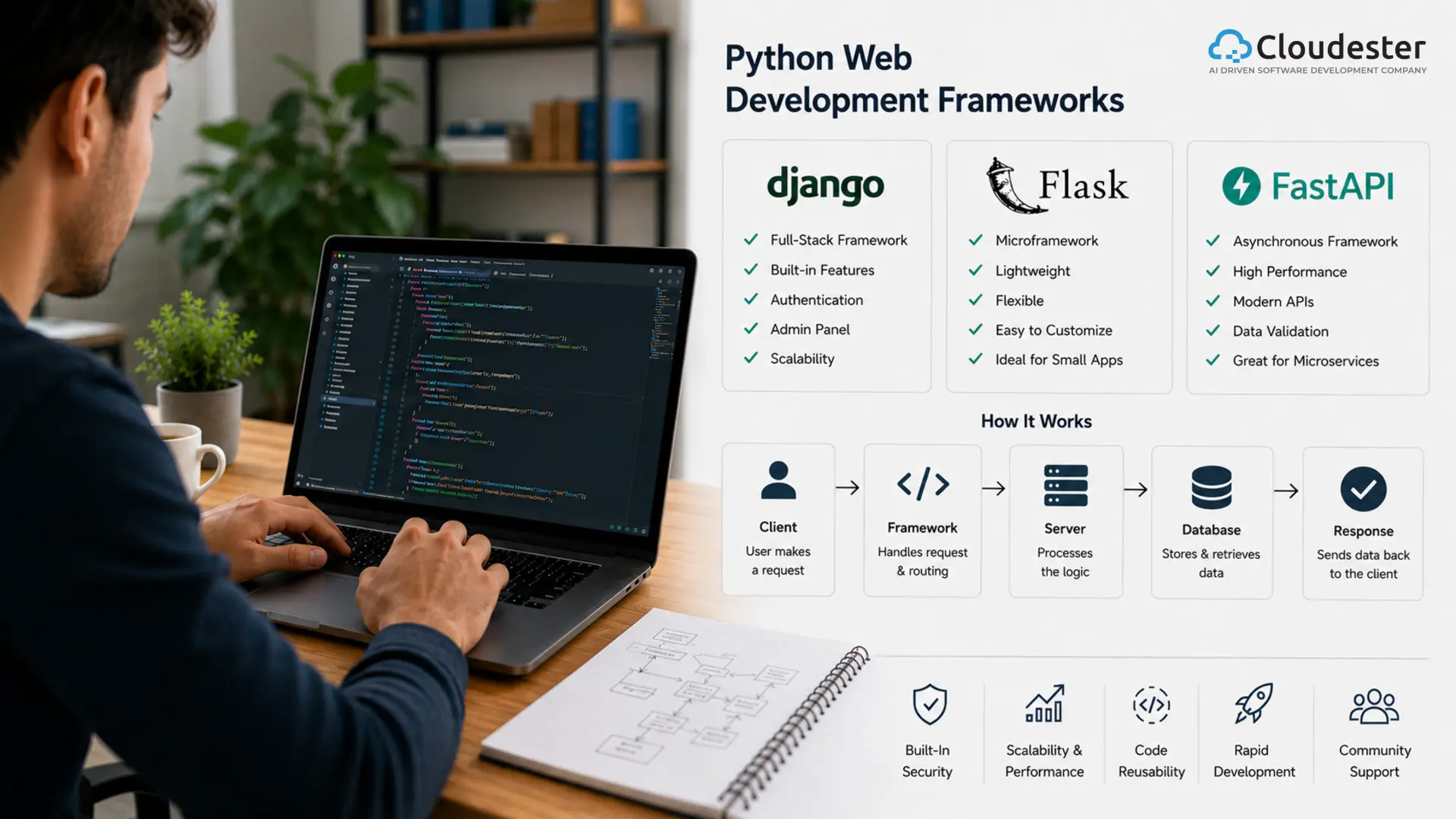
AI Generated. Credit: ChatGPT
The world of website construction has come a long way since the days when it meant simply publishing your web pages on the Internet. Now, there is a need for platforms that are quick, safe, reliable, and easy to handle. This is the reason why Python frameworks for web development play such a huge role.
Instead of building websites from scratch, developers can now save their time using frameworks.
Today, from startups to big companies, all kinds of organizations use Python frameworks for creating websites, APIs, software as a service, and AI applications.
If businesses want to accelerate development with experienced engineers, they often choose to hire Python developers who specialize in modern frameworks like Django, Flask, and FastAPI.
In this blog, you will learn more about these frameworks and get answers to all related questions.
The concept of a Python web development framework can be defined as a toolbox that developers rely on when creating websites and web applications. Using frameworks, developers don’t need to create each element anew because all the necessary structures are ready-made.
There are many elements that almost every website requires, such as:
It means that without web development frameworks, developers should code these components for every project. It is a tedious process that takes lots of time.
That is one of the main advantages of using Python for web development
Think of frameworks like a ready-made foundation for a house. The structure is already there, so developers can focus more on customizing features instead of rebuilding the basics over and over again.
That’s especially important for businesses trying to launch products quickly.
Most Python backend frameworks usually include:
Some frameworks come with almost everything built in, while others stay lightweight and flexible.
Not every application is built the same way, which is why different types of frameworks exist. Some projects need more structure, while others need flexibility or speed.
Full-stack frameworks come with many built-in tools already included. Developers usually don’t need to install extra components for basic functionality.
These frameworks typically support:
Django is one of the most widely used Python full-stack frameworks today.
A lot of developers prefer Django because it already handles many common development tasks. That’s why people often describe it as a “batteries included” framework.
Django works especially well for:
Many organizations use Django because it supports rapid development, scalability, and security.
Businesses looking for enterprise-grade application development also invest in cloud application development services to improve scalability and performance.
Microframeworks
Microframeworks take a different approach.
Instead of including every possible feature, they stay lightweight and only provide the essentials. Developers can then add extra tools depending on the project requirements.
Flask is one of the best-known lightweight Python web development frameworks. Developers often choose Flask because it gives them more freedom over how the application is structured.
Flask is commonly used for:
When people compare Flask vs. Django, the conversation usually comes down to flexibility versus built-in functionality.
Django gives developers more tools immediately, while Flask gives them more control over customization.
As applications became more advanced, developers started needing frameworks capable of handling multiple requests more efficiently. That’s where asynchronous frameworks became important.
FastAPI has become extremely popular over the last few years because of its speed and modern API capabilities.
It’s commonly used for:
Companies building AI-powered systems often combine FastAPI with machine learning consulting services to create intelligent web applications.
To understand how frameworks work, it helps to understand what happens behind the scenes when someone visits a website.
Whenever a user opens a website, the browser sends a request to the server.
For example:
The framework receives that request and decides what should happen next.
There are three main parts involved:
The framework acts like the middle layer that keeps the application organized.
Routing helps frameworks decide which page or function should respond to a specific URL.
For example:
/products → Product page
/login → Login page
This helps applications stay clean and structured instead of becoming messy as they grow.
Most websites display dynamic content, meaning the information changes depending on the user.
Frameworks use templates to display things like:
The framework combines backend data with the template before showing the final page to the user.
Most Python web development frameworks include ORM systems, which stand for Object Relational Mapping.
ORM allows developers to work with databases using Python code instead of writing complicated SQL queries manually.
This makes database management easier and keeps code cleaner.
Security is one of the biggest reasons developers use frameworks.
Most frameworks already include protection against:
That helps developers avoid common vulnerabilities without manually building every security layer themselves.
Applications built with modern frameworks can grow as businesses grow. A small startup application can eventually scale to support thousands or even millions of users when built properly.
Businesses requiring scalable digital products often combine frameworks with progressive web app development services to improve user experience and performance.
Frameworks encourage reusable code, which reduces repetitive work and makes applications easier to maintain.
Since many features are already available, developers can build and launch applications much faster.
That’s one reason startups often rely heavily on Python web development frameworks.
Popular frameworks like Django, Flask, and FastAPI have large communities and extensive documentation.
There are also thousands of plugins available, which makes development even easier.
Companies like Cloudester Software often use these ecosystems to speed up custom web application development for businesses.
Best for large applications that need built-in functionality, scalability, and security.
Best for lightweight applications and projects requiring flexibility.
Best for APIs, real-time systems, and high-performance applications.
The comparison between Flask and Django usually depends on project size, customization needs, and development preferences.
Pre-built tools help developers avoid repetitive setup work.
Frameworks encourage better organization, which makes projects easier to manage later.
Authentication systems, routing, and security features are already included in many frameworks.
From startups to large enterprises, Python full-stack frameworks support projects of almost every size.
Companies scaling development teams frequently use offshore development services to accelerate project delivery.
Certain full-stack frameworks may feel heavier for smaller projects.
Some frameworks take time to fully understand, especially for developers new to backend development.
Developers often need to follow the framework’s coding patterns and structure.
There isn’t one framework that works perfectly for every project.
The right choice depends on factors like:
For example, a startup building a quick MVP may choose Flask, while a larger enterprise platform may prefer Django.
Businesses planning modern software platforms also explore software development services to align framework selection with long-term business goals.
Modern web application development goes beyond simply making a website available. Companies require platforms that operate quickly, securely, and are scalable, all while being manageable during the growth process.
This can be considered as one of the most prominent factors contributing to the widespread use of Python frameworks in web development.
There are several types of frameworks, such as Django, Flask, and FastAPI, which differ in their capabilities and are more suitable to be used in specific situations. For example, some frameworks are better suited for enterprise platforms, whereas others will do a better job at providing lightweight web applications and API.
Understanding how frameworks work allows developers to develop applications faster and effectively manage their projects.
A Python web development framework is a set of tools and libraries that help developers build websites and web applications faster without creating everything from scratch.
Flask is usually considered beginner-friendly because it’s simple, lightweight, and easy to understand.
Not necessarily. Django is great for larger applications with built-in features, while Flask gives developers more flexibility and control.
Yes. Many large companies use Python web development frameworks because they’re reliable, scalable, and capable of handling high traffic.
FastAPI is currently one of the most popular choices for building fast and modern APIs.


We specialize in creating high-performance web and mobile apps, seamlessly integrating them with your existing systems to enhance user experiences and streamline business operations.
85 Delancey St, New York NY 10002, United States