August 28, 2026
AI Generated. Credit: ChatGPT
Artificial Intelligence (AI) and Machine Learning (ML) are among the most transformative technologies driving digital innovation in 2026. Businesses across industries are investing heavily in AI-powered systems to automate workflows, improve customer experiences, and make smarter decisions using data. However, many people still confuse artificial intelligence vs machine learning because the two terms are closely connected.
The topic of artificial intelligence vs machine learning has become increasingly important as businesses adopt intelligent technologies for automation, analytics, and digital transformation. Although the terms are often used interchangeably, understanding artificial intelligence vs machine learning is essential for choosing the right technology solutions.
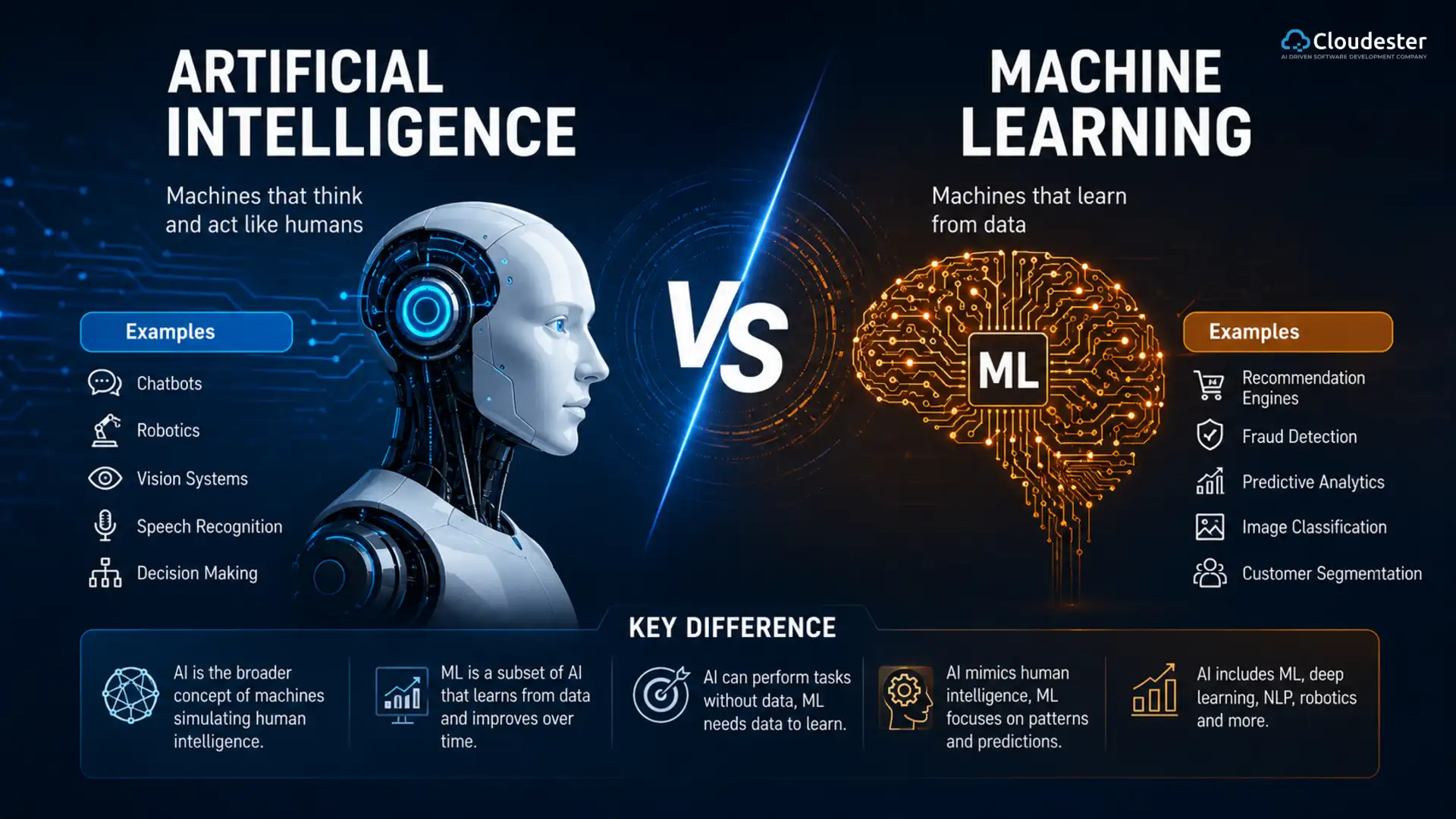
Artificial Intelligence is the broader concept of machines simulating human intelligence, while Machine Learning is a subset of AI that enables systems to learn from data and improve automatically without explicit programming. Although they work together, AI and ML serve different purposes and use different technologies.
From virtual assistants and recommendation engines to predictive analytics and autonomous systems, AI and machine learning are reshaping modern enterprises. Understanding the difference between AI and ML is important for businesses planning digital transformation initiatives and developers building intelligent applications.
In this blog, we will explore the major differences between artificial intelligence and machine learning, their real-world applications, advantages, challenges, and future trends shaping the AI ecosystem in 2026.
Artificial Intelligence refers to the simulation of human intelligence in machines. AI systems are designed to mimic human cognitive functions such as reasoning, learning, problem-solving, decision-making, and language understanding.
The primary goal of AI is to create systems capable of performing tasks that normally require human intelligence. These systems can analyze large amounts of information, recognize patterns, make decisions, and continuously improve performance.
Artificial intelligence is widely used across industries, including healthcare, finance, manufacturing, retail, transportation, and cybersecurity. Modern AI systems use technologies such as natural language processing, computer vision, robotics, neural networks, and machine learning algorithms.
Narrow AI is designed to perform specific tasks. Examples include voice assistants like Siri, recommendation systems used by Netflix, and AI chatbots such as ChatGPT.
General AI refers to machines capable of performing any intellectual task a human can do. Although this concept remains theoretical, researchers continue exploring advanced AI capabilities.
Generative AI creates new content such as text, images, videos, and code. Technologies like GPT models, Gemini, and Claude have accelerated enterprise adoption of AI solutions.
Some AI systems react to inputs without storing memory, while advanced AI systems continuously learn from data and user interactions.
Businesses are increasingly adopting artificial intelligence solutions to improve operational efficiency, automate repetitive tasks, and gain competitive advantages in rapidly evolving markets.
Machine Learning is a subset of artificial intelligence that enables computers to learn from data and improve performance without being explicitly programmed. Instead of following fixed rules, ML systems analyze patterns in historical data and make predictions or decisions automatically.
Machine learning algorithms are widely used in predictive analytics, recommendation engines, fraud detection, image recognition, natural language processing, and data-driven automation.
Unlike traditional software development, machine learning models continuously improve accuracy as they process more data. This ability to learn from experience makes ML a powerful technology for modern business applications.
Supervised learning uses labeled datasets to train models. The system learns from input-output pairs to predict future outcomes accurately.
Unsupervised learning identifies hidden patterns or relationships in unlabeled data. It is commonly used for customer segmentation and anomaly detection.
Reinforcement learning enables systems to learn through trial and error using rewards and penalties. This method is widely used in robotics and autonomous systems.
Machine learning plays a critical role in enterprise automation because it helps organizations process massive datasets efficiently and uncover actionable insights.
Although AI and ML are closely connected, they are not the same. Artificial intelligence is the broader field focused on simulating human intelligence, while machine learning specifically enables systems to learn from data.
When comparing artificial intelligence vs machine learning, it is important to understand that AI is the broader concept of intelligent systems, while machine learning focuses specifically on data-driven learning models.
| Feature | Artificial Intelligence | Machine Learning |
|---|---|---|
| Definition | Simulation of human intelligence | A subset of AI that learns from data |
| Goal | Create intelligent systems | Enable systems to learn automatically |
| Scope | Broad technology field | Specific branch of AI |
| Data Dependency | May or may not require data | Strongly dependent on data |
| Decision Making | Mimics human reasoning | Makes predictions using patterns |
| Applications | Robotics, NLP, automation | Recommendation engines, analytics |
| Complexity | More complex | Focused on model training |
| Human Involvement | Lower after deployment | Requires training and tuning |
Artificial intelligence covers a broad range of technologies, including robotics, computer vision, expert systems, speech recognition, and natural language processing. Machine learning focuses specifically on data-driven learning and prediction models.
AI systems can use multiple approaches to simulate intelligence, while machine learning systems continuously improve through data analysis and model optimization.
Machine learning requires large volumes of training data for accurate predictions. Some AI systems, however, can operate using predefined rules without extensive datasets.
Machine learning models often require human oversight during training and optimization. Advanced AI systems aim to reduce human involvement by automating decision-making processes.
Modern AI systems integrated with machine learning can adapt in real time based on user interactions, environmental changes, and new information.
Machine learning is considered a subset of artificial intelligence because it provides systems with the ability to learn from data automatically. AI is the broader concept, while ML is one of the key technologies powering intelligent systems.
The relationship between artificial intelligence vs machine learning can be confusing for beginners because both technologies work together in many modern applications. However, machine learning remains a subset within the broader field of artificial intelligence.
The relationship between AI and ML can be visualized as a hierarchy:
Deep learning is a specialized branch of machine learning that uses neural networks with multiple layers to process complex data patterns.
For example, self-driving cars use artificial intelligence for decision-making and machine learning for recognizing objects, predicting movements, and improving driving performance.
Similarly, AI chatbots rely on machine learning models trained on massive datasets to understand language and generate accurate responses.
Artificial intelligence, machine learning, and deep learning are interconnected technologies, but they differ in complexity, functionality, and applications.
Discussions around artificial intelligence vs machine learning often include deep learning because advanced AI systems rely heavily on deep neural networks for complex problem-solving and automation.
| Technology | Description | Best For | Examples |
|---|---|---|---|
| Artificial Intelligence | Simulation of human intelligence | Automation and intelligent systems | Virtual assistants |
| Machine Learning | Learning from data patterns | Predictions and analytics | Fraud detection |
| Deep Learning | Neural network-based learning | Complex AI tasks | Image recognition |
Deep learning is an advanced subset of machine learning that uses artificial neural networks to process massive datasets and identify highly complex patterns.
Deep learning powers modern AI innovations, including:
Technologies like ChatGPT, Gemini, and AI copilots rely heavily on deep learning architectures to process language and generate human-like outputs.
AI and machine learning are transforming industries by enabling intelligent automation, predictive analytics, and data-driven decision-making.
Healthcare organizations use AI and ML for medical imaging analysis, patient monitoring, drug discovery, predictive diagnostics, and personalized treatment recommendations.
Financial institutions use machine learning for fraud detection, risk analysis, algorithmic trading, and customer behavior prediction.
Ecommerce platforms use AI-powered recommendation systems to personalize shopping experiences and improve customer engagement.
AI systems identify unusual patterns and detect cyber threats in real time, helping organizations strengthen security measures.
Manufacturers use predictive maintenance systems powered by machine learning to reduce downtime and improve operational efficiency.
AI tools help businesses automate customer segmentation, campaign optimization, sentiment analysis, and lead scoring.
Enterprise software platforms integrate AI copilots and predictive analytics tools to improve productivity and automate workflows.
Also read: Machine Learning in Software Development: Trends to Watch
Businesses adopting AI and machine learning technologies gain significant competitive advantages through automation, analytics, and intelligent decision-making.
Understanding artificial intelligence vs machine learning helps businesses choose the right technologies for predictive analytics, intelligent automation, customer personalization, and enterprise transformation.
AI automates repetitive tasks, reduces manual effort, and accelerates workflows across departments.
Machine learning models analyze large datasets and generate actionable insights that support strategic business decisions.
AI-powered chatbots, recommendation systems, and personalization engines improve customer engagement and satisfaction.
Businesses use predictive models to forecast demand, detect risks, and optimize operations.
Automation reduces operational expenses while improving accuracy and scalability.
AI-driven systems enable organizations to scale services efficiently without proportional increases in workforce requirements.
Many enterprises partner with AI consulting companies to implement intelligent solutions tailored to their business objectives.
Despite their advantages, artificial intelligence and machine learning technologies also present challenges that organizations must address carefully.
AI systems require large datasets, raising concerns about data security, compliance, and privacy regulations.
Machine learning models may produce biased outcomes if trained on unbalanced or inaccurate datasets.
Developing AI infrastructure and training models often requires significant investments in technology and expertise.
Some deep learning systems operate as “black boxes,” making it difficult to explain how decisions are made.
Machine learning models require continuous monitoring and retraining to maintain accuracy.
Organizations must address ethical concerns related to AI governance, accountability, and responsible automation.
Businesses implementing AI solutions should establish clear governance frameworks to ensure responsible and secure AI adoption.
The future of artificial intelligence and machine learning is evolving rapidly as enterprises invest heavily in automation, generative AI, and intelligent systems.
The future of artificial intelligence vs machine learning will continue evolving as generative AI, autonomous systems, and enterprise AI adoption accelerate across industries.
Generative AI technologies are revolutionizing content creation, software development, customer support, and enterprise productivity.
AI agents capable of performing complex tasks autonomously are becoming increasingly popular across industries.
Organizations are integrating AI into core business operations, including finance, HR, customer service, and supply chain management.
Modern AI systems can process text, images, video, and audio simultaneously, enabling more advanced applications.
AI-powered coding tools are improving developer productivity by generating code, detecting bugs, and automating repetitive tasks.
Edge AI allows intelligent processing on local devices, reducing latency and improving real-time performance.
Businesses are combining AI, robotic process automation, and machine learning to automate entire workflows.
As AI technologies continue advancing, organizations that invest in intelligent systems will gain stronger competitive advantages in the digital economy.
Neither artificial intelligence nor machine learning is inherently better because both technologies serve different purposes. Machine learning is a subset of AI that focuses on data-driven learning, while AI encompasses broader intelligent capabilities.
Businesses should choose technologies based on their goals and requirements.
Many modern enterprise solutions combine AI, ML, and deep learning technologies to achieve maximum efficiency and scalability.
Also read: How AI and Machine Learning Are Shaping Mobile Apps?
Understanding the difference between artificial intelligence and machine learning is essential for businesses, developers, and technology leaders planning future digital transformation initiatives.
Artificial intelligence is the broader field focused on creating intelligent systems capable of simulating human behavior, while machine learning enables those systems to learn from data and improve automatically.
As the debate around artificial intelligence vs machine learning continues, organizations must understand how both technologies complement each other to build scalable, intelligent, and future-ready digital solutions.
As AI adoption accelerates in 2026, technologies like generative AI, deep learning, AI agents, and predictive analytics will continue transforming industries worldwide.
Organizations investing in AI and machine learning solutions can improve operational efficiency, automate workflows, enhance customer experiences, and unlock valuable business insights.
Businesses looking to implement scalable AI solutions should work with experienced AI development and machine learning experts to build secure, efficient, and future-ready intelligent systems.
Yes, machine learning is a subset of artificial intelligence that enables systems to learn from data and improve performance automatically.
The primary difference in artificial intelligence vs machine learning is that artificial intelligence focuses on simulating human intelligence, while machine learning specifically enables systems to learn from data patterns.
Yes, ChatGPT uses deep learning and machine learning models trained on massive datasets to generate human-like responses.
Yes, deep learning is a subset of machine learning, which itself is a subset of artificial intelligence.
Yes, some AI systems use predefined rules and logic without relying on machine learning algorithms.
Artificial intelligence is the broader and more advanced concept because it includes machine learning and other intelligent technologies.
Examples include virtual assistants, recommendation engines, fraud detection systems, autonomous vehicles, and predictive analytics tools.
Businesses use AI and ML for automation, customer support, predictive analytics, fraud detection, marketing optimization, and operational efficiency.
Industries such as healthcare, finance, retail, manufacturing, cybersecurity, and ecommerce heavily use AI technologies.
No, machine learning is a core part of AI and will continue evolving alongside broader artificial intelligence technologies.


We specialize in creating high-performance web and mobile apps, seamlessly integrating them with your existing systems to enhance user experiences and streamline business operations.
85 Delancey St, New York NY 10002, United States