
September 7, 2026
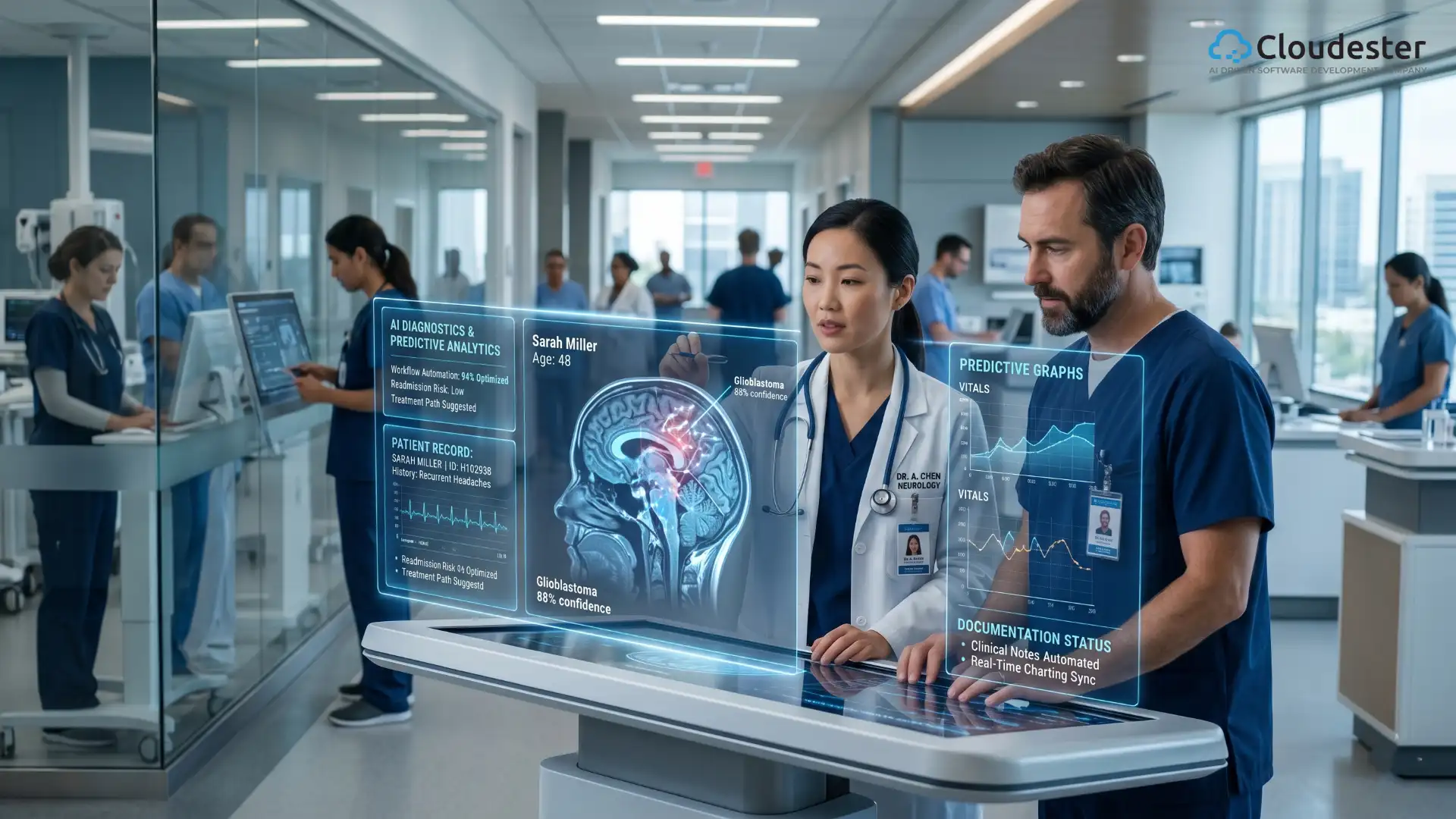
AI Generated. Credit: Google Gemini
Generative AI in healthcare is rapidly transforming the healthcare industry by improving operational efficiency, accelerating medical research, and enhancing patient care. From AI-powered clinical documentation to intelligent healthcare chatbots and predictive diagnostics, healthcare organizations are adopting advanced generative AI technologies to streamline workflows, automate administrative tasks, and improve healthcare decision-making.
The growing adoption of generative AI in healthcare is helping hospitals, clinics, and medical institutions automate repetitive processes, improve decision-making, and deliver more personalized patient experiences. As healthcare systems continue to evolve, generative AI is becoming a critical component of digital transformation strategies across the medical sector.
In this blog, we will explore real-world generative AI in healthcare examples, major benefits, implementation challenges, and future trends shaping the healthcare industry in 2026.
Generative AI in healthcare refers to artificial intelligence systems capable of generating new content, insights, recommendations, or data based on large healthcare datasets. These systems use advanced machine learning models such as Large Language Models (LLMs), Natural Language Processing (NLP), and multimodal AI technologies to automate complex healthcare workflows.
Unlike traditional AI systems that mainly analyze data, generative AI can create:
Healthcare organizations are using generative AI to improve productivity, reduce physician burnout, and optimize patient outcomes.
Healthcare providers face increasing pressure due to:
Generative AI helps healthcare organizations address these challenges by automating repetitive tasks and enabling intelligent decision-making.
Key reasons hospitals are investing in healthcare AI solutions include:
As AI technologies mature, generative AI is becoming essential for healthcare digital transformation initiatives.
One of the most impactful generative AI healthcare applications is automated clinical documentation. Physicians spend significant time creating patient notes, summaries, and reports.
Generative AI systems can automatically:
This helps reduce physician burnout while improving documentation accuracy and workflow efficiency.
Healthcare organizations are increasingly deploying AI-powered medical chatbots to improve patient engagement and automate communication.
These chatbots can:
AI healthcare chatbots improve accessibility while reducing pressure on support staff.
Generative AI is revolutionizing drug discovery by accelerating molecular research and identifying potential treatment compounds.
AI models can:
Pharmaceutical companies use generative AI to reduce research timelines and improve innovation efficiency.
Healthcare providers use generative AI to create personalized treatment plans based on patient history, genetics, and medical conditions.
AI systems analyze:
This enables more accurate and personalized healthcare recommendations.
Generative AI improves radiology and diagnostic imaging by assisting healthcare professionals in identifying abnormalities and patterns in medical scans.
AI systems can analyze:
These systems help radiologists detect diseases faster and improve diagnostic accuracy.
Healthcare billing processes are often time-consuming and error-prone. Generative AI automates medical coding, billing documentation, and insurance claim workflows.
AI systems help:
Virtual healthcare assistants powered by generative AI support patients with health tracking, medication reminders, and personalized wellness guidance.
These assistants can:
Generative AI systems automate communication workflows such as:
This improves operational efficiency while enhancing patient satisfaction.
Generative AI helps doctors make informed clinical decisions by analyzing medical data and generating evidence-based recommendations.
These systems support:
Healthcare organizations use generative AI to predict patient risks and identify potential health complications before they become critical.
AI systems analyze:
Healthcare institutions often face data privacy challenges. Generative AI can create synthetic healthcare datasets that replicate real-world medical information without exposing sensitive patient data.
Synthetic data supports:
Generative AI improves hospital operations by automating repetitive administrative processes such as:
Healthcare providers use generative AI to support mental health initiatives through conversational AI systems and digital therapy platforms.
These tools provide:
Generative AI helps optimize clinical trials by automating participant matching, analyzing trial data, and improving research efficiency.
AI systems support:
Hospitals generate massive amounts of healthcare information daily. Generative AI systems organize and retrieve medical knowledge efficiently.
AI-powered knowledge systems help healthcare professionals:
Also read: AI in Patient Care: Transformative Technologies & Solutions
The adoption of generative AI in healthcare offers numerous advantages for healthcare organizations and patients.
Generative AI is helping healthcare organizations modernize operations while improving overall healthcare delivery.
Despite its advantages, generative AI in healthcare also presents several challenges.
Healthcare organizations must implement strong governance, human oversight, and security measures to ensure responsible AI adoption.
| Feature | Traditional AI | Generative AI |
|---|---|---|
| Primary Function | Data analysis | Content generation |
| Healthcare Usage | Predictions & analytics | Reports, summaries & recommendations |
| Interaction Style | Rule-based | Conversational & adaptive |
| Flexibility | Limited | Highly dynamic |
| Personalization | Moderate | Advanced |
Generative AI provides more intelligent and adaptive healthcare capabilities compared to traditional healthcare AI systems.
Successful generative AI implementation in healthcare typically involves several stages.
Hospitals identify repetitive workflows suitable for AI automation.
Healthcare data is collected, secured, and prepared for AI training.
Organizations choose suitable AI models and healthcare AI platforms.
Healthcare providers ensure HIPAA compliance and data security.
AI systems integrate with EHR and hospital management platforms.
Healthcare professionals continuously validate AI outputs and monitor system performance.
The future of generative AI in healthcare is expected to include:
As AI technologies continue to evolve, healthcare organizations will increasingly rely on intelligent automation to improve patient care and operational efficiency.
Generative AI is transforming the healthcare industry by improving operational efficiency, enhancing patient experiences, and enabling smarter healthcare decision-making. From clinical documentation and medical imaging to predictive monitoring and drug discovery, healthcare organizations are increasingly adopting AI-powered systems to modernize healthcare delivery.
As the healthcare industry continues to embrace digital transformation, generative AI will play a critical role in building more intelligent, scalable, and patient-focused healthcare systems in the future.
Also read: Robotic Process Automation in Healthcare Industry Guide
Examples include clinical documentation automation, AI chatbots, drug discovery, medical imaging analysis, and personalized treatment recommendations.
Hospitals use generative AI for patient communication, documentation automation, workflow optimization, predictive monitoring, and healthcare analytics.
Generative AI can be secure when healthcare organizations implement proper HIPAA compliance, encryption, governance, and security protocols.
Major benefits include improved efficiency, reduced operational costs, faster diagnosis, enhanced patient care, and healthcare workflow automation.
No. Generative AI is designed to assist healthcare professionals, not replace them. Human expertise and oversight remain essential in healthcare decision-making.




We specialize in creating high-performance web and mobile apps, seamlessly integrating them with your existing systems to enhance user experiences and streamline business operations.
85 Delancey St, New York NY 10002, United States