March 25, 2026
AI Generated. Credit: Google Gemini
The V Model of Software Development exists for one simple reason: software failure is expensive. As modern systems grow more complex, interconnected, and regulated, the margin for error continues to shrink. A bug in a healthcare platform can compromise patient safety. A flaw in a banking system can expose financial data. Complexity is no longer just technical. It is operational and regulatory.
One of the biggest causes of software breakdown is late-stage testing. When teams wait until development is complete to validate functionality, they often uncover structural problems that require costly rework. By that point, tight timelines, stretched budgets, and declining confidence create serious project risks.
This is why structured validation became essential. Organizations needed a framework that ensured testing was not an afterthought but a parallel discipline. The V Model of Software Development solves this gap by aligning development and testing activities.
At a high level, the V Model of Software Development is a V-shaped model in software engineering that aligns each development phase with a corresponding testing phase. The V Model operates as a verification and validation model, ensuring teams build the system according to specifications and validate it against real user expectations.
In this blog, we will explore the V model phases, how software testing in V model environments works, the advantages of V model adoption, the disadvantages of V model rigidity, how V model vs waterfall comparisons play out, and when organizations should use this structured SDLC approach.
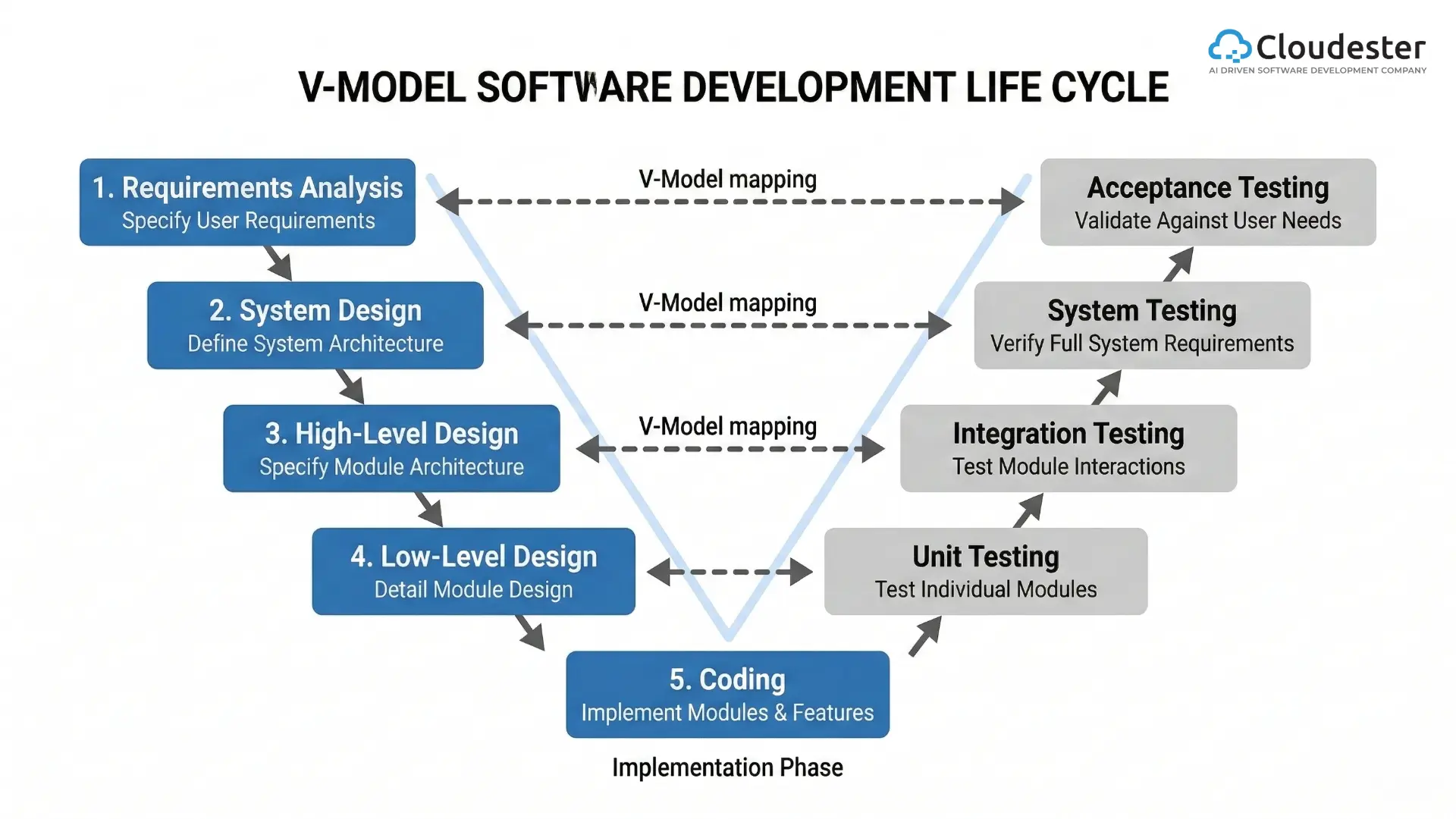
The V Model of Software Development is a structured SDLC framework in which development activities form the left side of a V shape and testing activities form the right side. Coding sits at the bottom, connecting both sides.
It is called the V model because of this mirrored structure. Every development stage has a corresponding validation stage. That symmetry is intentional.
The V Model SDLC strengthens traceability by linking requirements directly to test cases. Nothing is implemented without a plan to verify and validate it.
This verification and validation model ensures two critical outcomes:
Verification confirms the system is built correctly according to documented requirements. Validation confirms the system fulfills actual business needs.
By embedding both disciplines throughout the lifecycle, the V Model of Software Development reduces ambiguity and improves delivery confidence.
The V Model of Software Development evolved from limitations found in the traditional Waterfall approach.
Waterfall followed a linear sequence where testing occurred only after development was completed. That delay introduced risk. Teams would invest months building a system, only to discover during final testing that architectural or requirement misunderstandings existed.
The result was predictable:
Organizations needed a model that allowed parallel testing preparation. The V Model SDLC addresses this need by requiring teams to develop test strategies alongside requirements and design documentation.
This shift significantly improved accountability and reduced downstream surprises.
The V model phases are divided into two sides: verification and validation.
This one-to-one mapping between development and testing defines the V Model of Software Development and reinforces structured traceability.
Software testing in V model environments begins during requirement gathering. Test scenarios are drafted before coding starts.
The QA team plays an active role early in the lifecycle. They participate in requirement validation sessions and design reviews to ensure clarity.
Teams maintain a requirements traceability matrix throughout the project. This document links every requirement to its corresponding test case. It ensures complete coverage and accountability.
By identifying defects during early reviews rather than after deployment, teams help organizations reduce remediation costs and improve project timelines. This SDLC testing approach prioritizes prevention over reaction.
The advantages of V model adoption are particularly strong in regulated industries.
For industries such as healthcare, banking, and government systems, this structure reduces operational risk.
Despite its strengths, there are disadvantages of V model implementation.
For projects with evolving requirements, the V Model SDLC may feel restrictive.
The comparison of V model vs waterfall highlights a critical difference in testing timing.
| Feature | V Model | Waterfall |
|---|---|---|
| Testing Planning | Begins during requirements | Begins after development |
| Risk Detection | Early | Late |
| Phase Mapping | Direct mapping of development to testing | Linear progression |
| Flexibility | Limited | Limited |
While both models follow sequential stages, the V Model of Software Development integrates validation earlier and more deliberately.
The V Model of Software Development works best for projects that have fixed and clearly defined requirements.
It is commonly used for:
Organizations such as Cloudester Software frequently apply the V Model SDLC when delivering enterprise solutions that require documentation rigor and compliance alignment.
Consider a banking application handling secure online transactions.
Requirement Analysis defines authentication standards and regulatory compliance rules. Acceptance Testing later validates those requirements.
System Design establishes a secure system architecture. System Testing evaluates performance and reliability.
High Level Design defines modules such as authentication and transaction processing. Integration Testing confirms proper communication between them.
Low Level Design details transaction validation logic. Unit Testing verifies each function.
This structured flow demonstrates how the V Model of Software Development creates a transparent quality path from requirements to release. Cloudester Software has implemented similar structured lifecycle models in enterprise environments where reliability and traceability are non-negotiable.
The V Model of Software Development remains highly relevant in regulated industries and enterprise environments.
It is not always ideal for startups or rapidly evolving products where requirements change frequently. However, many modern organizations combine this V-shaped model in software engineering discipline with Agile practices to create hybrid models.
In large-scale enterprise settings, the V Model SDLC continues to provide stability, predictability, and strong governance.
The V Model of Software Development offers a disciplined approach to building high-quality systems through structured verification and validation. By mapping each development phase to a corresponding testing activity, it reduces risk, improves traceability, and strengthens accountability.
Although it may lack flexibility for rapidly changing projects, it excels in environments that demand reliability and compliance. As part of broader system development life cycle models, it remains a trusted framework for enterprise delivery.
Organizations achieve predictable execution and strong quality assurance by adopting the V-Model for software development, QA, and enterprise application strategies, while integrating Agile practices for greater flexibility.

We specialize in creating high-performance web and mobile apps, seamlessly integrating them with your existing systems to enhance user experiences and streamline business operations.
85 Delancey St, New York NY 10002, United States