
August 19, 2026
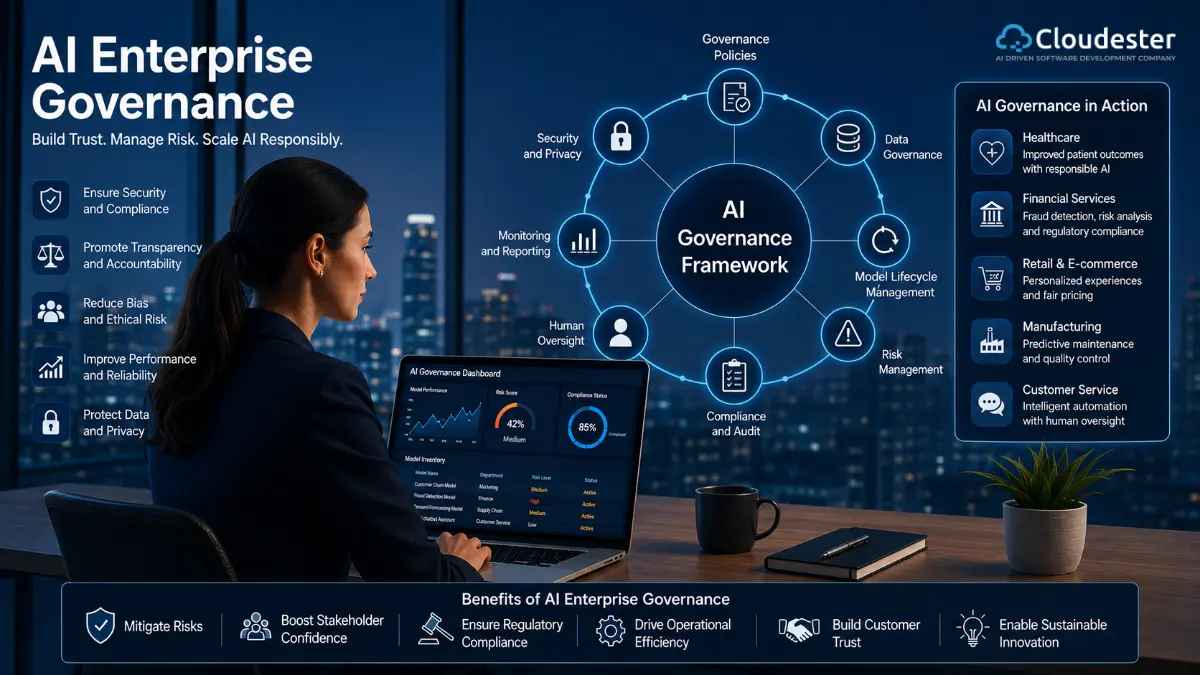
AI Generated. Credit: ChatGPT
AI enterprise governance has become a strategic necessity as organizations rapidly adopt artificial intelligence across operations, customer service, software development, analytics, and decision-making. While AI delivers significant efficiency and innovation, it also introduces challenges related to security, compliance, transparency, accountability, and risk management. Without a structured governance framework, enterprises may face inconsistent AI usage, regulatory violations, biased outcomes, and data privacy concerns. Establishing effective AI enterprise governance enables businesses to scale AI responsibly while maintaining trust, protecting sensitive information, and maximizing long-term value.
Over the past few years, enterprises have moved beyond experimenting with AI to integrating it into mission-critical workflows. From AI-powered customer support and predictive analytics to intelligent automation and generative AI applications, organizations are relying on AI more than ever before. As adoption accelerates, governance can no longer be treated as an optional compliance activity; it must become an integral part of enterprise strategy.
Many executives initially viewed AI governance as simply creating policies or ensuring regulatory compliance. In reality, it is a comprehensive framework that governs the entire AI lifecycle, from planning and development to deployment, monitoring, and retirement. Successful governance ensures that every AI initiative aligns with business objectives while minimizing operational, ethical, and security risks.
Modern enterprises also face increasing complexity because AI systems often interact with multiple business applications, cloud environments, and third-party platforms. Organizations investing in custom AI development company services frequently require governance mechanisms that standard IT policies cannot adequately address. AI models evolve continuously, making ongoing oversight essential rather than a one-time implementation effort.
Another major challenge is the emergence of generative AI and autonomous AI agents capable of creating content, writing code, analyzing documents, and making recommendations. These technologies introduce new governance considerations, including intellectual property protection, hallucination management, prompt security, and responsible human oversight. Businesses adopting generative AI development services should establish governance frameworks before deploying AI solutions at scale.
Enterprise leaders are also under growing pressure from customers, investors, and regulators to demonstrate responsible AI practices. Trust has become a competitive advantage. Organizations that can explain how their AI systems operate, protect data, reduce bias, and maintain accountability will be better positioned than those relying on uncontrolled experimentation.
AI enterprise governance is therefore not designed to slow innovation. Instead, it creates standardized processes that allow innovation to scale safely and efficiently. Just as financial governance ensures responsible management of capital, AI governance ensures responsible management of intelligent systems that increasingly influence business decisions.
AI enterprise governance is a structured framework of policies, processes, technologies, and organizational responsibilities that guide how artificial intelligence systems are designed, developed, deployed, monitored, and managed across an enterprise. Its primary objective is to ensure that AI remains secure, ethical, transparent, compliant, and aligned with business goals throughout its lifecycle.
Rather than focusing on a single AI model or application, enterprise governance establishes organization-wide standards that apply across departments, business units, and technologies. It defines who is responsible for AI decisions, how risks are evaluated, how data is protected, and how AI performance is continuously monitored.
A simple way to understand AI enterprise governance is to think of it as the operating system for responsible AI adoption. While AI algorithms generate predictions and automate tasks, governance provides the rules that determine how those systems should function within an organization’s legal, ethical, and operational boundaries.
For example, imagine a healthcare provider implementing AI to assist doctors in diagnosing patients. Without governance, the organization may struggle with inconsistent data quality, a lack of accountability, privacy violations, or biased recommendations. With governance in place, standardized review processes, validation procedures, security controls, and human oversight ensure that AI supports better clinical decisions while protecting patients.
Similarly, financial institutions using AI for fraud detection or credit assessment must ensure that algorithms remain fair, explainable, and compliant with regulations. Enterprise governance establishes these controls before AI systems affect customers or business operations.
The business landscape has changed dramatically with the rapid adoption of AI technologies. Organizations are no longer implementing isolated machine learning models; they are building interconnected AI ecosystems that influence strategic decisions, automate workflows, and generate valuable business insights.
As AI usage expands, several challenges emerge simultaneously:
Without governance, these challenges can create operational and reputational risks that outweigh the benefits of AI adoption. Enterprise governance establishes clear policies and accountability mechanisms that reduce uncertainty while encouraging responsible innovation.
Businesses investing in AI consulting initiatives increasingly recognize that governance should be embedded from the planning stage rather than added after deployment. Early governance reduces implementation costs, improves stakeholder confidence, and accelerates enterprise-wide AI adoption.
Traditional IT governance focuses primarily on infrastructure, applications, cybersecurity, and operational processes. AI systems introduce additional layers of complexity because they learn from data, evolve, and may produce outcomes that are difficult to predict or explain.
Unlike conventional software that follows predefined rules, AI models generate outputs based on statistical patterns and training data. This means governance must address questions such as:
Answering these questions requires collaboration between technology teams, legal departments, compliance officers, security professionals, business leaders, and executive management.
Organizations adopting machine learning development initiatives often discover that technical excellence alone is insufficient. Long-term success depends equally on governance, documentation, monitoring, and accountability.
An effective AI enterprise governance framework should achieve multiple strategic objectives rather than focusing on compliance alone. The most successful organizations build governance programs that simultaneously encourage innovation and reduce risk.
These objectives transform governance from a defensive compliance function into a strategic business capability that enables sustainable AI adoption across the enterprise.
Although governance frameworks vary by industry and organizational maturity, most enterprise strategies include several foundational components that work together to manage AI responsibly.
Organizations building enterprise-scale AI solutions through MLOps services and data engineering services can integrate these governance components directly into development pipelines, making governance an automated and continuous process rather than a manual review activity.
As AI capabilities continue expanding across every business function, enterprise AI governance will become one of the defining factors separating organizations that successfully scale AI from those that struggle with uncontrolled adoption, operational risks, and regulatory challenges.
As artificial intelligence becomes deeply integrated into enterprise operations, organizations need more than advanced technology to achieve sustainable success. They need a governance framework that ensures AI systems operate responsibly, securely, and consistently. AI enterprise governance provides the structure required to balance innovation with accountability while enabling businesses to maximize the value of their AI investments.
Rather than acting as a barrier to innovation, governance accelerates AI adoption by creating standardized processes, reducing uncertainty, and building trust among employees, customers, regulators, and stakeholders. Organizations that establish governance early can scale AI initiatives more efficiently while minimizing costly risks.
AI systems are increasingly used to support strategic decisions involving finance, marketing, operations, healthcare, manufacturing, and customer service. Without governance, different departments may develop AI models using inconsistent data sources and methodologies, leading to conflicting recommendations.
AI enterprise governance establishes standardized policies for data quality, model validation, and performance monitoring. As a result, executives can rely on AI-generated insights with greater confidence while maintaining consistency across business units.
Companies investing in AI agent development can further improve decision-making by ensuring autonomous agents operate within predefined governance policies and organizational objectives.
Governments and regulatory bodies worldwide are introducing new AI regulations focused on transparency, accountability, privacy, and ethical AI usage. Organizations that fail to establish governance frameworks may face legal penalties, financial losses, and reputational damage.
Enterprise governance helps organizations:
Instead of reacting to new regulations, governed organizations remain prepared through standardized compliance procedures.
AI models rely heavily on data. Poor governance can result in unauthorized access, data leakage, or misuse of confidential information. Enterprise governance introduces strict controls over data collection, storage, processing, sharing, and retention.
Security policies often include:
Organizations implementing data engineering services should integrate governance policies directly into data pipelines to maintain quality and security throughout the AI lifecycle.
Trust is becoming one of the most valuable competitive advantages in the AI era. Customers want assurance that AI systems make fair decisions, protect their information, and operate transparently.
AI enterprise governance establishes accountability mechanisms that demonstrate responsible AI practices. When organizations can explain how AI systems reach conclusions and how risks are managed, stakeholders gain greater confidence in AI-driven services.
This transparency strengthens brand reputation while encouraging wider adoption of AI-powered products and services.
AI models learn patterns from historical data. If that data contains bias, the resulting predictions may produce unfair or discriminatory outcomes. Governance frameworks introduce systematic reviews that identify and mitigate these risks before deployment.
Effective governance includes:
Organizations focused on generative AI development services should pay particular attention to ethical governance because generative models can create misleading or inappropriate content if not properly controlled.
Without governance, different teams may follow completely different development methodologies, documentation standards, and deployment procedures. This inconsistency creates operational inefficiencies and increases project risks.
AI enterprise governance introduces standardized workflows covering:
Standardization improves collaboration between technical teams and business stakeholders while reducing duplication of effort.
Many organizations successfully implement a few AI projects but struggle when expanding AI across departments. Governance provides the foundation needed to scale AI consistently without sacrificing quality or security.
Instead of creating isolated AI initiatives, enterprises can establish reusable governance frameworks that support future projects with minimal additional effort.
Businesses partnering with a custom AI development company often benefit from governance-first implementation strategies that support long-term scalability.
Understanding the value of governance becomes easier when examining the consequences of its absence. Organizations that adopt AI without governance frequently encounter operational, legal, financial, and reputational challenges that could have been prevented through standardized oversight.
| Challenge | Potential Business Impact |
|---|---|
| Inconsistent AI decisions | Loss of customer trust and operational inefficiencies |
| Poor data quality | Inaccurate predictions and unreliable insights |
| Regulatory violations | Legal penalties and compliance failures |
| Security vulnerabilities | Data breaches and intellectual property exposure |
| Model drift | Declining prediction accuracy over time |
| Algorithmic bias | Unfair outcomes and reputational damage |
| Shadow AI usage | Uncontrolled deployment of unauthorized AI tools |
| Lack of accountability | Difficulty investigating AI-related incidents |
Each of these risks can significantly affect business performance, making governance an investment in operational resilience rather than merely a compliance requirement.
One of the biggest emerging threats to enterprises is Shadow AI, the use of AI applications by employees without organizational approval or oversight. Staff members may use public AI tools to summarize documents, generate code, analyze confidential data, or create business content without understanding the associated risks.
While these tools may improve productivity, they can also expose proprietary information, violate compliance requirements, and create intellectual property concerns.
AI enterprise governance addresses Shadow AI by establishing:
Organizations implementing AI consulting strategies often begin by assessing existing Shadow AI usage before developing enterprise-wide governance policies.
A common misconception is that AI governance belongs exclusively to technology teams. In reality, governance is a cross-functional business strategy involving executives, legal teams, compliance officers, cybersecurity professionals, data scientists, operations leaders, and business managers.
Every AI system influences business outcomes, making governance an organizational responsibility rather than a technical exercise. Executive leadership must define strategic objectives, while technical teams implement governance controls that align with those goals.
Organizations investing in MLOps services can automate many governance activities, such as model versioning, approval workflows, performance monitoring, and audit logging, creating a scalable governance ecosystem capable of supporting enterprise-wide AI adoption.
As AI capabilities continue evolving through generative AI, multimodal models, and autonomous agents, governance will become one of the most important competitive differentiators for organizations seeking sustainable and responsible innovation.
Artificial intelligence has the potential to transform every aspect of an organization, but unmanaged AI adoption can introduce significant operational, financial, legal, and reputational risks. Many enterprises focus on building powerful AI models while overlooking the governance mechanisms needed to control them. As AI systems become more autonomous and interconnected, the consequences of poor governance become increasingly severe.
AI enterprise governance provides a structured framework that identifies, evaluates, and mitigates these risks before they impact business operations. Instead of reacting to AI failures, organizations with mature governance programs proactively establish controls throughout the AI lifecycle.
AI models require large amounts of data for training and inference. This data may include customer information, financial records, intellectual property, healthcare data, or confidential business documents. Without governance, sensitive information may be exposed through insecure storage, unauthorized access, or public AI tools.
For example, employees may unintentionally upload confidential business documents into publicly available AI platforms to generate summaries or reports. Once this information leaves the organization’s secure environment, controlling its usage becomes extremely difficult.
Effective AI enterprise governance establishes:
Organizations implementing data engineering services should integrate governance controls directly into data pipelines to ensure security throughout data collection, transformation, and storage.
Generative AI models sometimes produce responses that appear accurate but are factually incorrect. These hallucinations may lead to poor business decisions, incorrect customer communications, or compliance violations when AI-generated content is published without verification.
Examples include:
AI enterprise governance reduces these risks by requiring validation procedures, human review processes, confidence scoring, and continuous monitoring before AI-generated outputs are used in critical business operations.
AI models learn from historical data. If that data reflects existing biases, AI systems may unintentionally discriminate against certain individuals or groups. Bias can affect hiring decisions, lending approvals, insurance assessments, customer support, and numerous other business functions.
Governance frameworks establish standardized bias testing throughout model development and deployment. Organizations should regularly evaluate AI systems using fairness metrics and independent reviews to ensure equitable outcomes.
Businesses adopting machine learning development initiatives should include fairness assessments as a mandatory governance requirement rather than an optional evaluation.
Governments worldwide are introducing regulations that require organizations to demonstrate responsible AI practices. Enterprises unable to explain AI decisions or document governance procedures may face regulatory investigations, financial penalties, and legal disputes.
Compliance risks may include:
AI enterprise governance creates standardized documentation and approval processes that help organizations remain compliant while accelerating AI adoption.
AI models do not remain accurate indefinitely. Changes in customer behavior, market conditions, regulations, or business processes can gradually reduce model performance. This phenomenon, known as model drift, can significantly impact business outcomes if left undetected.
For example, an AI model developed to detect fraud using historical transaction patterns may become ineffective as fraud techniques evolve.
Governance frameworks establish continuous monitoring processes that measure:
Organizations utilizing MLOps services can automate many of these monitoring activities through integrated governance workflows.
Shadow AI refers to the unauthorized use of AI tools by employees without approval from IT or security teams. As publicly accessible AI applications become more powerful, employees may independently adopt these tools to improve productivity.
While well-intentioned, Shadow AI creates several risks:
AI enterprise governance establishes approved AI platforms, employee training programs, and usage policies that enable innovation while protecting enterprise assets.
AI systems introduce new attack surfaces beyond those associated with traditional software applications. Attackers may attempt to manipulate training data, exploit prompts, steal models, or compromise AI infrastructure.
Common AI security threats include:
Organizations investing in AI consulting services should incorporate cybersecurity planning into governance strategies from the earliest stages of implementation.
| Risk Category | Business Impact | Governance Priority |
|---|---|---|
| Data Privacy | Very High | Critical |
| Compliance Failure | Very High | Critical |
| Model Bias | High | High |
| Hallucinations | High | High |
| Shadow AI | Medium | High |
| Model Drift | High | High |
| Cybersecurity | Very High | Critical |
| Lack of Accountability | High | High |
Successful AI enterprise governance is built on multiple interconnected pillars rather than a single policy or technology. These pillars create a comprehensive framework that supports responsible AI development and deployment across the organization.
Every enterprise should establish formal policies defining how AI can be developed, deployed, monitored, and retired. These policies create consistency across departments and reduce uncertainty during implementation.
High-quality AI depends on high-quality data. Data governance ensures information remains accurate, secure, compliant, and accessible only to authorized users. Organizations partnering with a custom AI development company should establish data governance standards before model development begins.
Model governance focuses on the complete lifecycle of AI models, including development, testing, approval, deployment, monitoring, retraining, and retirement. Every model should have documented ownership and performance metrics.
Risk management identifies potential threats before they impact operations. Governance frameworks establish procedures for evaluating technical, operational, legal, ethical, and business risks associated with AI initiatives.
Compliance ensures AI systems align with applicable regulations, industry standards, and internal policies. Proper documentation and audit trails enable organizations to demonstrate responsible AI practices during regulatory reviews.
AI security extends beyond traditional cybersecurity by protecting models, training data, APIs, prompts, and inference environments. Governance defines security requirements throughout the AI lifecycle.
Even highly advanced AI systems should not operate without appropriate human supervision. Governance establishes approval workflows, escalation procedures, and accountability mechanisms that ensure critical decisions receive expert review.
Governance does not end after deployment. AI performance, fairness, security, and compliance should be continuously monitored to identify issues before they affect business operations.
Organizations adopting generative AI development services and AI agent development should treat these governance pillars as foundational components of every AI initiative rather than post-deployment considerations. A governance-first approach enables enterprises to innovate confidently while maintaining security, compliance, and long-term business value.
AI enterprise governance is most effective when it is integrated throughout the entire AI lifecycle rather than implemented only after a model is deployed. Every stage, from identifying a business problem to retiring an outdated model, requires clear policies, defined responsibilities, and continuous oversight.
Many organizations fail because they focus only on model development while ignoring governance during planning, deployment, and monitoring. A comprehensive governance framework ensures that artificial intelligence remains aligned with business objectives, regulatory requirements, security standards, and ethical principles throughout its lifecycle.
Businesses investing in custom AI development company solutions should establish governance processes before development begins to reduce project risks and improve long-term scalability.
Every AI initiative should begin with a clearly defined business objective. Organizations should avoid implementing AI simply because the technology is available. Instead, they should identify measurable problems that AI can solve while supporting strategic goals.
Questions that should be answered include:
Clearly defining objectives prevents unnecessary AI investments and ensures governance starts with accountability.
Data serves as the foundation of every AI system. Poor-quality or biased data will produce unreliable results regardless of how advanced the model may be.
AI enterprise governance requires organizations to establish policies covering:
Organizations implementing data engineering services should automate validation checks to ensure data remains accurate, consistent, and secure throughout processing pipelines.
Once data has been approved, development teams begin building AI models using standardized methodologies. Governance ensures that development follows documented procedures instead of individual preferences.
Key governance activities during development include:
Documentation created during development becomes essential for future audits and model improvements.
Before deployment, AI models should undergo rigorous testing to verify accuracy, reliability, fairness, and security.
Validation should include:
Models failing predefined governance criteria should not proceed to production until identified issues are resolved.
Organizations adopting machine learning development practices should establish standardized validation procedures applicable across all AI projects.
Unlike traditional software deployment, enterprise AI requires cross-functional approval before production implementation. Governance committees should review technical performance alongside legal, ethical, and business considerations.
Typical stakeholders include:
This collaborative review reduces organizational risk while ensuring accountability.
Deployment should follow standardized governance procedures rather than ad hoc implementation. Every deployed AI model should include monitoring capabilities, access controls, documentation, and rollback mechanisms.
Deployment governance should include:
Businesses implementing MLOps services can automate deployment approvals and monitoring through governance-integrated pipelines.
Governance does not end after deployment. AI systems continuously interact with changing business environments, customer behaviors, and external data sources. Their performance must therefore be monitored regularly.
Continuous monitoring evaluates:
Automated monitoring enables organizations to detect problems before they significantly impact business operations.
Business conditions evolve, requiring AI models to adapt accordingly. Governance establishes policies defining when retraining should occur and how updated models should be validated.
Triggers for retraining may include:
Every retrained model should undergo the same governance reviews as the original implementation.
AI systems eventually become obsolete due to technological advancements or changing business requirements. Governance frameworks define structured retirement procedures to ensure outdated models no longer influence business decisions.
Retirement activities include:
Proper retirement prevents legacy AI systems from creating unnecessary risks.
Successful governance requires collaboration across multiple departments. AI should never be managed exclusively by technical teams because its decisions affect the entire organization.
| Role | Primary Responsibility |
|---|---|
| Board of Directors | Strategic oversight and risk management |
| CEO | Business alignment and executive accountability |
| CTO/CIO | Technology strategy and implementation |
| Chief Data Officer | Data governance and quality management |
| Legal Team | Regulatory compliance and policy review |
| Compliance Team | Audit readiness and governance enforcement |
| Cybersecurity Team | AI security and access controls |
| AI Engineers | Model development and maintenance |
| Business Owners | Business objectives and performance evaluation |
| Risk Management Team | Identification and mitigation of AI risks |
Many organizations mistakenly believe governance begins after deployment through audits and compliance reviews. In reality, governance should guide every decision from project conception to model retirement.
Lifecycle governance provides several advantages:
Organizations investing in AI agent development and generative AI development services should adopt lifecycle governance from the outset, ensuring autonomous AI systems remain secure, explainable, compliant, and aligned with enterprise objectives as they evolve.
Implementing AI enterprise governance is not a one-time project but an ongoing organizational strategy. Enterprises that successfully scale artificial intelligence establish governance frameworks before deploying AI solutions rather than trying to fix problems later. A structured implementation approach helps organizations reduce risk, improve transparency, and accelerate AI adoption across departments.
Whether an organization is deploying predictive analytics, large language models, intelligent automation, or autonomous AI agents, governance should become part of every stage of the AI lifecycle.
The first step is understanding how AI is already being used throughout the organization. Many enterprises discover that different departments are independently using AI tools without centralized oversight.
An AI assessment should identify:
This assessment creates a complete inventory that serves as the foundation for enterprise governance.
Organizations working with an AI consulting partner often begin their governance journey with a comprehensive AI maturity assessment to identify opportunities and risks.
AI governance cannot be managed by the IT department alone. Since AI impacts business operations, legal compliance, cybersecurity, human resources, and customer experience, governance should involve cross-functional leadership.
An AI Governance Committee may include:
The committee should define governance objectives, approve policies, review risks, and monitor enterprise-wide AI initiatives.
Policies provide consistency across the organization by defining how AI should be developed, deployed, and managed. Without standardized policies, different teams may follow different practices, increasing operational and compliance risks.
An enterprise AI policy should include:
Organizations investing in custom AI development company services should ensure these policies apply equally to internal teams and external technology partners.
Not every AI system carries the same level of risk. A chatbot generating marketing ideas presents different challenges than an AI model approving financial transactions or assisting medical diagnoses.
Governance should classify AI systems according to their business impact.
| Risk Level | Example | Governance Requirement |
|---|---|---|
| Low | Content brainstorming | Basic monitoring |
| Medium | Customer support automation | Human review and logging |
| High | Financial recommendations | Comprehensive validation and approvals |
| Critical | Healthcare or legal decision support | Continuous oversight and regulatory compliance |
Risk classification allows governance resources to focus where they are needed most.
Consistency is essential for scalable AI adoption. Governance should establish standardized development methodologies that every AI project follows, regardless of department or business function.
Development standards should include:
Organizations implementing machine learning development projects benefit significantly from standardized development processes because they simplify future maintenance and audits.
Although AI systems continue to become more sophisticated, important business decisions should still involve human oversight. Human-in-the-loop governance ensures that qualified professionals review AI outputs before high-impact actions are taken.
Examples include:
Human oversight improves accountability while reducing risks associated with hallucinations, bias, and unexpected model behavior.
AI governance should operate continuously rather than through occasional audits. Monitoring systems help organizations detect declining model performance, security incidents, compliance violations, and operational anomalies before they become significant problems.
Continuous monitoring should evaluate:
Organizations adopting MLOps services can automate many of these governance activities using integrated monitoring and alerting platforms.
Leading enterprises share several governance practices that enable responsible AI adoption while supporting innovation and business growth.
Every AI model, application, and automation tool should be documented within a centralized inventory. This inventory should include ownership, purpose, deployment status, risk classification, and monitoring requirements.
Governance requires transparency. Organizations should maintain documentation covering datasets, algorithms, assumptions, testing results, approvals, and deployment history.
Stakeholders should understand how AI systems reach important decisions. Explainable AI improves trust, simplifies audits, and supports regulatory compliance.
Business environments evolve rapidly. Governance should include automated processes that identify declining model accuracy and trigger retraining when necessary.
Technology alone cannot establish governance. Employees should understand approved AI tools, data privacy requirements, ethical responsibilities, and organizational policies.
Many enterprises rely on third-party AI platforms and cloud providers. Governance should evaluate vendor security, compliance certifications, data handling practices, and contractual responsibilities before adoption.
Organizations implementing generative AI development services should carefully assess foundation model providers to ensure enterprise data remains protected.
Governance frameworks should include periodic audits that evaluate:
Audit findings should drive continuous improvement rather than merely satisfying compliance requirements.
| Governance Activity | Status |
|---|---|
| AI inventory established | ✔ Recommended |
| Governance committee formed | ✔ Recommended |
| Enterprise AI policy created | ✔ Recommended |
| Risk classification framework defined | ✔ Recommended |
| Data governance implemented | ✔ Recommended |
| Model validation process established | ✔ Recommended |
| Human oversight procedures defined | ✔ Recommended |
| Continuous monitoring enabled | ✔ Recommended |
| Incident response plan documented | ✔ Recommended |
| Periodic governance audits are scheduled | ✔ Recommended |
Enterprises that implement these governance practices create a scalable foundation for responsible AI adoption. As organizations expand into autonomous systems and intelligent workflows through AI agent development, a mature governance framework becomes essential for maintaining security, compliance, transparency, and long-term business value.
Although the benefits of AI enterprise governance are substantial, implementing an effective governance framework is not without challenges. As organizations adopt generative AI, machine learning, and autonomous AI systems across multiple departments, governance becomes increasingly complex. The objective is not to eliminate innovation but to create an environment where AI can grow responsibly while minimizing operational and regulatory risks.
Understanding these challenges enables enterprises to proactively design governance strategies that support sustainable AI adoption rather than reacting to problems after deployment.
Many enterprises adopt AI through isolated departmental initiatives instead of following a unified business strategy. Marketing teams may use one AI platform while customer support, finance, and software development adopt entirely different solutions without coordination.
This fragmented approach creates:
Organizations should establish a centralized governance framework that aligns every AI initiative with overall business objectives.
Artificial intelligence depends on high-quality data. Incomplete, outdated, duplicated, or biased datasets directly affect model performance and decision-making accuracy.
Common data governance problems include:
Businesses investing in data engineering services should establish automated validation processes that continuously improve data quality before it reaches AI models.
The AI landscape evolves at an extraordinary pace. New large language models, multimodal systems, AI agents, and automation platforms are introduced regularly. Governance policies created today may require updates within months.
Instead of creating rigid governance frameworks, organizations should develop flexible policies capable of adapting to technological advancements while maintaining security and compliance.
Employees increasingly use publicly available AI tools to improve productivity, generate reports, write code, summarize meetings, or create marketing content. While these activities may increase efficiency, they often occur without organizational approval.
Shadow AI creates several risks:
Rather than banning AI tools entirely, organizations should provide secure enterprise-approved alternatives supported by governance policies and employee training.
Some advanced AI models function as complex systems whose internal reasoning is difficult to interpret. When AI influences hiring, lending, healthcare, or legal decisions, stakeholders often require explanations regarding how conclusions were reached.
AI enterprise governance promotes explainability by encouraging:
Organizations implementing machine learning development projects should prioritize explainability alongside prediction accuracy.
Many enterprises possess strong business knowledge but lack experienced AI governance professionals. Technical teams may understand model development while legal teams focus on compliance, creating knowledge gaps between departments.
Organizations can address this challenge by:
Companies collaborating with an AI consulting partner often accelerate governance maturity by leveraging proven frameworks and industry best practices.
Modern enterprises frequently integrate external AI platforms into their operations. While these solutions accelerate implementation, they also introduce vendor-related risks involving data handling, security, compliance, and long-term support.
Before adopting external AI solutions, governance teams should evaluate:
Vendor governance should become an ongoing process rather than a one-time procurement activity.
Organizations progress through different stages of AI governance maturity as their AI capabilities expand. Understanding these stages helps enterprises assess their current position and establish realistic improvement goals.
| Maturity Level | Characteristics |
|---|---|
| Level 1: Initial | AI adoption is informal with little or no governance. |
| Level 2: Developing | Basic policies exist but are inconsistently applied. |
| Level 3: Defined | Standard governance processes are documented across departments. |
| Level 4: Managed | Continuous monitoring, auditing, and risk management are implemented. |
| Level 5: Optimized | Governance is automated, measurable, and integrated into enterprise strategy. |
The goal is not simply reaching the highest maturity level but creating governance practices that align with business objectives and organizational complexity.
Governance should be measurable. Organizations need clear performance indicators to evaluate whether governance initiatives effectively reduce risk while supporting innovation.
Common governance metrics include:
Tracking these indicators allows leadership teams to identify governance improvements and allocate resources effectively.
Organizations that successfully scale AI often follow a common set of governance best practices regardless of industry or business size.
Organizations investing in MLOps services can automate many governance controls, such as model versioning, deployment approvals, monitoring, rollback procedures, and audit logging, significantly improving operational efficiency.
AI governance is evolving from a compliance-focused initiative into a strategic business capability. As enterprises deploy increasingly autonomous AI systems, governance frameworks must evolve to address new challenges involving AI agents, multimodal models, and real-time decision-making.
Several trends are expected to shape the future of AI enterprise governance:
Businesses implementing generative AI development services and AI agent development initiatives should view governance as a long-term competitive advantage rather than a regulatory obligation. Organizations that establish strong governance foundations today will be better positioned to innovate responsibly, earn stakeholder trust, and maximize the value of artificial intelligence in the years ahead.
AI enterprise governance is not limited to technology companies. Organizations across healthcare, finance, retail, manufacturing, logistics, and eLearning are integrating artificial intelligence into their daily operations. As AI becomes more deeply embedded in business processes, governance ensures these systems remain secure, transparent, compliant, and aligned with organizational goals.
The following examples illustrate how governance frameworks help enterprises manage AI responsibly while improving operational efficiency and reducing business risk.
Healthcare providers use AI to assist with disease detection, medical imaging analysis, patient scheduling, and treatment recommendations. Since these decisions directly impact patient outcomes, governance plays a critical role.
An effective governance framework ensures:
Without governance, inaccurate recommendations or unauthorized access to sensitive medical information could create significant legal and ethical challenges.
Banks and financial institutions increasingly rely on AI for fraud detection, credit scoring, investment analysis, and customer support automation. These applications require strict governance because financial decisions directly affect customers and regulatory compliance.
AI enterprise governance helps financial organizations by:
Organizations investing in machine learning development for financial services should establish governance controls before deploying customer-facing AI systems.
Retail businesses use AI for product recommendations, inventory forecasting, dynamic pricing, customer segmentation, and personalized marketing campaigns.
Governance ensures that:
Businesses implementing generative AI development services for product descriptions and customer engagement should establish approval workflows to maintain quality and consistency.
Manufacturers leverage AI for predictive maintenance, quality inspection, supply chain optimization, and production planning. Governance ensures that AI recommendations are reliable before influencing operational decisions.
Typical governance activities include:
Proper governance minimizes downtime while improving efficiency across manufacturing operations.
AI-powered virtual assistants and intelligent chatbots are transforming customer service by providing instant responses and personalized assistance. However, inaccurate or inappropriate responses can negatively affect customer trust.
Governance ensures:
Organizations implementing AI agent development should establish governance mechanisms that define when autonomous agents can act independently and when human intervention is required.
Many executives initially assume governance slows innovation by introducing additional reviews and approvals. In practice, the opposite is often true. Well-designed governance frameworks accelerate enterprise AI adoption because teams can work within clearly defined standards instead of creating new processes for every project.
Governance contributes to business growth by:
Organizations partnering with a custom AI development company often achieve faster implementation because governance frameworks provide repeatable processes that can be applied across multiple AI initiatives.
| AI Enterprise Governance | Data Governance |
|---|---|
| Focuses on responsible AI lifecycle management. | Focuses on managing organizational data. |
| Includes model validation and monitoring. | Includes data quality and consistency. |
| Addresses explainability and ethics. | Addresses ownership and accessibility. |
| Manages AI risks and compliance. | Manages data security and privacy. |
| Covers deployment and model retirement. | Covers collection, storage, and usage of data. |
| Requires collaboration across business and technical teams. | Primarily manages organizational information assets. |
Although these disciplines differ, they complement each other. Strong data governance provides the foundation upon which successful AI enterprise governance is built.
| AI Enterprise Governance | AI Ethics |
|---|---|
| Provides organizational policies and controls. | Defines moral principles for AI usage. |
| Focuses on implementation and accountability. | Focuses on fairness and responsible behavior. |
| Measures compliance through audits and monitoring. | Evaluates societal impact and ethical considerations. |
| Includes technical, legal, and operational processes. | Guides decision-making through ethical values. |
| Supports enterprise scalability. | Supports public trust and responsible innovation. |
Ethics establishes what organizations should do, while governance defines how those principles are implemented, monitored, and continuously improved.
Artificial intelligence will continue transforming industries over the next decade through automation, intelligent assistants, predictive analytics, and autonomous decision-making systems. Enterprises that adopt AI without governance expose themselves to unnecessary operational and regulatory risks.
A structured governance roadmap enables organizations to:
Organizations investing in AI consulting, MLOps services, and enterprise AI platforms should integrate governance into every phase of implementation rather than treating it as a separate compliance initiative.
AI enterprise governance has evolved from a technical consideration into a strategic business necessity. As organizations increasingly rely on artificial intelligence to automate processes, improve customer experiences, and support critical decision-making, governance provides the framework that ensures these systems operate responsibly, securely, and transparently.
Successful governance is not about restricting innovation, it is about enabling sustainable innovation through standardized policies, continuous monitoring, accountability, and risk management. Enterprises that establish governance early can confidently scale AI initiatives while maintaining compliance, protecting sensitive information, and building long-term trust with customers and stakeholders.
Whether implementing predictive analytics, intelligent automation, large language models, or autonomous AI agents, organizations should view AI enterprise governance as the foundation for responsible digital transformation. By combining strong governance with strategic AI adoption, businesses can unlock the full potential of artificial intelligence while minimizing risks and maximizing long-term value.
Looking to implement AI solutions with security, scalability, and governance at the core? Cloudester helps organizations design, develop, and deploy enterprise-grade AI solutions tailored to business objectives. From custom AI development company solutions to generative AI development services, AI agent development, machine learning development, data engineering services, MLOps services, and AI consulting, our experts build responsible AI systems that drive innovation while maintaining compliance and operational excellence. Schedule a consultation with Cloudester today.
AI enterprise governance is a structured framework of policies, processes, technologies, and organizational responsibilities that guide how artificial intelligence is developed, deployed, monitored, and managed across an enterprise. Its primary objective is to ensure AI systems operate securely, ethically, transparently, and in compliance with business and regulatory requirements. Rather than focusing only on technical implementation, AI enterprise governance covers the entire AI lifecycle, including planning, data management, model validation, deployment, monitoring, and retirement.
AI enterprise governance is important because it helps organizations reduce risks while maximizing the value of AI investments. Without governance, AI systems may produce biased results, expose sensitive data, violate regulations, or make unreliable decisions. Governance establishes accountability, improves transparency, strengthens security, and ensures AI initiatives align with business objectives. It also builds trust among customers, employees, regulators, and stakeholders.
A comprehensive AI enterprise governance framework typically includes governance policies, data governance, model lifecycle management, security controls, compliance management, risk assessment, human oversight, continuous monitoring, auditing, and performance measurement. Together, these components create a standardized approach for managing AI responsibly across the organization while supporting innovation and scalability.
Data Governance focuses on managing the quality, security, ownership, and accessibility of organizational data. AI enterprise governance goes beyond data management by governing the complete lifecycle of AI systems, including model development, validation, deployment, monitoring, explainability, accountability, and retirement. Data Governance serves as a foundation, while AI enterprise governance provides broader oversight of intelligent systems.
AI enterprise governance is a shared responsibility across multiple departments. Executive leadership establishes strategic direction, while technology teams develop AI solutions. Legal, compliance, cybersecurity, risk management, and business leaders all contribute to governance decisions. Many organizations create an AI Governance Committee that oversees policies, reviews risks, approves deployments, and monitors enterprise-wide AI initiatives.
Without AI enterprise governance, organizations may experience data breaches, regulatory violations, algorithmic bias, inaccurate predictions, model drift, cybersecurity vulnerabilities, intellectual property exposure, and reputational damage. Employees may also adopt unauthorized AI tools, creating Shadow AI risks that expose confidential business information. Governance helps identify and mitigate these challenges before they impact operations.
Shadow AI refers to employees using artificial intelligence tools without organizational approval or oversight. This may include public AI platforms used to generate reports, analyze confidential documents, write code, or summarize internal information. Although Shadow AI can improve productivity, it may also create security, compliance, and privacy risks if sensitive information is shared outside approved enterprise environments.
AI model governance is the process of managing AI models throughout their lifecycle. It includes documentation, version control, validation, approval, deployment, performance monitoring, retraining, auditing, and retirement. Model governance ensures AI systems remain accurate, reliable, explainable, and aligned with organizational policies while adapting to changing business conditions.
Organizations can implement AI enterprise governance by first assessing existing AI usage, establishing a governance committee, creating enterprise AI policies, classifying AI risks, standardizing development processes, implementing human oversight, deploying continuous monitoring systems, and conducting regular audits. Governance should be integrated into every phase of the AI lifecycle rather than treated as a separate compliance activity.
Responsible AI governance ensures artificial intelligence systems operate fairly, transparently, ethically, and securely while respecting legal requirements and human values. It includes bias mitigation, explainability, accountability, privacy protection, human oversight, and continuous monitoring. Responsible governance helps organizations build trust while reducing operational and regulatory risks associated with AI adoption.
Almost every industry benefits from AI enterprise governance, including healthcare, financial services, retail, manufacturing, logistics, education, insurance, telecommunications, and government. Any organization using AI for decision-making, automation, analytics, or customer interactions requires governance to ensure security, compliance, reliability, and ethical operation.
AI model drift occurs when an AI model’s performance declines because underlying data patterns or business conditions change over time. A model that performed accurately during deployment may gradually become less reliable. Continuous monitoring, performance evaluation, and retraining are essential governance practices that help organizations detect and address model drift before business outcomes are affected.
AI enterprise governance supports compliance by establishing documentation standards, audit trails, approval workflows, security controls, data privacy policies, and explainability requirements. These governance practices help organizations demonstrate responsible AI usage and prepare for evolving regulations affecting artificial intelligence across different industries and jurisdictions.
Human oversight ensures that AI systems do not operate without appropriate accountability, especially for high-risk decisions involving healthcare, finance, legal services, or employment. Governance frameworks define when human review is required, establish escalation procedures, and ensure qualified professionals can intervene whenever AI outputs require validation or correction.
The future of AI enterprise governance will focus on automated governance platforms, real-time risk assessment, explainable AI, governance for autonomous AI agents, advanced cybersecurity protections, and continuous compliance monitoring. As organizations increasingly adopt generative AI and intelligent automation, governance will become a strategic business capability that enables responsible innovation while maintaining trust, security, and long-term enterprise value.
We specialize in creating high-performance web and mobile apps, seamlessly integrating them with your existing systems to enhance user experiences and streamline business operations.
85 Delancey St, New York NY 10002, United States