
September 14, 2026
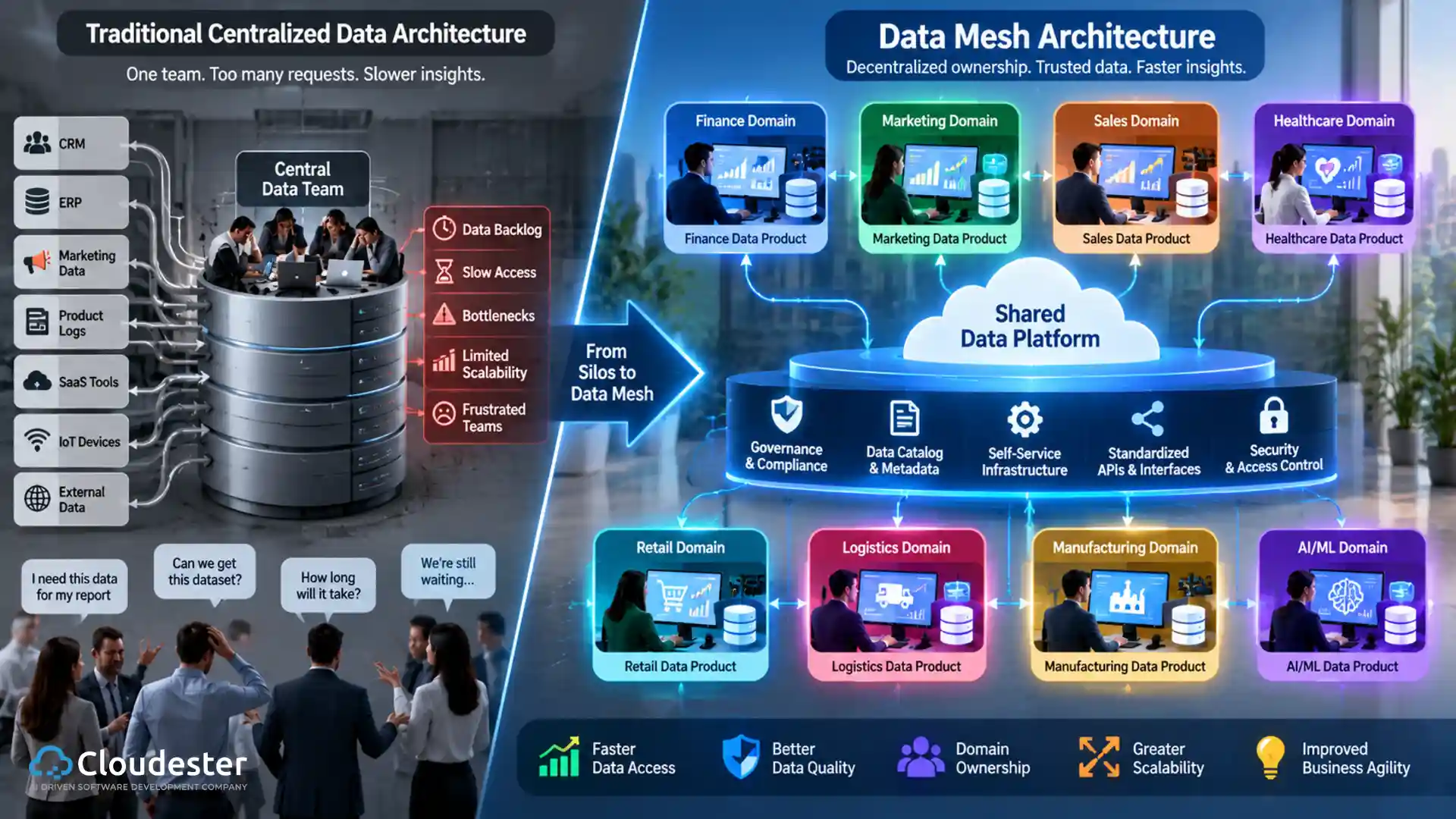
AI Generated. Credit: ChatGPT
Enterprise data has outgrown the systems that were supposed to manage it. A mid-size company today pulls data from CRMs, product logs, marketing platforms, ERP systems, and a dozen SaaS tools nobody quite remembers signing off on, and every one of those sources keeps growing faster than the last.
The central data team that used to handle all of it? Now it’s the reason everyone else is stuck waiting. That’s the problem data mesh architecture was built to solve. Instead of funneling every dataset through one central team and one central platform, data mesh spreads ownership across the business domains that actually understand the data, backed by shared standards so things don’t fall apart the moment nobody’s watching closely.
Netflix and JPMorgan Chase have both adopted some version of this model, and US enterprises are leading global adoption of it overall, according to Fortune Business Insights.
So what is data mesh architecture actually, how does it work, what principles hold it together, and is it worth the trouble for your organization right now?
Let’s get into it.
Data mesh architecture is a decentralized way of managing analytical data. Ownership sits with the business domains that produce the data, not with one central team sitting off to the side.
Zhamak Dehghani, who was Director of Emerging Technologies at Thoughtworks at the time, coined the term in 2018 and described it as a sociotechnical approach to sharing and managing data across large, messy organizations. Sociotechnical is really the key word there.
This is as much about how people work together as it is about the tech stack underneath it.
The old way routes everything into one data lake or warehouse, run by a central engineering team that every other department has to go through for access, cleaning, and modeling. Ask that team for a dataset and congratulations, you’re in line behind everyone else who asked before you.
Data mesh flips that.
Each domain, be it finance, marketing, logistics, whatever fits your org chart, owns its own data pipelines and puts out clean, usable datasets for the rest of the company to just… take.
No middleman required.
Nobody understands a dataset’s quirks better than the team that built it.
They know why a field is sometimes blank, what “active customer” actually means in their system versus what someone in finance assumes it means, and which numbers can actually be trusted.
Hand that same data to a central team with none of that context, and you end up with exactly the kind of quality issues and mismatched definitions data mesh exists to prevent.
Data mesh treats each domain’s output as a “data product.” Built with the same care you’d put into something people actually pay for: documented, easy to find, reliable enough that nobody feels the need to double-check it against three other sources.
Self-service infrastructure is what makes that realistic on a Tuesday afternoon rather than in theory. Domain teams shouldn’t need to book time on a platform engineer’s calendar just to publish or query something.
Four moving parts, really. Domain-oriented data ownership hands each dataset to the team that generates it in the first place. Data as a product means data shows up with documentation, quality guarantees, and an actual owner attached to it, not a raw dump someone forgot to clean up.
Self-service data infrastructure gives domain teams the tools to build and publish on their own, instead of getting in line behind everyone else’s request to a central platform group.
Federated computational governance handles the non-negotiables- security, compliance, naming conventions- while leaving the day-to-day calls to each domain.
Put it all together, and data moves between domains through standardized interfaces, APIs, and shared catalogs, and marketing can grab verified customer data straight from the sales domain without a ticket, an email chain, or a two-week wait for someone to get around to it.
Domain-oriented data ownership means data responsibility maps to business domains, not to IT, full stop.
Data as a product means every dataset gets built and maintained with the discoverability, reliability, and documentation you’d expect from something you’re actually selling, not something you’re just trying to get off your plate.
Self-service data infrastructure is the shared platform piece. It lets any domain provision, publish, and consume data without needing specialized help every single time they want to do something.
And federated computational governance is the balancing act: global policies for security and compliance get enforced automatically, while domains still keep control over their own day-to-day decisions.
Improved data ownership comes first. Business domains become directly accountable for the data they produce, instead of handing it off to IT and moving on with their day.
Data quality tends to get better too, mostly because domain teams feel the pain first when their own data is wrong. That has a way of making people a lot more careful than a central team, three departments removed from the mess, ever was.
Then there’s faster data access. Teams can find and use what they need without sitting behind every other request already stacked up in someone else’s queue.
Scalability improves as well, since ownership is spread out and data management grows alongside the business instead of slamming into a wall the second volume outpaces one overworked team.
Business agility improves for similar reasons. Domains can adjust their own data products the moment something shifts, instead of filing a request and waiting for it to clear somebody else’s backlog.
And bottlenecks shrink, because decentralized ownership takes the central data engineering team out of the critical path for most everyday requests. That’s probably why Technavio’s 2026 research ties early data mesh adoption to a measurable drop in pipeline failures.
Implementation is genuinely complex. Re-architecting how data flows through an entire company isn’t a sprint-sized task, and Gartner still places data mesh in its innovation trigger phase for a reason.
There’s also the organizational and cultural side of it. Domain teams suddenly have to think like data owners, and that usually comes with new responsibilities, new skills, and sometimes headcount nobody budgeted for.
Governance gets harder too. Without firm global standards, decentralization can quickly turn into five teams with five different definitions of “revenue,” none of which match.
Gartner’s 2026 analysis found that only 18% of organizations currently have the governance maturity to pull this off cleanly.
Consistent data quality is another sticking point, since it now depends on dozens of teams instead of one, and inconsistency creeps in domain by domain if nobody’s enforcing a shared bar.
Skills and expertise become a real gap as well. Domain teams need people who understand data engineering basics, not just their own function, and those people aren’t always easy to find or train fast enough.
Technology and integration add up fast. Self-service platforms, catalogs, and interoperable APIs across every domain take serious upfront investment.
Recent market analysis puts full data fabric-plus-mesh hybrid implementations somewhere between $3.5 million and $11.6 million for large enterprises, with ROI often taking two to three years to actually show up.
And then there’s cross-domain dependency, which sounds minor until it isn’t. When domain A’s data product feeds domain B’s report, a quiet schema change in A can break B’s dashboard before anyone realizes the two were ever connected.
Start with clear domain ownership before a single line of infrastructure code gets written. Define data product standards so every team publishes to the same baseline, not whatever they personally think is good enough.
Automate governance instead of leaning on manual review, because federated governance only holds up at scale if the platform is the one enforcing the rules.
Create common data standards for naming, schemas, and metadata so domains can actually understand each other without a translation layer in between. Invest in self-service infrastructure early, since a data mesh without a usable platform just becomes decentralized chaos with extra steps.
Keep monitoring data quality and performance continuously, rather than finding out something broke from an angry message three departments away. And start with one focused pilot domain. Prove the model works there before trying to sell it to everyone else.
| Factor | Data Mesh | Traditional Architecture |
| Data ownership | Domain teams | Central data/IT team |
| Architecture | Distributed, domain-based | Centralized lake or warehouse |
| Governance | Federated, policy-driven | Top-down, manually enforced |
| Scalability | Scales with business domains | Bottlenecks as volume grows |
| Data access | Self-service, near real-time | Ticket-based, often delayed |
| Team responsibilities | Shared across domains | Concentrated in one team |
A data warehouse is built for structured, query-ready reporting data. A data lake holds raw data at any scale, structured or not, as cheaply as possible.
Data mesh isn’t a storage technology at all, and that trips people up more than it should. It’s an operating model for who owns and manages the data, regardless of where it physically sits.
Most large organizations now run some kind of hybrid: a lakehouse or warehouse doing the actual storage, with mesh-style domain ownership layered on top of it.
Kroger’s rollout is a decent real-world example, domain teams owning their own data products while a shared governance layer, built on Databricks Unity Catalog and Alation, keeps everything consistent underneath.
Data mesh tends to earn its keep once a company has genuinely outgrown what a single central team can handle. Before that point, honestly, a warehouse or lake on its own is usually enough.
Enterprise analytics gets a real lift when domains publish trusted, ready-to-use datasets instead of analysts digging through raw tables trying to guess what a column actually means.
Financial services firms, which make up roughly 80% of hybrid mesh-fabric implementations according to recent market research, use it to balance domain-level agility against regulatory pressure that isn’t going anywhere.
Healthcare organizations lean on it to keep patient, claims, and operational data properly siloed for compliance while still sharing insights where it’s actually needed.
Retail and eCommerce companies use domain ownership so merchandising, supply chain, and customer experience teams can move at their own pace instead of a shared one that slows everybody down.
Manufacturing applies it across plant-level and supply-chain domains that rarely overlap cleanly to begin with.
Telecommunications companies manage network, billing, and customer domains separately, at a scale most other industries never really deal with.
And AI and machine learning teams depend on it for a steady supply of well-documented, trustworthy training data, instead of scrambling to clean up whatever a central lake happened to collect along the way.
Start by identifying the business domains that actually generate and consume data at scale, not every team that technically touches a spreadsheet once a quarter.
Define ownership so each domain has a named team accountable for its data, not a vague “we’ll sort it out later.”
Build data products with documentation, access controls, and quality guarantees baked in from day one, instead of bolted on after the complaints start rolling in.
Establish a self-service data platform so domains can publish and consume without constant hand-holding.
Set governance policies that apply globally, with no exceptions carved out for whichever team complains the loudest.
Implement security and access controls consistently, especially anywhere regulated data shows up.
Monitor data quality on an ongoing basis instead of finding out something broke from an angry Slack message.
Then expand domain by domain, using whatever you learned from the last rollout to make the next one faster.
Start small and scale gradually. One or two pilot domains, not the whole company at once. Treat data as a product, complete with an owner, a roadmap, and something resembling a support model.
Define ownership clearly before any technical work even starts. Standardize data interfaces so domains aren’t each building their own one-off connection to everything.
Automate governance wherever you realistically can, instead of hoping someone remembers to check a box.
Prioritize discoverability through a shared catalog, because a data product nobody can find might as well not exist.
Keep monitoring data quality with automated checks rather than the occasional manual audit.
And align technology choices with what the business actually needs, not whatever platform happens to be getting attention this year.
Data mesh tends to make sense once a company has several mature business domains generating real volume, and a central team that’s become an obvious chokepoint everyone’s already complaining about.
It suits organizations with the engineering capacity to build and maintain a self-service platform, plus the organizational appetite for an actual cultural shift, not just a new tool rollout with a training video attached.
A centralized architecture is still the smarter call for smaller companies, or ones with just a handful of data domains where a warehouse and a lean central team hold up fine on their own.
Before adopting data mesh, take a hard look at your data maturity, how many domains you actually have and how complex they are, your governance capacity, and how much scale you genuinely expect to need in the next few years, not the next quarter.
This is exactly the kind of assessment Cloudester Software works through with clients before recommending an architecture, because jumping into data mesh without that groundwork tends to create more problems than it solves.
A decentralized approach to managing analytical data where business domains, not a central IT team, own and publish their own data as products.
Faster data access, better data quality, improved scalability, and fewer bottlenecks caused by routing everything through one central team.
Implementation complexity, the cultural shift required from domain teams, and keeping governance consistent across every domain instead of just some of them.
Domain-oriented ownership, data as a product, self-service infrastructure, and federated computational governance.
By putting accountability directly on the teams closest to the data, who tend to notice and fix quality issues faster than a disconnected central team ever could.
Not really a fair comparison. A warehouse is storage, data mesh is an ownership model, and most large enterprises run both together anyway.
A dataset built and maintained like an actual product, with documentation, a named owner, and reliability guarantees, for whoever ends up using it.
Most enterprise rollouts take 18 to 36 months from the first pilot domain to broader adoption, based on recent implementation research.
Cloud data platforms, catalog tools, and orchestration frameworks tend to show up most, though the specific stack varies a lot depending on what infrastructure a company already has.
Rarely. Small businesses with only a few data domains usually get more out of a well-run centralized warehouse than they would from the overhead of a mesh.
Data mesh architecture offers real advantages: faster data access, stronger domain accountability, a model that grows with the business instead of choking on its own success.
But it comes with real costs too, in governance discipline, engineering investment, and the cultural work of getting domain teams to actually own their data instead of just being told to.
Getting this right takes more than new infrastructure. It takes buy-in at every level that touches data, from the engineers building the platform to the domain leads who now have to care about things they used to be able to ignore.
Before adopting data mesh, businesses should take an honest look at their data maturity, how many domains they’re actually dealing with and how complex those are, their governance readiness, and whether they’re really at the point where a central team can no longer keep up.
Cloudester Software helps organizations work through that evaluation and build the architecture that fits where they actually are, not just wherever the industry trend happens to be pointing this year.





We specialize in creating high-performance web and mobile apps, seamlessly integrating them with your existing systems to enhance user experiences and streamline business operations.
85 Delancey St, New York NY 10002, United States