August 24, 2026
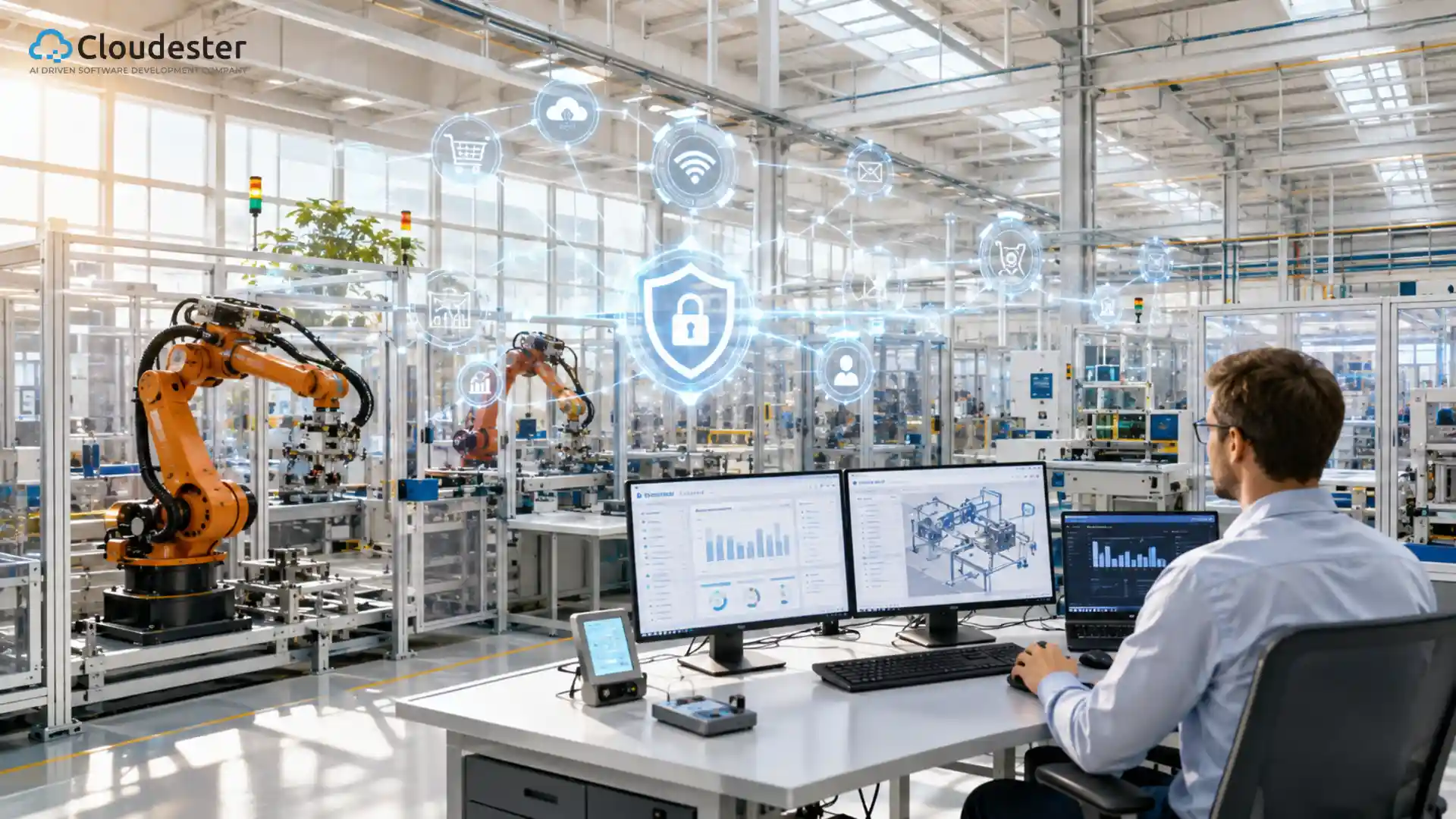
AI Generated. Credit: ChatGPT
Managed IT Services for Manufacturing help factories keep production systems, business applications, networks, devices, and data secure, available, and properly supported. Unlike general IT support, manufacturing-focused services must account for production uptime, operational technology (OT), industrial equipment, remote access, cybersecurity, compliance, and the high cost of unexpected downtime.
A manufacturing company may rely on ERP software for planning, MES platforms for production visibility, barcode systems for inventory, connected machines for real-time monitoring, and cloud applications for collaboration. When these systems work together, IT becomes part of the production process rather than a separate back-office function.
That creates a different IT challenge. A network outage can stop production. A compromised remote-access account can expose an entire plant. An outdated workstation may create a security weakness. Even a routine software update can cause problems if it affects a machine or application that production depends on.
The right managed IT partner therefore needs to understand both business IT and manufacturing operations.
Managed IT Services for Manufacturing are outsourced technology services designed specifically to support manufacturers’ IT infrastructure, cybersecurity, applications, users, networks, and connected production environments. A managed service provider (MSP) continuously monitors, maintains, secures, and supports these systems to improve reliability, reduce risk, and minimize unplanned downtime.
The service can cover corporate IT, plant networks, endpoints, cloud systems, backups, cybersecurity, help desk support, disaster recovery, and selected OT environments.
Manufacturing environments have a wider technology footprint than many traditional offices. Employees may use laptops and cloud applications while production teams depend on PLCs, HMIs, SCADA systems, sensors, industrial PCs, and specialized software.
At the same time, manufacturers often operate multiple facilities, shifts, vendors, and remote connections. That makes consistent IT management difficult without dedicated resources.
Managed IT services can identify problems before they become production disruptions. Monitoring can detect failing hardware, network congestion, storage problems, unusual login activity, backup failures, or system health issues.
For example, imagine a plant where a core network switch begins showing repeated errors during a night shift. A reactive IT team may only discover the problem after production connectivity fails. A proactive MSP can detect the warning signs, investigate the device, and coordinate replacement before the failure affects operations.
The goal is not simply to fix computers faster. The goal is to prevent technology problems from becoming production problems.
Manufacturing managed IT services must balance security and reliability with operational requirements. A patch that is routine for an office laptop may require testing and scheduling when it affects a production workstation or industrial system.
A manufacturing-focused provider should understand:
NIST’s manufacturing cybersecurity guidance specifically addresses environments involving ICS, PLCs, SCADA, DCS, and other industrial technologies. Its newer Manufacturing Profile work also emphasizes areas such as supply-chain risk management, platform security, and technology infrastructure resilience.
The strongest IT services for manufacturers usually combine day-to-day support with proactive infrastructure management and cybersecurity.
Manufacturers cannot always operate on a traditional 9-to-5 schedule. Monitoring should cover critical servers, switches, firewalls, wireless infrastructure, internet connections, endpoints, and other agreed systems.
Alerts allow IT teams to investigate problems before users report them.
Manufacturing companies face risks from phishing, ransomware, stolen credentials, vulnerable devices, insecure remote access, and compromised suppliers.
A managed security program may include:
NIST’s CSF 2.0 provides a risk-management structure that organizations can use to identify, prioritize, and communicate cybersecurity outcomes.
A backup is useful only if it can actually be restored.
Manufacturers should maintain tested backups for critical business systems and establish recovery priorities for applications that affect production, logistics, finance, and customer operations.
A good recovery plan should answer:
Employees need quick assistance with laptops, applications, passwords, printers, connectivity, email, and business software.
A structured help desk gives users a consistent support channel while allowing internal IT leaders to focus on projects, infrastructure, security, and strategic planning.
Manufacturers increasingly use a mix of on-premises infrastructure, private systems, SaaS applications, and public cloud services.
An MSP can help manage identities, Microsoft 365 environments, cloud resources, backups, security policies, and integrations across this hybrid environment.
Old servers, unsupported operating systems, aging network equipment, and unmanaged endpoints increase operational and security risk.
A managed provider can maintain an inventory of:
This creates a clearer technology roadmap and reduces surprise capital expenses.
Cybersecurity in manufacturing cannot stop at office computers. Connected production environments create additional attack surfaces.
For instance, a vendor may need remote access to troubleshoot equipment. If that access remains permanently enabled or uses weak authentication, it can become an entry point for attackers.
A stronger approach uses least privilege, MFA, network segmentation, controlled remote access, logging, monitoring, and documented approval procedures.
IEC 62443 provides a major family of standards and specifications for security in industrial automation and control systems. Its 2025 IEC PAS 62443-2-2 addresses technical, physical, and process security measures for IACS environments.
Managed IT services should complement, not replace, the manufacturer’s engineering and OT teams. Production engineers understand machine behavior and process requirements. IT specialists understand infrastructure and security. The best results come when both teams work from clearly defined responsibilities.
| Benefit | Manufacturing Impact |
|---|---|
| Proactive monitoring | Problems can be identified before major disruption |
| Stronger cybersecurity | Reduces exposure to common cyber threats |
| Faster support | Employees spend less time waiting for technical help |
| Predictable IT costs | Recurring services make budgeting easier |
| Better backup management | Improves recovery readiness |
| Lifecycle planning | Reduces dependence on obsolete technology |
| Remote support | Helps multi-site and shift-based operations |
| Compliance support | Creates stronger documentation and controls |
| Strategic guidance | Connects technology decisions with business goals |
The biggest benefit is often predictability. Manufacturing leaders can plan around known processes instead of repeatedly reacting to emergencies.
The answer depends on the manufacturer’s size, complexity, budget, and internal expertise.
| Area | In-House IT | Managed IT Services |
|---|---|---|
| Direct internal control | High | Shared |
| 24/7 monitoring | Requires additional staffing | Commonly available |
| Specialized expertise | Depends on team size | Available across provider team |
| Cost model | Employee and infrastructure costs | Recurring service cost |
| Scalability | Hiring may be required | Easier to scale |
| Manufacturing expertise | Depends on staff | Must be verified during selection |
| Strategic support | Depends on leadership capacity | Often included in service model |
Many manufacturers use a co-managed IT model. Internal employees retain control over business priorities and plant-specific knowledge while the MSP handles monitoring, help desk, cybersecurity, infrastructure management, or specialized projects.
That model can work particularly well when the internal IT team is capable but overloaded.
Choosing a provider based only on price can create problems later. Manufacturers should evaluate the provider’s technical capabilities, response model, security practices, and understanding of production environments.
Look for an MSP that can clearly explain:
Ask for examples of similar manufacturing environments. A provider that mainly supports professional offices may not understand the operational consequences of changing a production network.
Also review the contract carefully. Confirm what the provider includes, which services qualify as additional projects, how the provider handles emergency support, and which systems the provider does not cover.
Managed IT services are not a substitute for good leadership, documented processes, or reliable equipment.
An MSP cannot eliminate every outage or cyberattack. It also cannot automatically understand every proprietary production system without cooperation from plant engineers and equipment vendors.
Common limitations include:
The solution is a clear operating model. Define responsibilities, escalation paths, maintenance windows, security requirements, and recovery priorities before an incident occurs.
A mature program can be organized into five layers:
This structure keeps everyday support connected to long-term business objectives.
For example, a manufacturer preparing to add a second facility should not wait until construction is complete to think about IT. Network architecture, identity management, cybersecurity, connectivity, equipment integration, backup requirements, and support coverage should all form part of the planning process.
Also read: Smart Manufacturing Execution System for Real-Time Production
Managed IT Services for Manufacturing give manufacturers a structured way to manage technology, cybersecurity, infrastructure, support, and resilience without relying entirely on reactive troubleshooting.
The strongest approach goes beyond keeping computers running. It connects IT operations with production requirements, protects critical systems, improves recovery readiness, and gives leadership clearer visibility into technology risks.
Manufacturing companies should choose providers that understand both enterprise IT and industrial environments. A provider that can work effectively with plant engineers, internal IT teams, security leaders, and equipment vendors can create a much stronger technology foundation.
Managed IT Services for Manufacturing provide ongoing technology management for factories and manufacturing businesses. Services can include help desk support, network monitoring, cybersecurity, cloud management, backups, disaster recovery, endpoint management, and infrastructure maintenance. Manufacturing-focused providers also consider production uptime, OT environments, remote access, and plant-specific technology requirements.
Manufacturers depend on technology across production, inventory, logistics, finance, quality, and customer operations. A technology failure can affect more than employee productivity; it can interrupt production or shipping. Managed services provide proactive monitoring, maintenance, security, and support that help identify and resolve problems before they become larger operational issues.
Services vary by provider, but common offerings include 24/7 monitoring, help desk support, cybersecurity, network management, endpoint protection, cloud management, backup, disaster recovery, asset management, patch management, and strategic IT planning. Manufacturers should also ask how the provider handles OT systems, production networks, vendor access, and maintenance windows.
Yes, but the provider needs appropriate expertise and clearly defined responsibilities. IT systems and OT systems have different operational requirements. An MSP should work closely with plant engineers and equipment vendors before making changes to production environments. Network segmentation, controlled remote access, monitoring, and documented change procedures can help reduce unnecessary operational risk.
Managed services can strengthen cybersecurity through endpoint protection, MFA, vulnerability management, firewall administration, monitoring, identity controls, security awareness, backup protection, and incident response planning. Manufacturers should also address OT-specific risks and use recognized frameworks such as NIST CSF 2.0 where appropriate.
Yes. Smaller manufacturers may benefit because they often cannot maintain specialists for networking, cybersecurity, cloud infrastructure, backups, and support internally. An MSP can provide access to a broader range of expertise without requiring the company to build a large internal technology team.
Ask about manufacturing experience, response times, after-hours support, cybersecurity controls, backup testing, remote access, escalation procedures, documentation, service-level agreements, and OT responsibilities. Also, ask the provider to clearly explain what the monthly service includes and which activities they bill separately as projects.
Not necessarily in every situation. The value depends on the organization’s size, requirements, internal expertise, and service scope. Managed services can make specialized capabilities and after-hours coverage easier to obtain, while larger manufacturers may still need substantial internal IT teams. A co-managed model can combine internal expertise with external specialization.
IT teams should monitor critical systems continuously and conduct broader security, infrastructure, asset, backup, and risk reviews on a defined schedule. Manufacturers should also review their environment after major changes such as facility expansions, new production equipment, acquisitions, significant software deployments, or cybersecurity incidents.
The primary goal is to make technology reliable, secure, recoverable, and aligned with manufacturing operations. That means reducing avoidable downtime, protecting business and production-related systems, supporting employees, maintaining recovery capabilities, and helping leadership make informed technology decisions.

We specialize in creating high-performance web and mobile apps, seamlessly integrating them with your existing systems to enhance user experiences and streamline business operations.
85 Delancey St, New York NY 10002, United States