
What Is the MLOps Lifecycle and Why Does It Matter?
August 19, 2026
By Cloudester Team
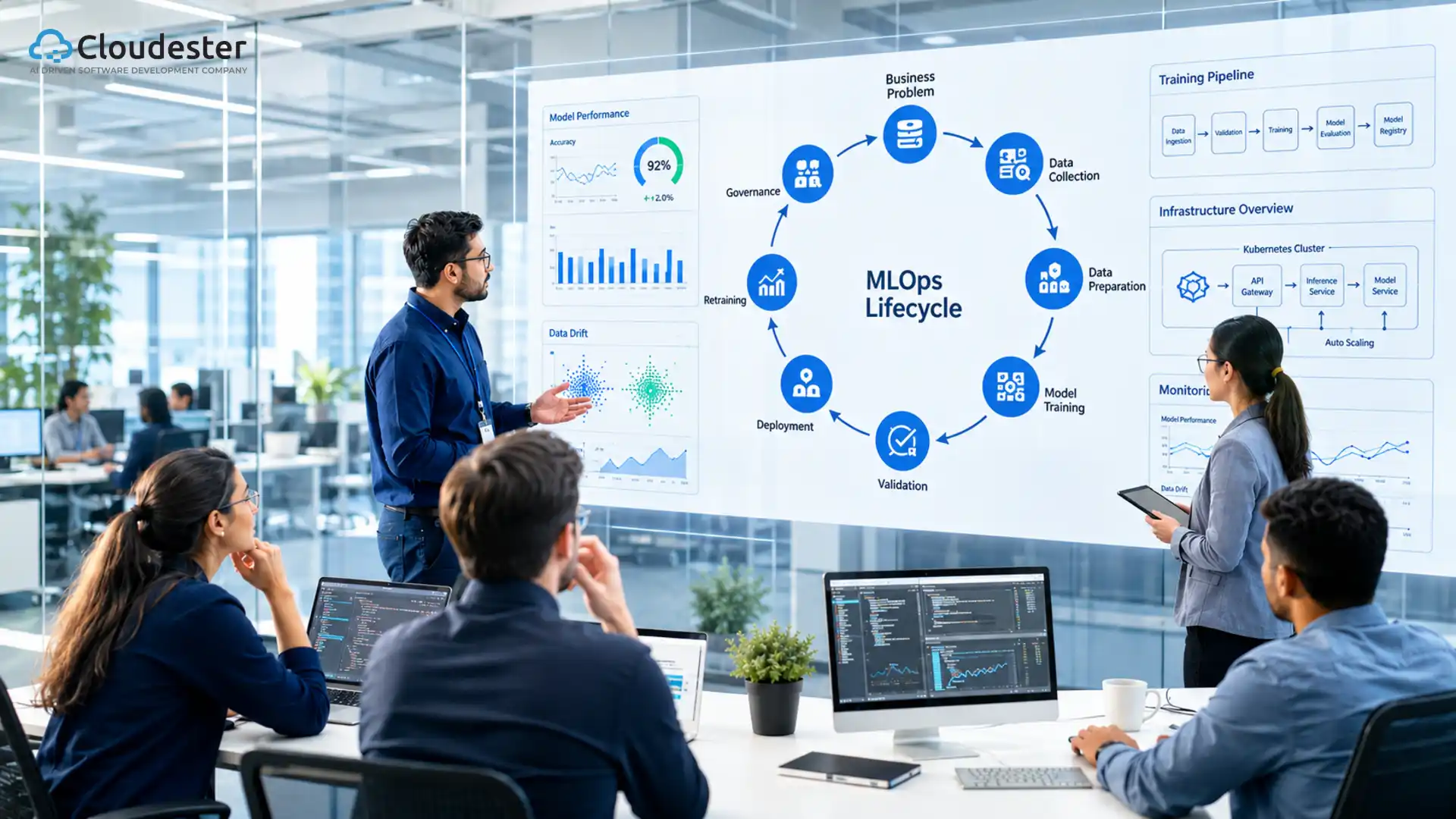
AI Generated. Credit: ChatGPT
In plain terms, the MLOps lifecycle is the set of stages a machine learning model moves through, from the first business question to a model running in production and getting retrained as things change. Most organizations don’t struggle to build a model.
They struggle to keep it working once it’s live, since data shifts and a model that performed well in testing can quietly lose accuracy within months. This article covers what the MLOps lifecycle is, why it matters, what the MLOps workflow looks like stage by stage, the tools teams use, and how to build the practice without drowning in complexity.
What Is the MLOps Lifecycle?
The MLOps lifecycle is the structured process for building, deploying, monitoring, and maintaining machine learning models in production, drawing on practices from software engineering and data operations. It combines ML, DevOps, and DataOps into one continuous loop instead of treating model building as a one-time project that ends at deployment.
DevOps brings the automation and CI/CD discipline. DataOps brings the rigor around data quality. Machine learning brings the actual modeling work. Put together, the goal is simple: models that stay accurate, deploy reliably, and don’t require a fire drill every time something changes upstream.
Why Does the MLOps Lifecycle Matter?
Before getting into the stages themselves, it’s worth understanding why this structure matters in the first place.
Faster model deployment happens when there’s a repeatable process instead of a custom effort every time.
Consistent model performance comes from monitoring and retraining built into the workflow rather than left to chance.
Reduced manual work follows once pipelines are automated instead of run by hand.
Better collaboration happens because data scientists, engineers, and operations teams work from the same process instead of separate silos.
Continuous monitoring catches problems before they become bad business decisions. Easier compliance comes from a documented process auditors can follow.
And lower operational costs show up over time, since fewer manual interventions and failures both save money.
What Are the Stages of the MLOps Lifecycle?
These are the core MLOps lifecycle stages most teams follow, in roughly this order.
1. Business Problem Definition
Every model starts with a clear question worth answering, not a dataset looking for a use.
2. Data Collection
Raw data gets pulled from databases, APIs, and logs into one place.
3. Data Preparation & Feature Engineering
The data gets cleaned and shaped into features a model can learn from.
4. Model Development & Training
Data scientists test approaches and train models against the prepared data.
5. Model Validation & Testing
The model gets checked against metrics that matter for the business problem, not just accuracy on a test set.
6. Model Deployment
The validated model moves into production, usually behind an API or embedded in an application.
7. Continuous Monitoring
Once live, the model’s performance and the incoming data both get watched for signs of trouble.
8. Model Retraining
When performance drops or the data shifts, the model gets retrained on fresh data.
9. Governance & Lifecycle Management
Every version and decision gets tracked, so the process stays auditable and repeatable.
MLOps Lifecycle Workflow

That loop from monitoring back to retraining is the whole point of treating this as a lifecycle instead of a straight line.
What Are the Benefits of Following an MLOps Lifecycle?
Beyond the reasons already covered, a structured MLOps process pays off in outcomes a business feels.
Faster releases mean new models reach users in days instead of months. Higher model reliability keeps predictions trustworthy long after launch. Scalability lets a team run dozens of models without dozens of separate processes.
Better ROI comes from models that keep performing instead of quietly decaying.
Reduced downtime follows from monitoring that catches issues before they become outages. And improved collaboration keeps everyone working off the same playbook.
MLOps Lifecycle vs Traditional Machine Learning Lifecycle
| Aspect | Traditional ML Lifecycle | MLOps Lifecycle |
| Deployment | Manual, one-off | Automated and repeatable |
| Monitoring | Rare or after the fact | Continuous, built into the process |
| Collaboration | Siloed between teams | Shared workflow across roles |
| Retraining | Ad hoc, when someone notices a problem | Scheduled or triggered |
| Scalability | Hard to manage past a few models | Built to handle many models at once |
| Governance | Minimal documentation | Versioned, auditable, and tracked |
The traditional approach treats a model like a project that ships once. The MLOps lifecycle treats it like a product that needs ongoing care, closer to how models actually behave in the real world.
Popular Tools Used Across the MLOps Lifecycle
| Lifecycle Stage | Popular Tools |
| Data Versioning | DVC |
| Experiment Tracking | MLflow |
| Pipelines | Kubeflow |
| Deploymen | Docker, Kubernetes |
| Monitoring | Evidently AI, Arize AI |
| Feature Store | Feast |
No single MLOps architecture uses every one of these MLOps tools. Most teams pick one or two per stage based on their existing infrastructure and stitch them together into a pipeline that fits how they already work.
Custom AI Software Development Solution For Enterprises
Best Practices for Building an Effective MLOps Lifecycle
A few habits separate teams that run this well from teams that struggle.
- Automate pipelines instead of running steps by hand, since manual work is where mistakes creep in.
- Version everything- code, data, and models- so any result can be traced back to what produced it.
- Implement CI/CD the way software teams do, so changes move through testing before reaching production.
- Monitor data drift, since production data often looks different from what a model was trained on.
- Monitor concept drift too, since the relationship between inputs and outcomes can shift even when the data looks normal.
- Secure deployments with proper access controls, since a model endpoint is still an attack surface.
- Standardize documentation so a new team member can understand a pipeline without help.
- Schedule retraining rather than waiting for a visible failure to trigger it.
Common Challenges in the MLOps Lifecycle
Even solid MLOps best practices run into friction.
- Poor data quality is the most common culprit behind a model that underperforms in production.
- Model drift shows up quietly, as slow performance decay that’s easy to miss without monitoring.
- Scaling gets harder as the number of models grows past what a small team can track manually.
- Compliance adds overhead in regulated industries where every decision needs an audit trail.
- Infrastructure complexity piles up fast when pipelines and tools don’t talk to each other cleanly.
- Monitoring production models means watching both the output and the data feeding it, continuously.
How Cloudester Can Help Implement an MLOps Lifecycle
Building this out from scratch is a lot to take on alongside everything else a team is already doing.
That’s where an experienced partner helps, handling MLOps consulting to map out a lifecycle that fits your existing stack, then managing the harder parts: pipeline automation, AI deployment, model monitoring, and infrastructure management.
Frequently Asked Questions
What is the MLOps lifecycle?
The full process a machine learning model goes through, from defining the business problem to deployment, monitoring, and retraining, using practices borrowed from DevOps and DataOps.
Why is the MLOps lifecycle important?
Without it, models tend to degrade quietly in production, and teams end up firefighting issues a structured process would have caught early.
What are the stages of the MLOps lifecycle?
Business problem definition, data collection, data preparation, model development, validation, deployment, monitoring, retraining, and governance.
What tools are used in MLOps?
Common ones include DVC for data versioning, MLflow for experiment tracking, Kubeflow for pipelines, Docker and Kubernetes for deployment, and Evidently AI for monitoring.
How is MLOps different from DevOps?
DevOps focuses on software releases. MLOps applies similar automation to machine learning, but adds data versioning, model monitoring, and retraining, which DevOps doesn’t need to handle.
How often should a model be retrained?
It depends on how fast the data changes, but most teams schedule retraining on a set interval or trigger it when monitoring detects drift.
What is model drift?
When a model’s predictions become less accurate over time because the real-world data no longer matches what it was trained on.
Does every company need a full MLOps pipeline?
Not necessarily. Smaller teams with one or two models can often get by with a lighter process, but the value grows fast as models multiply.
Can MLOps reduce costs?
Yes. Fewer manual interventions and fewer production failures both cut down on the hidden costs of running models without structure.
Is MLOps only for large enterprises?
No. Smaller teams benefit too, especially once they’re running more than one model and need a repeatable model deployment lifecycle instead of custom work each time.
Conclusion
The MLOps lifecycle isn’t just a framework for large tech companies. It’s the difference between a model that works well in a demo and one that keeps working reliably months after launch.
Getting the stages right, from problem definition through monitoring and retraining, turns machine learning from a one-off project into something a business can actually depend on.
Teams that adopt a structured approach early save themselves the harder work of untangling a messy process later.
If your organization is ready to build this out properly, working with a partner like AI development company Cloudester Software can help turn that structure into something your team can run day-to-day.
Back
Latest posts




July 30, 2026