How Are Agentic AI Workflows Reshaping Modern Web Development?
April 08, 2026
By Cloudester Team
AI Generated. Credit: Google Gemini
Agentic AI workflows are quietly changing the way we build for the web, and not in a small way. This is not just another upgrade from autocomplete to better autocomplete. It is a shift in how development actually happens, especially as AI in web development 2026 continues to evolve.
A couple of years ago, using AI meant asking it to write a function, maybe fix a bug, or help you understand documentation. Now, we are doing something very different. We are giving AI a goal and letting it figure out the rest.
That is essentially what agentic AI workflows are. Instead of waiting for constant instructions, the AI sets out to complete a task on its own. It writes code, runs it, checks what broke, fixes it, and tries again until it works.
Because of this, developers are starting to look less like coders and more like system designers. Agentic AI workflows are not just improving speed; they are redefining how development responsibility is handled.
The Shift from Generative AI to Agentic AI
If you have used AI tools before, you already know the old pattern.
You ask for something.
It gives you an answer.
You refine the prompt.
Repeat.
It works, but it is slow and, honestly, a bit tiring.
Traditional tools needed constant direction. Building something even slightly complex meant breaking it into steps. First HTML, then styling, then logic, then debugging. You were still doing most of the thinking.
This is where agentic AI workflows change everything.
Now you can say something like, build a dashboard that pulls user data from an API and shows trends, and the AI does not stop at generating a snippet. It continues working until the task is complete.
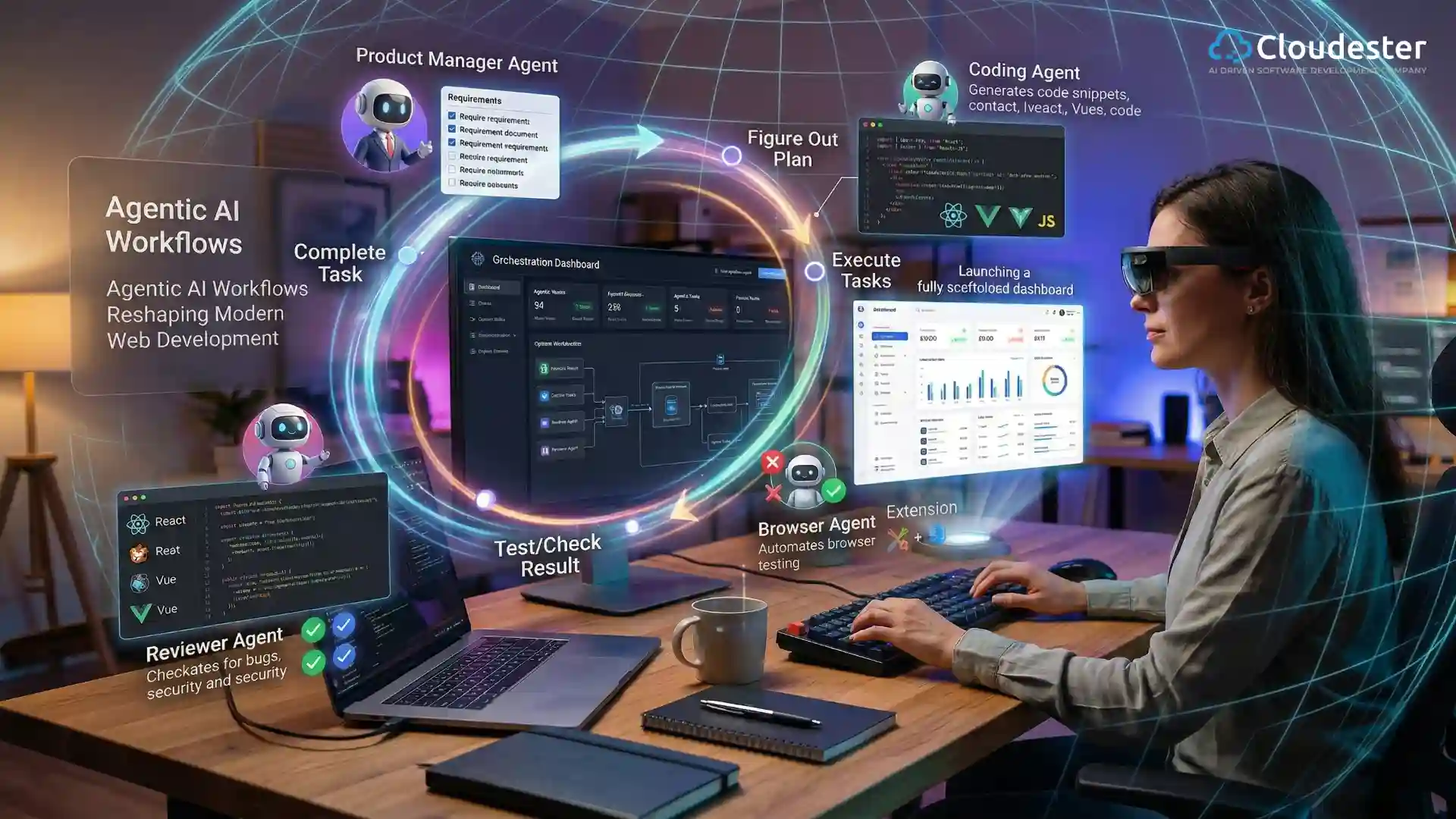
At the core of agentic AI workflows is a simple loop. The system understands what needs to be done, figures out how to do it, executes the task, checks the result, and fixes it if something fails.
One of the biggest reasons this works today is tool access. These systems are no longer limited to a chat interface. They can open terminals, run scripts, start servers, and fetch updated documentation. This is what makes autonomous AI coding feel practical and not just experimental.
It is not perfect, but it is reliable enough to be useful in real development environments.
Real World Applications in Modern Web Development
This is no longer theoretical. Agentic AI workflows are already being used in real projects and day-to-day development.
Automating Browser Tools
Take something like building a Chrome extension.
Earlier, you would manually set up files, permissions, scripts, and UI, then debug when something broke. Now, with agentic AI workflows, an AI agent can handle most of that process.
It can create the structure, write the logic, test permissions, and resolve errors as they appear. You are not controlling every step anymore. You are reviewing and guiding the output.
This significantly reduces development time and mental load.
Dynamic Content and UI Scaffolding
With automated web scaffolding, AI can generate complete page structures before you even start working on them.
This includes layout creation, component structuring, and even integrating real-time data. Agentic AI workflows make it possible to go from idea to functional interface much faster.
For example, an agent can fetch live data from an API, organize it into a clean layout, apply responsive design, and structure reusable components.
You are no longer starting from zero. You are refining something that already exists.
Continuous Testing and QA
Testing has always been important, but often ignored due to time constraints.
With agentic AI workflows, software testing can run continuously in the background. If a test fails, the AI does not just report the issue. It tries to fix it.
It reads the error, updates the code, and runs the test again. This loop continues until the issue is resolved.
Over time, this creates a system that improves itself. Teams at Cloudester Software are already exploring how these workflows can make development faster while maintaining stability and quality.
Multi-Agent Systems in the Dev Environment
Another major shift is the rise of multi-agent systems.
Instead of one AI trying to handle everything, multiple agents work together, each with a specific role. This makes agentic AI workflows more efficient and structured.
The Virtual Development Team
In a multi-agent setup, you might have:
- A product manager agent who breaks down requirements
- A coding agent that builds components using frameworks like React or Vue
- A reviewer agent that checks for bugs, performance issues, and security concerns
These agents collaborate, pass tasks, and refine outputs. It feels very similar to how real development teams operate.
Tools Making This Possible
Several frameworks are enabling this approach:
- AutoGen
- CrewAI
- LangGraph
These tools are making agentic AI workflows more accessible to everyday developers. You do not need to be an AI expert to start using them.
When multiple agents work together, development becomes faster, more organized, and easier to scale.
The Developer’s New Role: Overseer and Architect
There is a common fear that AI will replace developers. That is not what is happening.
If anything, agentic AI workflows are making the developer’s role more important.
These systems can still make mistakes. They can lose context, create inefficient structures, or make decisions that do not scale well.
That is where human input matters.
The Human in the Loop
Developers are still responsible for reviewing outputs, guiding direction, and correcting mistakes. AI can move fast, but it does not always move correctly.
Strategic Oversight
With agentic AI workflows, developers now focus more on designing systems than writing every line of code.
This includes defining workflows, writing better prompts, setting boundaries for security, and managing how different agents interact with each other.
A Shift in Skillset
Coding syntax is still useful, but it is no longer the main differentiator.
What matters more is understanding systems, thinking logically, and knowing how different tools connect. Developers are becoming architects of intelligent systems rather than just code writers.
Companies like Cloudester Software are already adapting to this shift, integrating agentic AI workflows into their development processes to stay ahead.
Also read: How AI Agents Are Transforming Modern Web Applications
Conclusion
Agentic AI workflows are not something we are waiting for in the future. They are already here and actively reshaping modern web development. From autonomous AI coding to multi-agent systems and automated web scaffolding, the way we build is changing fast.
The real question is not whether this shift will happen. It is whether you are ready to work with it.
Back
Latest posts

March 25, 2026