
September 16, 2026
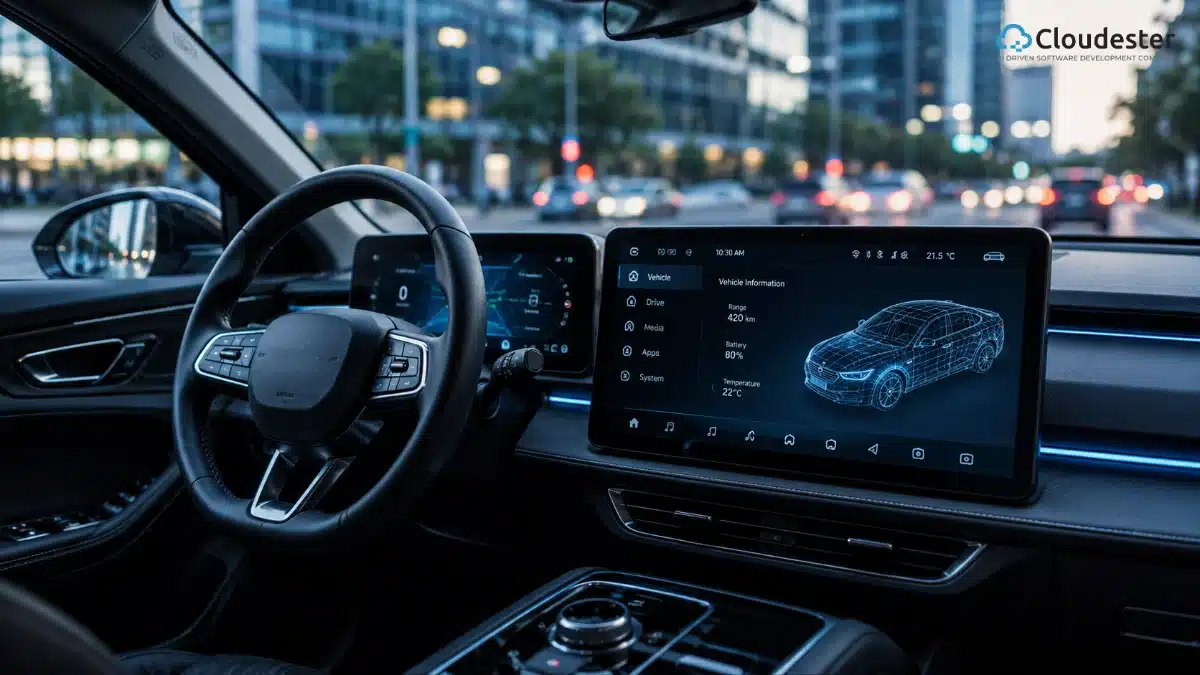
AI Generated. Credit: ChatGPT
Software development for automotive is transforming the way vehicles are designed, manufactured, and operated. The automotive industry is undergoing one of the most significant technological shifts in its history, with software becoming the foundation of connected vehicles, electric mobility, advanced driver assistance systems (ADAS), and autonomous driving technologies. As vehicles become increasingly intelligent, automotive software plays a critical role in enhancing safety, performance, efficiency, and user experience.
Modern vehicles contain millions of lines of code that control everything from engine performance and battery management to infotainment systems and driver assistance technologies. As a result, software development for automotive has become a critical investment area for manufacturers, suppliers, and mobility startups worldwide.
Whether it’s an electric vehicle, a connected car, or a software-defined vehicle, software now plays a central role in shaping the driving experience. Automotive companies are increasingly partnering with specialized development teams to create intelligent, secure, and scalable solutions that meet evolving consumer expectations and industry regulations.
In this blog, we’ll explore how automotive software development works, the different types of software used in vehicles, and why software is becoming the backbone of modern mobility.
Software development for automotive refers to the process of designing, building, testing, deploying, and maintaining software applications and embedded systems used in vehicles and transportation ecosystems.
Unlike traditional software projects, automotive software must operate reliably in real-time environments where safety, performance, and compliance are critical. A minor software defect can impact vehicle functionality, driver safety, or regulatory compliance, making quality assurance and validation essential throughout the development lifecycle.
Automotive software powers numerous vehicle systems, including:
As vehicles become increasingly digital, the demand for automotive software development services continues to grow across the global automotive ecosystem.
Historically, vehicle manufacturers focused primarily on mechanical innovation. Today, competitive advantage is increasingly determined by software capabilities.
Consumers expect vehicles to deliver experiences similar to smartphones and connected devices. Features such as voice assistants, real-time navigation, smartphone integration, remote diagnostics, and personalized user experiences are now standard expectations.
Several factors are accelerating the demand for automotive software:
Connected vehicles communicate with cloud platforms, mobile applications, infrastructure systems, and other vehicles in real time. These capabilities enable:
Organizations investing in connected car software development are creating safer and more intelligent transportation ecosystems.
Electric vehicles rely heavily on software to optimize battery performance, monitor charging systems, manage energy consumption, and maximize driving range.
Advanced software algorithms continuously analyze battery health and performance data, helping manufacturers improve efficiency while enhancing the ownership experience.
The rapid expansion of the EV market has increased demand for EV software development and intelligent battery management solutions.
Self-driving technologies depend on sophisticated software systems that process data from cameras, sensors, LiDAR, radar, and onboard computing platforms.
These systems must make complex decisions within milliseconds while ensuring safety and reliability under various driving conditions.
This growing market has fueled significant investments in ADAS software development and autonomous vehicle technologies.
The automotive industry is transitioning toward software-defined vehicles, where software capabilities determine functionality, user experience, and future upgrades.
Instead of requiring hardware replacements, manufacturers can introduce new features through software updates, creating opportunities for continuous innovation and recurring revenue streams.
The emergence of software-defined vehicle development is reshaping how vehicles are designed, manufactured, and maintained.
Automotive software encompasses a broad range of technologies that serve different functions within a vehicle ecosystem.
Embedded software operates directly within vehicle hardware systems. It manages essential vehicle functions and communicates with sensors, actuators, and control units.
Examples include:
Automotive embedded software development requires expertise in real-time operating systems, hardware integration, and safety-critical programming.
Infotainment platforms enhance the in-vehicle experience by providing entertainment, navigation, communication, and connectivity features.
Common functionalities include:
Automotive manufacturers increasingly prioritize intuitive infotainment experiences to improve customer satisfaction and brand loyalty.
Telematics solutions collect, transmit, and analyze vehicle data using wireless communication technologies.
Applications include:
Telematics systems play a critical role in modern mobility ecosystems by enabling data-driven decision-making.
ADAS technologies help drivers avoid accidents and improve road safety.
Common ADAS features include:
These systems rely on artificial intelligence, computer vision, and sensor fusion technologies to operate effectively.
Battery management systems are essential components of electric vehicles. They monitor battery performance, temperature, charging cycles, and overall health.
Effective battery software helps:
The growing adoption of electric vehicles has made battery software a major area of innovation within the automotive industry.
Investing in modern automotive software delivers significant advantages for manufacturers, suppliers, fleet operators, and end users.
Software enables proactive safety measures through intelligent monitoring, predictive analysis, and automated responses. Features such as collision avoidance and emergency braking can significantly reduce accident risks.
Today’s drivers expect personalized and connected experiences. Software makes it possible to deliver seamless navigation, entertainment, communication, and remote access capabilities.
Automotive software streamlines maintenance processes, optimizes vehicle performance, and reduces downtime through predictive analytics and remote diagnostics.
Manufacturers can deploy new features through software updates rather than hardware replacements, reducing costs while accelerating innovation cycles.
Vehicle-generated data provides valuable insights that support product improvements, customer engagement strategies, and operational optimization initiatives.
For decades, vehicle performance was largely determined by mechanical engineering excellence. While hardware remains important, software is now becoming the primary differentiator in the automotive market.
Leading manufacturers are investing heavily in automotive software solutions that enable smarter, safer, and more connected mobility experiences.
The shift toward software-defined vehicles represents a fundamental change in how vehicles are developed and maintained. Future vehicles will increasingly rely on software updates, artificial intelligence, cloud connectivity, and data-driven services to deliver ongoing value throughout their lifecycle.
This transformation is creating enormous opportunities for organizations seeking to innovate within the automotive industry while meeting the growing demands of consumers and regulatory authorities.
In the next section, we’ll explore the architecture, technologies, frameworks, and development methodologies that power modern automotive software systems.
Modern vehicles are powered by highly sophisticated software architectures that integrate embedded systems, cloud platforms, sensors, communication networks, and intelligent applications. Unlike traditional software environments, automotive systems must operate under strict performance, safety, and reliability requirements.
As vehicles evolve into connected and software-defined platforms, automotive software architecture has become a critical foundation for innovation, scalability, and regulatory compliance.
Organizations investing in automotive software architecture gain the flexibility needed to support future technologies, over-the-air updates, advanced driver assistance systems, and autonomous driving capabilities.
An Electronic Control Unit (ECU) is a specialized embedded computer responsible for managing specific vehicle functions.
Modern vehicles may contain anywhere from 50 to over 150 ECUs controlling different systems throughout the vehicle.
Common ECU applications include:
Each ECU processes data from sensors and communicates with other control units to ensure coordinated vehicle operation.
Traditional automotive architectures rely on numerous distributed ECUs. However, modern vehicle manufacturers are increasingly adopting domain-based architectures.
In this model, related functions are consolidated into centralized domains, reducing hardware complexity while improving software scalability.
Typical domains include:
This approach simplifies maintenance and enables more efficient software deployment strategies.
Many next-generation vehicles are moving toward centralized computing architectures where high-performance processors manage multiple vehicle functions.
Benefits include:
This architecture is becoming a key component of software-defined vehicle development.
AUTOSAR (Automotive Open System Architecture) is one of the most widely adopted software frameworks in the automotive industry.
It provides a standardized architecture that allows software components to operate independently of underlying hardware platforms.
Without standardization, automotive software development becomes increasingly complex as manufacturers integrate components from multiple suppliers.
AUTOSAR helps solve this challenge by providing:
Today, AUTOSAR plays a major role in modern automotive embedded software development projects.
AUTOSAR architecture consists of several layers that separate application logic from hardware-specific implementations.
This layered approach improves portability and simplifies software maintenance throughout the vehicle lifecycle.
The automotive industry utilizes a diverse technology stack to support embedded systems, connectivity, cloud integration, artificial intelligence, and real-time processing.
C and C++ remain the dominant programming languages for automotive software due to their performance, reliability, and hardware-level control.
These languages are commonly used for:
Python is increasingly used for:
Its flexibility makes it valuable for automotive AI initiatives.
As cybersecurity concerns continue to grow, Rust is gaining popularity because of its memory safety capabilities and secure coding practices.
Many experts view Rust as an important technology for future automotive software systems.
Embedded Linux powers many modern infotainment and connectivity platforms.
Advantages include:
Automotive applications often require deterministic responses within strict timing constraints.
RTOS platforms provide predictable execution and are commonly used in:
Automotive software depends on reliable communication between sensors, ECUs, actuators, and cloud platforms.
Controller Area Network (CAN) remains one of the most widely used communication protocols in vehicles. It enables efficient data exchange between ECUs while maintaining reliability under demanding operating conditions.
Local Interconnect Network (LIN) supports lower-cost applications such as:
As vehicles generate increasing amounts of data, Automotive Ethernet is becoming essential for high-bandwidth applications.
It supports:
Vehicle-to-Everything (V2X) technology enables communication between vehicles, infrastructure, pedestrians, and cloud systems.
This technology is expected to play a significant role in future intelligent transportation systems.
Developing software for vehicles requires a structured and highly disciplined methodology that prioritizes safety, reliability, and regulatory compliance.
The process begins by gathering functional, technical, regulatory, and business requirements.
Teams identify:
Engineers design the software architecture, hardware integration strategy, communication interfaces, and system components.
This stage establishes the foundation for future scalability and maintainability.
Developers implement application logic, control algorithms, communication protocols, and user-facing features. Automotive projects often utilize agile methodologies while maintaining compliance with industry standards.
Individual software modules are integrated and tested to ensure seamless interaction across systems. This stage identifies compatibility issues before full deployment.
Extensive testing confirms that the software behaves correctly under both normal and abnormal operating conditions.
Validation activities include:
Once validated, software is deployed into production vehicles. Manufacturers continue monitoring performance and releasing updates through over-the-air mechanisms.
Cloud computing is becoming a vital component of modern automotive ecosystems.
Leading organizations increasingly invest in custom automotive software development solutions that combine embedded systems with cloud-native architectures.
This integration helps automotive businesses deliver scalable digital experiences while supporting continuous software innovation.
The future of mobility depends on robust software architectures capable of supporting autonomous driving, electrification, connectivity, artificial intelligence, and cybersecurity.
Companies that build scalable foundations today will be better positioned to adapt to future technological advancements and changing customer expectations.
Whether developing connected vehicles, advanced driver assistance systems, or electric mobility platforms, investing in modern automotive software engineering practices is essential for long-term success.
In the next section, we’ll explore automotive software testing, ISO 26262 compliance, ASPICE requirements, cybersecurity frameworks, and how AI is transforming the future of vehicle software development.
Testing is one of the most critical phases in software development for automotive. Unlike traditional software applications, automotive systems operate in safety-critical environments where even minor software defects can lead to significant safety, operational, and financial consequences.
To ensure reliability, automotive software undergoes extensive testing and validation throughout the development lifecycle. Manufacturers must verify that every software component performs consistently under various real-world conditions while meeting strict regulatory requirements.
Modern vehicles rely on software to manage essential functions such as steering, braking, acceleration, battery management, navigation, and driver assistance systems.
Testing helps organizations:
As software complexity increases, testing strategies must evolve to address millions of lines of code operating across interconnected vehicle systems.
Unit testing validates individual software modules before integration with larger systems. Developers test specific functions, algorithms, and code segments to verify expected behavior and identify defects early in the development process.
Benefits include:
Automotive software consists of multiple interconnected modules that must communicate seamlessly. Integration testing ensures that software components interact correctly with:
This phase helps identify compatibility issues before deployment.
System testing evaluates complete vehicle software systems under realistic operating conditions. Engineers verify that integrated components function together as intended while meeting performance and safety requirements.
HIL testing is widely used in automotive software testing environments. This method simulates real vehicle hardware while testing software in a controlled environment.
Benefits include:
SIL testing evaluates software algorithms using virtual simulations before deployment on actual hardware. It enables teams to validate software behavior while accelerating development cycles.
Every software update introduces the possibility of unintended side effects. Regression testing ensures that new features or bug fixes do not negatively impact existing functionality.
This process is particularly important for vehicles receiving frequent over-the-air software updates.
Functional safety is a cornerstone of modern automotive software development services. It focuses on preventing system failures that could result in hazardous situations.
Manufacturers must implement rigorous safety processes to ensure that software-controlled vehicle functions operate reliably under all expected conditions.
Functional safety refers to the ability of a system to detect faults and respond appropriately to maintain safe operation.
Examples include:
These systems must continue operating safely even when hardware or software failures occur.
ISO 26262 is the most widely recognized international standard for functional safety in road vehicles. It provides a framework for managing risks associated with electrical and electronic systems throughout the vehicle lifecycle.
Organizations investing in ISO 26262 software development demonstrate their commitment to vehicle safety and regulatory compliance.
ISO 26262 categorizes risks using Automotive Safety Integrity Levels (ASIL).
The levels range from:
Higher ASIL classifications require stricter development and testing procedures.
Automotive SPICE (ASPICE) is a process assessment model used throughout the automotive industry to evaluate software development maturity.
Many manufacturers require suppliers to comply with ASPICE standards before awarding contracts.
ASPICE has become a major differentiator for organizations providing automotive software solutions to global manufacturers.
As vehicles become increasingly connected, cybersecurity has emerged as one of the industry’s most significant challenges.
Modern vehicles exchange vast amounts of data through cloud platforms, mobile applications, wireless networks, and connected infrastructure.
Without proper security controls, these systems can become targets for cyberattacks.
Investing in automotive cybersecurity is now essential for maintaining customer trust and regulatory compliance.
The UNECE WP.29 cybersecurity regulation requires automotive manufacturers to establish cybersecurity management systems throughout vehicle development and operation.
This regulation has accelerated the adoption of advanced security practices across the automotive industry.
Artificial intelligence is transforming how vehicles operate, interact, and learn from their environments.
From advanced driver assistance systems to predictive maintenance, AI is enabling smarter, safer, and more efficient mobility solutions.
ADAS technologies use AI algorithms to analyze sensor data and assist drivers in real time.
Popular ADAS features include:
The growing demand for ADAS software development continues to drive innovation throughout the automotive sector.
Computer vision enables vehicles to interpret visual information captured by onboard cameras.
Applications include:
These capabilities are essential for both advanced safety systems and autonomous vehicles.
AI-powered driver monitoring solutions help identify signs of distraction, fatigue, or impairment. When risks are detected, the system can provide alerts or initiate corrective actions.
Such technologies are becoming increasingly important as governments prioritize road safety initiatives.
AI algorithms analyze vehicle performance data to identify potential issues before failures occur.
Benefits include:
Predictive maintenance is particularly valuable for commercial fleet operators and mobility service providers.
Artificial intelligence can optimize navigation by analyzing:
This improves fuel efficiency, reduces travel time, and enhances the overall driving experience.
Machine learning allows automotive systems to continuously improve through data analysis and pattern recognition.
Applications include:
As connected vehicles generate increasing amounts of data, machine learning will play an even larger role in shaping future mobility solutions.
The future of software development for automotive will be shaped by two critical factors: compliance and intelligence.
Manufacturers must balance innovation with strict safety, quality, and cybersecurity requirements while integrating advanced AI capabilities that enhance vehicle performance and user experiences.
Organizations that successfully combine compliance expertise with cutting-edge artificial intelligence technologies will be best positioned to lead the next generation of automotive innovation.
In the next section, we’ll explore automotive software development costs, implementation challenges, emerging trends, software-defined vehicles, and how businesses can choose the right automotive software development partner.
One of the most common questions businesses ask is: How much does automotive software development cost?
The answer depends on multiple factors, including project complexity, software functionality, regulatory requirements, hardware integration, cybersecurity needs, and testing requirements.
Unlike conventional software applications, automotive solutions often require compliance with strict industry standards and extensive validation processes, which can significantly impact project costs.
A simple telematics application will require considerably fewer resources than an advanced autonomous driving platform.
The more complex the system, the greater the investment required for development, testing, and long-term maintenance.
Projects requiring ISO 26262, ASPICE, and cybersecurity compliance involve additional planning, documentation, audits, and validation efforts.
These requirements increase development costs but are essential for ensuring safety and regulatory approval.
Automotive software frequently interacts with sensors, ECUs, cameras, radar systems, LiDAR devices, and battery management platforms.
Hardware integration introduces additional complexity that influences project budgets.
Automotive software testing often represents a significant portion of the overall project cost.
Organizations must perform:
| Solution Type | Estimated Cost Range |
|---|---|
| Telematics Platform | $40,000 – $150,000+ |
| Fleet Management Software | $50,000 – $250,000+ |
| Infotainment Platform | $80,000 – $300,000+ |
| Battery Management System | $100,000 – $500,000+ |
| ADAS Solution | $250,000 – $2M+ |
| Autonomous Driving Software | $1M – $50M+ |
Businesses seeking custom automotive software development should consider long-term scalability, maintenance, and update requirements when evaluating project budgets.
As vehicles become more intelligent and connected, automotive software development continues to grow in complexity.
Organizations face numerous technical, operational, and regulatory challenges throughout the development lifecycle.
Modern vehicles contain millions of lines of code distributed across multiple systems. Managing software complexity while maintaining reliability remains one of the industry’s greatest challenges.
Safety-critical systems require extensive validation and verification. Manufacturers must ensure that software behaves predictably under all operating conditions.
Connected vehicles introduce new attack surfaces that must be protected from malicious actors. Robust automotive cybersecurity strategies are essential for safeguarding vehicles and customer data.
Automotive technology evolves rapidly, requiring organizations to continuously adapt to new platforms, frameworks, regulations, and customer expectations.
The demand for skilled automotive software engineers continues to exceed supply. Companies often struggle to recruit professionals with expertise in:
The automotive industry is moving toward a future where software becomes the primary driver of vehicle functionality.
These vehicles are known as Software-Defined Vehicles (SDVs).
In traditional vehicles, hardware largely determines functionality. In contrast, SDVs rely on software to deliver features, updates, and new capabilities throughout the vehicle lifecycle.
Organizations investing in software-defined vehicle development are helping shape the future of intelligent transportation.
The automotive industry continues to evolve rapidly as manufacturers embrace new technologies and business models.
AI will continue driving innovation across:
OTA technology enables manufacturers to deploy software improvements without requiring dealership visits. This capability reduces maintenance costs while accelerating innovation cycles.
V2X technologies will improve traffic management, road safety, and transportation efficiency through real-time communication between vehicles and infrastructure.
Edge computing allows vehicles to process data locally, reducing latency and improving response times for safety-critical applications.
Digital twin technology creates virtual representations of vehicles and systems, enabling simulation, optimization, and predictive maintenance.
Many experts view digital twins as a key innovation within future automotive software solutions.
Selecting the right development partner can significantly impact project success.
Organizations should evaluate potential vendors based on technical expertise, industry experience, compliance knowledge, and long-term support capabilities.
Choose a company with proven experience delivering automotive software projects across multiple vehicle systems and technologies.
The ideal partner should understand:
Look for expertise in:
Automotive software requires ongoing maintenance, security updates, and feature enhancements. Your development partner should be capable of supporting long-term product evolution.
Software has become a strategic differentiator within the automotive industry. Manufacturers, suppliers, and mobility providers invest in software to:
As the automotive landscape becomes increasingly digital, software will continue to influence how vehicles are designed, manufactured, sold, and maintained.
Software development for automotive has become the driving force behind innovation in today’s automotive industry. From connected vehicles and advanced driver assistance systems (ADAS) to electric mobility platforms and software-defined vehicles, software now powers nearly every aspect of the modern driving experience.
As consumer expectations evolve and regulatory requirements become more stringent, automotive companies must invest in scalable, secure, and future-ready software solutions. Organizations that embrace emerging technologies such as artificial intelligence, cloud computing, V2X communication, and predictive analytics will be better positioned to improve safety, enhance user experiences, accelerate innovation, and maintain a competitive advantage.
The future of mobility will be defined by intelligent software ecosystems that seamlessly connect vehicles, infrastructure, drivers, and data. Businesses that prioritize innovation today will lead the next generation of automotive transformation.
Ready to build the next generation of automotive software? Partner with Cloudester to develop intelligent, secure, and future-ready automotive solutions. Our team combines expertise in embedded systems, AI, cloud technologies, vehicle connectivity, and automotive compliance standards to help organizations accelerate innovation and reduce time-to-market.
Schedule a consultation with Cloudester today and explore how our automotive software development services can help transform your mobility vision into reality.
Software development for automotive refers to designing, developing, testing, and maintaining software systems used in vehicles, including embedded systems, ADAS platforms, infotainment systems, telematics solutions, and electric vehicle technologies.
C, C++, Python, Rust, and Java are among the most commonly used programming languages in automotive software engineering.
AUTOSAR is a standardized automotive software architecture that improves interoperability, scalability, and software reuse across vehicle platforms.
ISO 26262 is the international standard for functional safety in automotive electrical and electronic systems.
Costs vary depending on project complexity. Simple solutions may cost tens of thousands of dollars, while autonomous driving platforms can require multi-million-dollar investments.
Software-defined vehicles are vehicles whose features and functionality are primarily controlled through software rather than hardware, enabling continuous updates and innovation.
Cybersecurity protects connected vehicles from unauthorized access, data breaches, malware, and other threats that could compromise vehicle safety and user privacy.




We specialize in creating high-performance web and mobile apps, seamlessly integrating them with your existing systems to enhance user experiences and streamline business operations.
85 Delancey St, New York NY 10002, United States