
How Iterative and Incremental Development Improves Software Quality?
February 27, 2026
By Cloudester Team
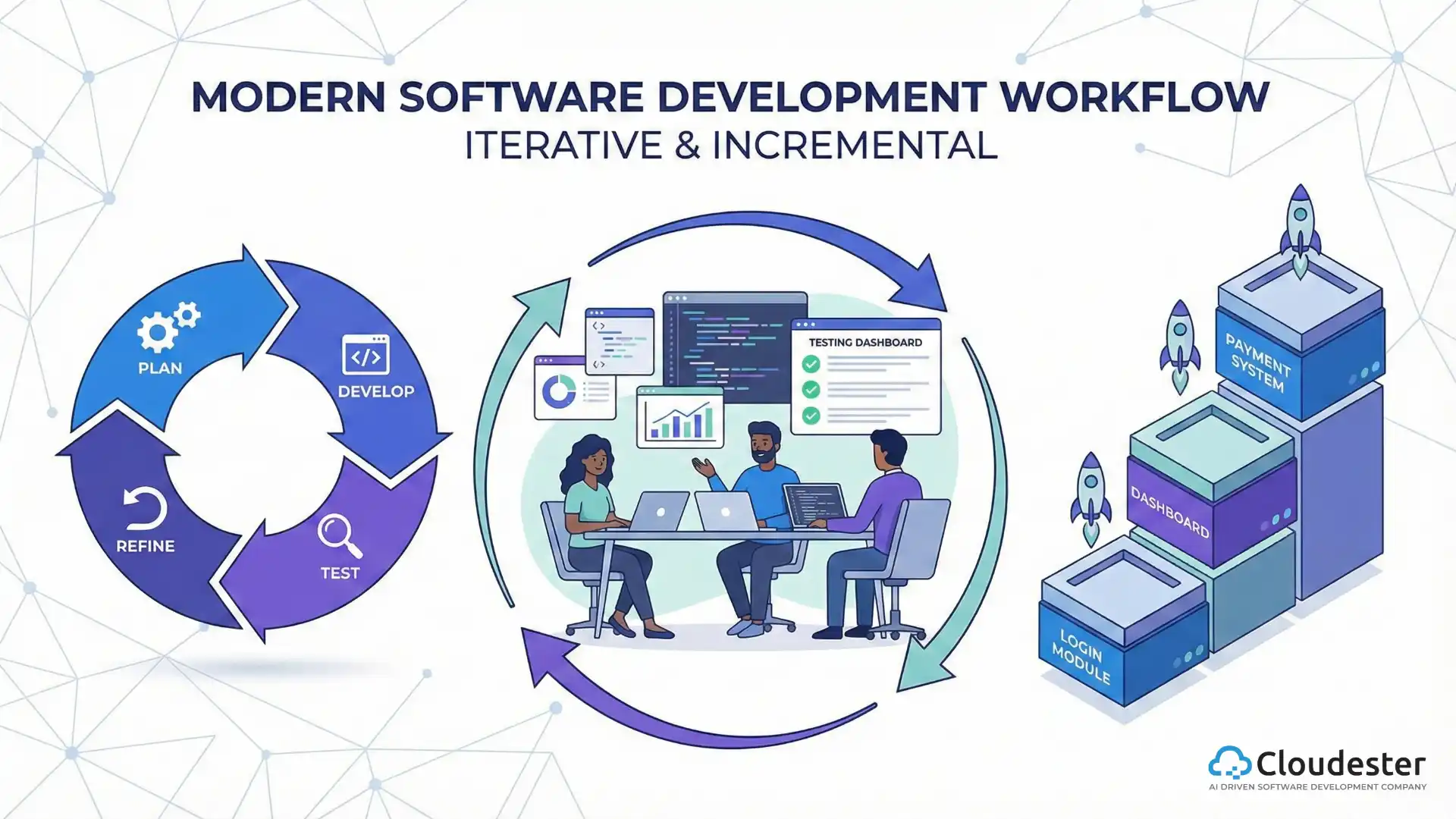
AI Generated. Credit: Google Gemini
Table of Contents
- What Is Iterative and Incremental Development?
- Relationship Between Iterative and Incremental Development and Software Quality
- Key Ways Iterative and Incremental Development Improves Software Quality
- Role of Testing in Iterative and Incremental Development
- Iterative and Incremental Development vs Traditional Models
- Real-World Examples of Quality Improvement
- Best Practices to Maximize Software Quality
- Common Challenges and How to Overcome Them
- Conclusion
Building high-quality software is probably the hardest part of the job right now. Systems are getting more complex by the minute, and user expectations are through the roof. That’s exactly why Iterative and Incremental Development has become the preferred approach for modern software teams aiming to deliver reliable, scalable, and high-performing applications.
If you try to build everything at once and save the testing for the very end, you are basically asking for a disaster. It is slow, it is expensive, and it almost never works out the way you planned.
By combining iterative refinement with incremental releases, developers can spot and fix quality issues while they are still small and manageable. This approach lays the foundation for consistent software quality improvement and helps software development company like Cloudester Software deliver top-tier results every single time.
What Is Iterative and Incremental Development?
To really get why this works, you have to look at the two distinct parts of the process.
Iterative Development is all about the polish. Think of a sculptor. You start with a rough block of stone and keep carving and refining through cycle after cycle until the details are perfect.
Incremental Development is about the actual components. You build and ship the software in small, working parts. You might build the login system first, then the user profile, then the payment gateway.
When you put them together, you are building a piece, making sure it is perfect, and then moving to the next. It is a cycle of building and refining that does not stop until the job is done.
Relationship Between Iterative and Incremental Development and Software Quality
The iterative development process is not just a way to manage a calendar. It is a built-in safety net for the code itself.
First, early feedback loops change everything. You do not have to wait months to find out if a feature is actually useful. You get feedback every couple of weeks.
Second, there is the benefit of continuous validation. Every new increment has to pass a battery of tests before it is accepted. This keeps technical debt from spiraling out of control. Finally, involving users frequently means you are building the right thing, which is the most important part of quality.
Key Ways Iterative and Incremental Development Improves Software Quality
Custom AI Software Development Solution For Enterprises
1. Early Detection of Defects
In an incremental development model, bugs have fewer places to hide. If a developer only writes a small amount of code in a week, finding a mistake is incredibly fast. This makes catching bugs easy and fixing them way cheaper for the client.
2. Continuous Testing and Validation
Software testing in iterative development is a constant heartbeat. You do not wait for a testing phase at the end. Instead, you test every single day. This creates a culture where everyone on the team feels responsible for the quality of the product from day one.
3. Improved Requirement Clarity
Vague requirements kill projects. Through constant refinement, the developers and the client stay on the same page. If a feature is not what the client had in mind, the team catches it in days rather than months.
4. Enhanced Code Quality
Developers know they will be coming back to the code in the next iteration. That is a huge incentive to keep things clean. This regular cleanup, or refactoring, keeps the codebase healthy and easy to maintain as the project grows.
5. Reduced Project Risk
By delivering working parts as you go, you eliminate the chance of a total project failure. Even if the project has to stop early for some reason, you still have a high-quality, working version of the most critical features.
Role of Testing in Iterative and Incremental Development
Testing is the actual pulse of agile software development. To keep quality high without killing the timeline, teams use a layered approach.
Unit Testing looks at the tiny parts of the code immediately. Integration Testing makes sure the new pieces play nice with the old ones. Lastly, Regression Testing ensures that a new update did not accidentally break something that was already working perfectly.
Automation is the secret weapon here. By letting machines handle the boring, repetitive tests, the human experts can focus on the tricky logic and the actual user experience.
Iterative and Incremental Development vs Traditional Models
The old Waterfall model is like building a skyscraper. Once the foundation is poured, you are stuck with the design. Iterative work is more like a garden. You plant, you prune, and you adapt as things grow.
In Waterfall, you check the quality at the end. If there was a mistake in the beginning, it would cost a fortune to fix. In an iterative style, quality is part of the DNA. Mistakes are found fast, and the continuous improvement in software development lets teams pivot without wasting a massive budget.
Real-World Examples of Quality Improvement
Big names in tech prove that an iterative development process is the best way to keep quality high under pressure.
Take Spotify as a prime example; they don’t just drop massive, scary updates once a year. Instead, they use small squads to test tiny features on a fraction of their users first to see if people actually like them. If a feature fails, they kill it before it ever reaches the global audience.
Even NASA used this logic for the Mars Rovers. They built the landing code in small, tested increments because you obviously can’t send a repairman to Mars if the software crashes.
Amazon also follows this path by decomposing its massive systems into tiny services managed by small teams, allowing them to release code thousands of times a day while maintaining a high software quality improvement standard.
Best Practices to Maximize Software Quality
If you want to keep your code from becoming a mess, you have to be disciplined about your cycles. Short iterations of one to four weeks are the sweet spot because they keep the feedback fresh and prevent the team from drifting off into the weeds.
High-end development teams, like those at Cloudester Software, emphasize a rock-solid Definition of Done. This is a simple checklist that ensures no piece of code is called finished until it is fully tested, documented, and peer-reviewed by someone else. Automation is another non-negotiable part of this.
If you aren’t running automated regression tests every time you add a new increment, you’ll eventually spend all your time fixing things you accidentally broke instead of building new value for your users.
Common Challenges and How to Overcome Them
Even with a great incremental development model, you are going to hit some speed bumps. Scope creep is a classic one where a project slowly inflates because everyone keeps adding just one more thing mid-cycle.
The best way to beat this is to be ruthless about sticking to your current goals and pushing new ideas to the next iteration.
Another common hurdle is the feedback vacuum, where stakeholders go silent and leave the developers guessing. To fix this, you should bake Demo Days into your schedule so the client can see and approve the work in real-time.
Finally, testing fatigue is real, which is why balancing automated tools with smart, manual oversight is the only way to keep your team from burning out while still pushing for continuous improvement in software development.
Conclusion
The move toward iterative and incremental development is a massive shift in how we think about success. It moves the goal from just finishing a project to delivering something truly excellent every single time.
By focusing on early feedback and constant testing, developers make sure their work is not just okay, but actually great. In a world where software reliability is everything, this approach is the only way to stay ahead of the curve.
Back
Latest posts




July 30, 2026