July 30, 2026

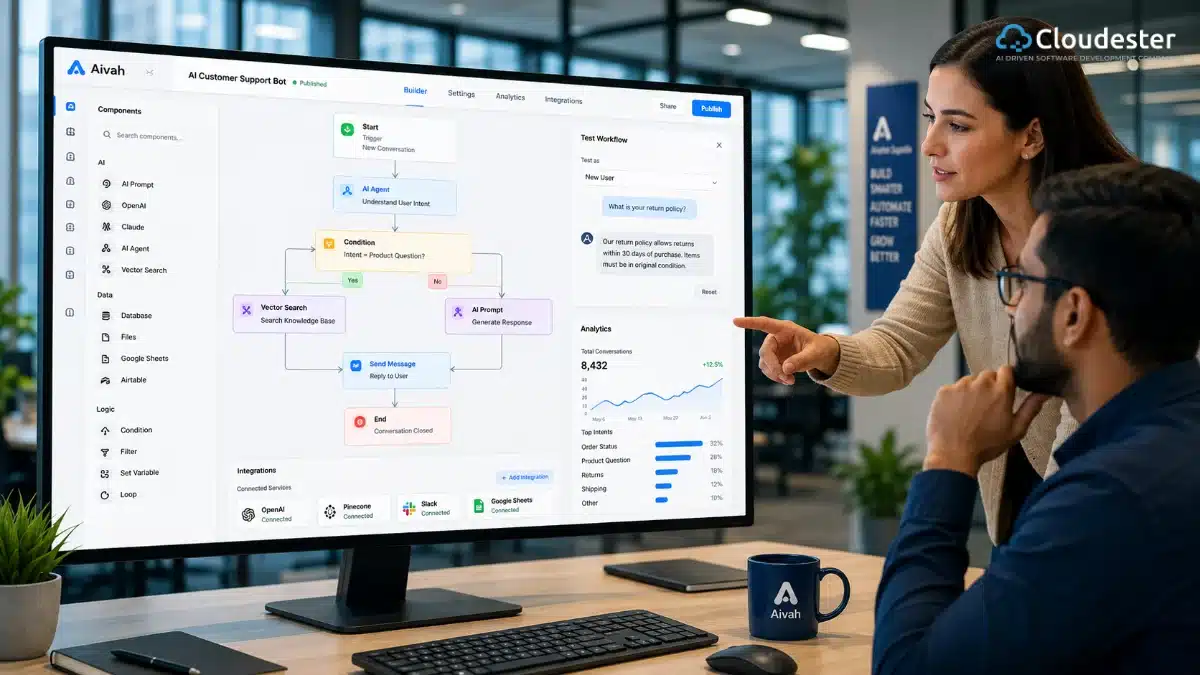
AI Generated. Credit: Google Gemini
Agentic AI web development is rapidly redefining how modern web applications are designed, built, and operated. Unlike traditional automation or reactive chatbots, agentic AI introduces autonomous agents that can reason, plan, make decisions, and take actions across web systems with minimal human intervention.
As businesses demand smarter, faster, and more adaptive digital experiences, agentic AI is emerging as a foundational technology for next-generation web platforms. From self-optimizing user journeys to intelligent backend workflows, agentic AI enables web applications to act more like decision-making systems rather than static software.
In this blog, you will learn what agentic AI web development really means, how it works, its architecture, real-world use cases, technical challenges, and why enterprises are increasingly adopting it for scalable and intelligent web solutions.
Agentic AI in web development refers to the use of autonomous AI agents that can independently perform tasks, make decisions, and interact with web systems to achieve defined goals.
Unlike rule-based automation or prompt-driven chatbots, agentic AI systems:
In a web development context, this means AI agents can operate across frontend interfaces, backend services, APIs, and third-party integrations to manage workflows dynamically.
Traditional web applications:
Agentic AI web applications:
This shift marks a move from reactive software to goal-driven digital systems.
Agentic AI web development combines AI reasoning models with web technologies to create systems capable of autonomous action. At a high level, these systems operate through a continuous perception–decision–action loop.
The agent observes data from:
This data becomes the context for decision-making.
The AI agent:
This is where large language models and reasoning engines play a key role.
The agent executes actions such as:
The system evaluates outcomes:
This feedback loop enables continuous improvement.
A scalable agentic AI web architecture typically includes the following components:
The decision-making engine responsible for reasoning, planning, and goal execution.
Allows the agent to interact with:
Stores:
This memory enables continuity across sessions.
Manages:
Includes:
Together, these layers form a self-directing web ecosystem rather than a static application.
Understanding the difference between agentic AI and traditional automation is critical when evaluating adoption.
| Feature | Traditional Automation | Agentic AI |
|---|---|---|
| Decision-making | Rule-based | Goal-oriented |
| Flexibility | Low | High |
| Context awareness | Limited | Advanced |
| Learning capability | None | Continuous |
| Adaptability | Manual updates | Self-optimizing |
While automation executes predefined workflows, agentic AI adapts workflows dynamically based on changing conditions.
Agentic AI is already reshaping how modern web applications operate across industries.
AI agents dynamically personalize user journeys by:
Agentic systems can:
Instead of static reports, AI agents:
Agentic AI improves:
Large organizations use agentic AI to:
Building agentic AI web applications requires a carefully selected technology stack.
A well-designed stack ensures scalability, security, and maintainability.
Despite its advantages, agentic AI web development presents several challenges.
Autonomous systems must operate within defined boundaries to avoid unintended actions.
AI reasoning models can be resource-intensive, requiring efficient orchestration.
Businesses need transparency into how decisions are made.
Agents interacting with sensitive systems must follow strict security protocols. Addressing these challenges requires strong governance and engineering discipline.
To ensure successful implementation:
These practices help maintain trust, reliability, and performance.
Enterprises are increasingly adopting agentic AI web development because it delivers measurable business value:
Organizations that adopt agentic AI early gain a strategic advantage in digital transformation.
The future of web development lies in intelligent, self-directing systems. As AI models become more capable and frameworks mature, agentic AI will move from experimental use cases to production-grade platforms.
We can expect:
Agentic AI is not a trend. it is a fundamental shift in how software is built.
Agentic AI web development uses autonomous AI agents to build web applications that can reason, plan, and take actions independently to achieve goals.
Chatbots respond to prompts, while agentic AI systems proactively make decisions and execute multi-step workflows.
Yes, many enterprises use agentic AI to manage workflows, analytics, customer experiences, and internal systems.
With proper governance, monitoring, and access controls, agentic AI can be deployed securely in production environments.
Agentic AI web development represents a major evolution in how web applications are designed and operated. By enabling autonomy, intelligence, and adaptability, agentic AI transforms web platforms into living systems that continuously optimize themselves.
For businesses and developers alike, understanding and adopting agentic AI is no longer optional. It is becoming essential for building future-ready digital experiences.


We specialize in creating high-performance web and mobile apps, seamlessly integrating them with your existing systems to enhance user experiences and streamline business operations.
85 Delancey St, New York NY 10002, United States