How AI and Automation Are Transforming System Development Integration
December 04, 2025
By Cloudester Team

AI Generated. Credit: Google Gemini
Table of Contents
- What Is System Development Integration?
- What Role Do AI and Automation Play?
- Key Areas Where AI + Automation Are Transforming Integration
- Benefits for Organizations
- Challenges and Risks
- Best Practices & Strategic Approach
- Future Trends in System Development Integration
- Real-World Case Studies or Examples
- Conclusion
If you look beneath the surface of any modern enterprise, you’ll find a complex network of interconnected systems, making the challenge of successfully stitching these disparate parts together, what we call system development integration, absolutely crucial. Why are we talking so much about the intersection of Artificial Intelligence (AI) and automation right now? Frankly, it’s because the old, manual methods just can’t handle the sheer complexity and breakneck pace that digital business demands today.
Let me define the terms. System development integration means the organized practice of developing and integrating different software, hardware, and service components into a unified, coherent system. Automation is about using technology to reliably execute all of those repetitive activities and workflows we loathe doing by hand.
Finally, AI represents the smart layer: it’s about systems that can emulate human intelligence, learn from operational data, make informed predictions, and support tricky and complex decisions.
Historically, integration was painful and an error-prone effort that required developers to write custom code by hand and map endless APIs. Today, AI and automation fundamentally change system development integration, moving the oft-tedious bespoke craft of yesteryear to a scalable, intelligent, and highly efficient engineering practice.
This blog looks at how these powerful technologies are reshaping the entire landscape of system development, from initial data mapping to proactive, predictive maintenance.
What Is System Development Integration?
System development integration is the master blueprint for your entire technology stack. It ensures all system components can communicate without friction. and sits at the center of the System Development Lifecycle. It brings legacy software and modern cloud microservices together. Its goal is to unite every part so the business can achieve shared objectives
The whole point of integration is to establish robust interoperability, guaranteeing that data flows between all components are efficient, accurate, and often instant, while simultaneously eliminating redundancy and preventing those crippling information silos. We aim for things like seamless customer experiences and fully automated business processes.
But the traditional approach was riddled with challenges: manual processes are agonizingly slow, human errors are inevitable, and older systems put up a lot of resistance, often leading to months of frustrating work.
What Role Do AI and Automation Play?
AI and automation are the twin engines driving this modern revolution in integration. Automation of system development focuses on the execution of predictable and repetitive tasks with unflappable reliability. This includes the establishment of continuous integration and delivery, infrastructure orchestration, and standardized, large-scale integration of modern technologies.
AI in system integration provides the much-needed intelligence that we have always wanted. This involves leveraging ML models for accurate predictive analytics, the deployment of smart agents to manage complex system states, and the use of clever anomaly detection algorithms to identify subtle issues hours before they escalate into critical failures.
These two technologies work beautifully together to transform system development and integration. Automation handles the routine execution-for example, automatically deploying a new API-whereas AI provides the needed intelligence, such as predicting the downstream performance impact or automatically mapping complex data structures.
They work together to automate critical yet difficult tasks such as intelligent API mapping, dynamic generation of data conversion logic, proactive error detection, and continuous system health monitoring.
Key Areas Where AI + Automation Are Transforming Integration
The tangible impact of intelligent automation is profoundly changing what’s possible across the entire spectrum of system integration.
Custom AI Software Development Solution For Enterprises
1. Automated Workflow & Orchestration
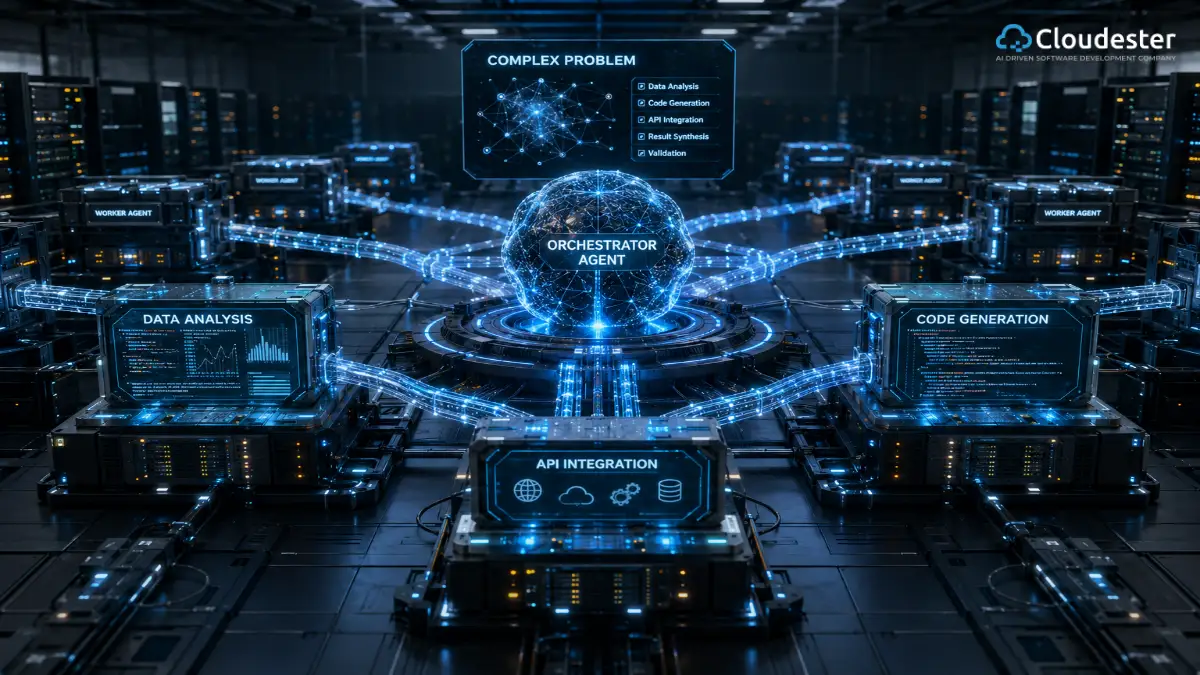
Automation tools now manage the intricate, ballet-like coordination of all system-to-system data flows, triggers, and tasks. These sophisticated tools can automatically manage the lifecycle of an integrated system. Imagine onboarding a brand new business module to a large corporate ecosystem instantly, with the tool managing to set up all the data synchronizations and security protocols instantly. This drastically cuts down the time for deploying new functionality.
2 AI-Driven Data Mapping & Semantic Integration
One of the most mind-numbing tasks is manual mapping of complex data fields between two systems using different terminology. The task is now being revolutionized with AI. AI tools analyze enormous volumes of data schemas, detect subtle mismatches, and have impressive accuracy in suggesting optimal data mappings.
This feature, called semantic integration, enables quite different data models to be harmonized through machine learning. This has become a core function of integrating systems with AI.
3 Predictive Monitoring & Maintenance
AI models constantly watch over the health of the integrated system, predicting potential failures or emerging bottlenecks hours or even days in advance through log analysis, volume of transactions, and latency metrics.
Integration automation in the system automatically triggers automated responses when an anomaly raises a red flag, such as rerouting traffic from a troubled microservice or automatically scaling resources. It greatly improves system uptime and spares engineers from constant, reactive troubleshooting.
4 Faster Deployment & Continuous Integration / Continuous Delivery (CI/CD)
Automation pipelines are the bedrock of modern CI/CD. They automatically build, test, and deploy new system modules and their integration layers. AI takes this further by assisting in comprehensive test coverage, identifying high-risk code changes, and even generating adaptive integration tests based on past failure patterns.
This intelligent approach ensures that new modules are integrated both securely and efficiently, providing robust support for system development lifecycle automation.
5 Decision-making & Adaptive Systems
AI empowers integrated systems to become truly adaptive and learn from experience. Over time, the system learns from its operational data, pinpointing the most efficient integration paths or data transfer schedules based on real-world usage patterns.
For example, AI might proactively suggest optimizing a costly, synchronous API call by automatically substituting it with a more efficient, asynchronous synchronization method, constantly fine-tuning the architecture for peak, intelligent performance.
Benefits for Organizations
Organizations that embrace intelligent automation for transforming system development integration aren’t just modernizing; they’re gaining substantial, measurable competitive advantages.
The main payoff is enormous efficiency, translating to faster integration times, significantly less manual effort, and a lower chance of human error. This directly leads to substantial cost savings, since there’s less rework and reduced maintenance overhead.
Companies gain superior agility, allowing for quicker time to market for system changes or new product features. The seamless flow of data dramatically enhances data utilization, giving teams, including those at Cloudester Software, faster and more reliable business insights.
Challenges and Risks
While the promise is great, implementing AI and automation in system integration definitely presents new hurdles. The initial complexity requires specialized skills and sophisticated platforms. Data quality and governance issues become critically amplified because, while AI needs perfect data, the integration process itself complicates the data landscape.
Security considerations are paramount; deep, automated integrations unavoidably increase the attack surface, meaning robust security must be built into the automation logic from day one. Integrating older legacy systems often presents considerable resistance.
Finally, we must guard against over-reliance on automation/AI without proper human oversight, which risks rapid, large-scale errors if the foundational logic is flawed.
Best Practices & Strategic Approach
All these challenges require us to take a very measured and strategic approach. It starts with a well-defined strategy that identifies clear-cut business goals for the places where automation and AI will make the most impact. Teams have to meticulously evaluate the current landscape, understanding limitations in the various existing data silos.
It’s about choosing the right tools and technologies: AI platforms, automation middleware, and robust integration software. Critical steps include putting in place rigorous data governance and architecture standards that assure clean, standardized data flows. Implementation should always be incremental, first focusing on pilot projects, then scaling.
Continuous monitoring and measurement against key metrics, iteration, these are absolute necessities. Crucially, it remains vital to retain human-in-the-loop oversight to verify AI decisions, update complex automation logic, and much else. Security and compliance need to be baked in from the start.
Future Trends in System Development Integration
The trajectory of this technology points strongly toward systems that are even more autonomous and deeply intelligent. We anticipate the continued growth of AI-native systems designed from the ground up for easy integration. The proliferation of low-code/no-code integration platforms will be dramatically enhanced with AI that can automatically suggest or even build highly complex integration flows.
We foresee the emergence of autonomous systems featuring self-healing integration layers, capable of resolving most connectivity issues without human intervention.
Furthermore, generative AI is expected to play a critical role in anticipating future integration demands and self-generating much of the necessary integration scripts and models.
The work performed by forward-thinking developers at companies like Cloudester Software will increasingly rely on leveraging these advanced autonomous capabilities.
Real-World Case Studies or Examples
UPS (United Parcel Service), a global leader in shipping and logistics, provides an excellent example of leveraging intelligence for massive-scale system development integration. Their primary system integration challenge is optimizing the flow of billions of data points daily across thousands of trucks, warehouses, and customer platforms.
UPS is building a digital twin of its entire distribution network, a virtual replica of its physical infrastructure, which requires continuous, real-time integration of data from IoT sensors, inventory management systems, and driver platforms. This automated integration environment, powered by AI and machine learning, allows them to run thousands of simulations to optimize distribution efficiency and test integration changes without risking the live network.
This advanced use of AI in system integration strengthens critical logistics applications. It allows them to instantly consume real-time data. It also enables autonomous route optimization and package rerouting. These abilities show a measurable and intelligent approach to system integration automation. They also support higher levels of operational excellence.
Also read: How AI Is Transforming Custom Software Development
Conclusion
AI and automation are more than new technologies. They are transforming system development integration in powerful ways. They shift integration from a slow bottleneck to a strategic business accelerator.
By adding intelligence and speed to manual workflows, these tools reduce errors. They also deliver lasting gains in efficiency, agility, and system reliability.
Any organization seeking to stay competitive must adopt these trends. Mastering them is now a critical strategic requirement.
This is the ideal time to review your integration maturity. Identify a high-value pilot project and begin your journey toward intelligent integration automation.
Back
Latest posts


June 26, 2026