Our Clients












2011
Founded
Year
50+
Achieved
Awards
98%
Clients Retention
100+
Core
Team
120+
Projects Implemented
40%
Business Efficiency with AI
Generative AI Engineering Services for Business Applications
Generative AI engineering services support organizations in designing, building, and operating AI systems that function reliably within real business environments. These services address the full lifecycle of generative AI, from data preparation and model design to deployment, optimization, and long term maintenance.
The focus is on enabling practical use cases such as workflow automation, decision support, and content generation while maintaining control, security, and scalability across teams and regions.
-
 Data Analysis and Preparation
This service ensures data is suitable, relevant, and structured for effective generative AI usage.
- Assess data sources for quality and relevance.
- Prepare structured and unstructured datasets.
- Identify data gaps and limitations early.
- Support data governance and access controls.
- Align data usage with business objectives.
-
Domain Aligned Model Development
This service adapts language models to specific industries, workflows, and terminology.
- Select appropriate base models for the domain.
- Apply fine tuning or contextual adaptation where required.
- Align outputs with industry language and norms.
- Reduce irrelevant or generic model responses.
- Validate behavior across domain specific scenarios.
-
Generative AI Application Development Services
This service focuses on building usable generative AI features within business systems.
- Design AI driven workflows for real use cases.
- Develop APIs and interfaces for AI interaction.
- Support text, image, and multimodal generation.
- Align development with guidance from AI consulting services.
- Prepare systems for production deployment.
-
AI Strategy and Implementation Planning
This service helps organizations plan how generative AI fits into their operations.
- Identify suitable generative AI use cases.
- Define success metrics and constraints.
- Assess risks related to cost, quality, and governance.
- Plan phased implementation and scaling.
- Align AI initiatives with business priorities.
-
System Integration and Output Optimization
This service ensures generative AI systems work effectively within existing platforms.
- Integrate AI models with applications and APIs.
- Optimize outputs for accuracy and relevance.
- Manage latency and operational costs.
- Support retrieval based and contextual workflows.
- Test integrations in staging environments.
-
Monitoring, Maintenance, and Continuous Improvement
This service supports long term reliability and adaptability of AI systems.
- Monitor system behavior and output quality.
- Detect performance drift and anomalies.
- Apply updates as models and data change.
- Maintain documentation and version history.
- Support stable operations over time.






Looking for Generative AI Engineers?
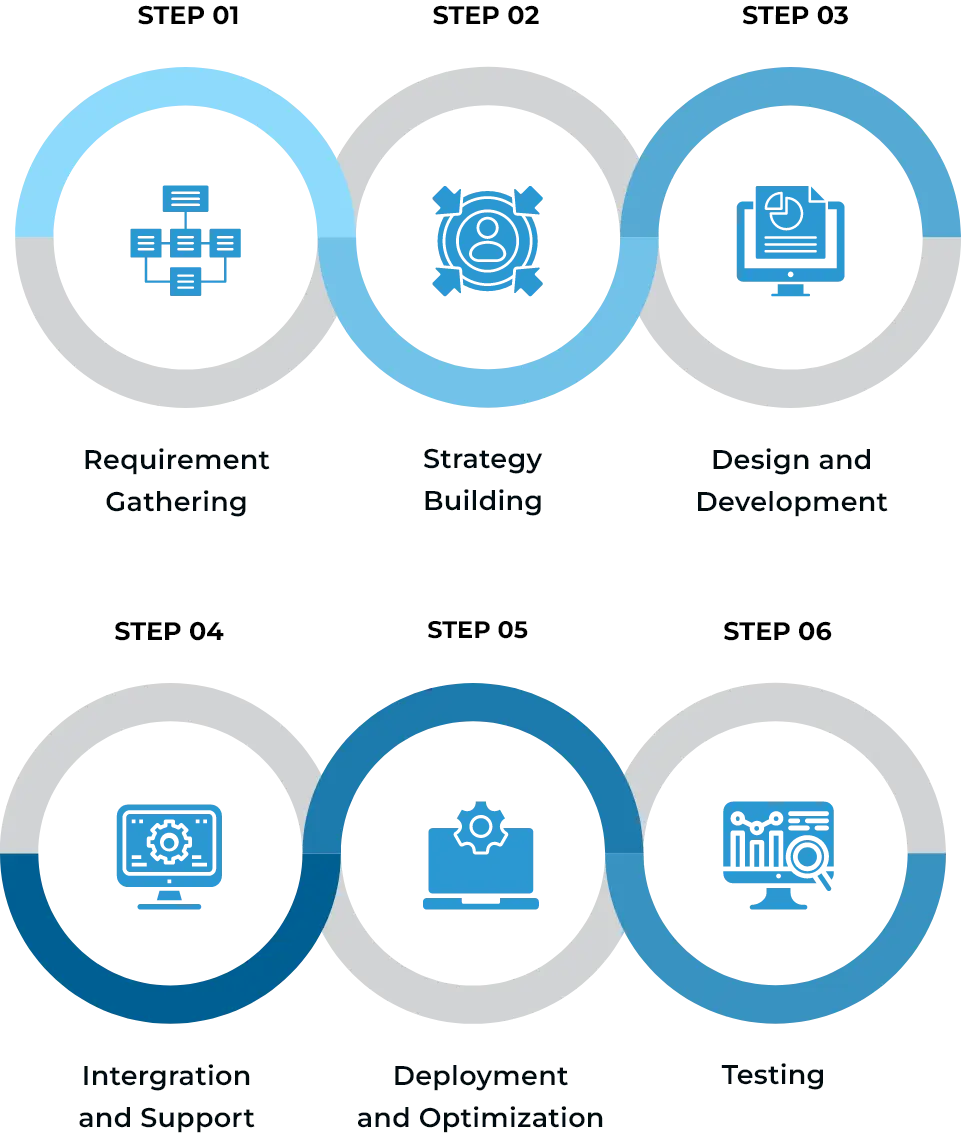
Generative AI Engineering Process for Business Ready Solutions
This process outlines how generative AI solutions are planned, built, tested, and supported to ensure they function reliably within real business environments and scale with evolving requirements.

-
1. Business Requirement Assessment
This stage defines the business problem, success criteria, and operational constraints before development begins.
- Identify business objectives and expected outcomes.
- Understand users, workflows, and usage scenarios.
- Assess data availability and quality.
- Define functional and non functional requirements.
- Document assumptions, risks, and dependencies.
-
2. AI Strategy and Architecture Planning
This stage establishes how generative AI will be structured, governed, and scaled.
- Select suitable models and system patterns.
- Define architecture for security and scalability.
- Plan cost, performance, and governance controls.
- Align AI usage with business and regulatory needs.
- Create a phased implementation roadmap.
-
3. Solution Design and Development
This stage focuses on building generative AI components that support real use cases.
- Design AI workflows and interaction patterns.
- Develop model integrations and application logic.
- Implement prompt structures and retrieval flows.
- Ensure code clarity and maintainability.
- Document design decisions and configurations.
-
4. Validation and Quality Testing
This stage verifies that AI outputs meet defined quality, reliability, and safety criteria.
- Test outputs across normal and edge cases.
- Evaluate accuracy, relevance, and consistency.
- Perform integration and regression testing.
- Validate security and access controls.
- Track and resolve defects systematically.
-
5. Release and Performance Optimization
This stage prepares generative AI systems for controlled production use.
- Deploy solutions to staging or production environments.
- Optimize response quality, latency, and cost.
- Establish monitoring and alerting mechanisms.
- Validate release acceptance criteria.
- Prepare rollback and recovery plans.
-
6. Support, and Continuous Improvement
This stage ensures long term stability, adaptability, and operational support.
- Integrate AI systems with existing platforms.
- Monitor performance and usage trends.
- Apply updates as data and requirements evolve.
- Maintain documentation and version history.
- Support knowledge transfer and internal teams.
Criteria for Selecting Generative AI Engineers for Business Use
Organizations evaluating generative AI engineers typically focus on delivery maturity, technical breadth, and the ability to support production systems over time. The following criteria outline what matters when selecting engineers for business critical generative AI initiatives.
-
Collaborative Delivery and Problem Framing
Effective generative AI work depends on clear collaboration between technical teams and business stakeholders.
- Translate business needs into technical requirements.
- Work across product, engineering, and data teams.
- Clarify ambiguous use cases early.
- Support iterative feedback and refinement.
- Maintain alignment throughout delivery.
-
Applied Machine Learning and AI Foundations
Generative AI engineering requires a strong grounding in machine learning concepts and applied practices.
- Understand supervised and unsupervised learning methods.
- Apply model evaluation and validation techniques.
- Work with training, fine tuning, and inference workflows.
- Align solutions with guidance from machine learning consulting services.
- Support explainability and reviewability.
-
Experience with Generative AI Platforms and Tools
Practical experience with generative AI tools supports faster and safer implementation.
- Work with large language and multimodal models.
- Use prompt frameworks and orchestration tools.
- Integrate APIs for text and image generation.
- Manage model configuration and access controls.
- Support production monitoring and usage tracking.
-
Understanding of Generative AI Algorithms
Algorithm level understanding supports better control over model behavior.
- Work with transformer based architectures.
- Understand sampling, tokenization, and decoding.
- Apply techniques to manage bias and drift.
- Balance creativity and constraint in outputs.
- Evaluate tradeoffs between accuracy and cost.
-
Data Analysis and Insight Awareness
Generative AI systems rely on data quality and interpretation.
- Assess data relevance and limitations.
- Support data preprocessing and enrichment.
- Interpret output patterns and anomalies.
- Align AI usage with data governance needs.
- Enable informed decision making from outputs.
-
Quality, Governance, and Long Term Readiness
Sustainable AI adoption depends on quality controls and clear ownership.
- Apply structured testing and validation practices.
- Support versioning and change management.
- Respect data privacy and security boundaries.
- Enable audit readiness where required.
- Support maintainability over time.






Our Hire Generative AI Engineers Services
Our Expertise in AI Models

GPT-4
OpenAI’s GPT-4 sets the benchmark for complex problem-solving with its advanced reasoning and extensive general knowledge. It excels in tasks like nuanced text generation, summarization, multilingual communication, and creative ideation, making it a versatile tool for various industries.

GPT-4o
This advanced multimodal model excels at processing text, images, and audio, offering businesses versatile applications for communication and automation.

LLaMA 2
Meta’s LLaMA 2 is a state-of-the-art large language model designed for high-performance AI applications. It supports customization, enabling businesses to tackle challenges like content generation, problem-solving, and text summarization with precision.

PaLM2
Google’s PaLM2 leads the way in intricate reasoning tasks, such as code interpretation, mathematical solutions, and multilingual translation. It’s the perfect model for enterprises looking to enhance productivity through AI-powered insights and operations.

Claude 2
Anthropic’s Claude 2 offers a safer and more ethical generative AI approach. It is ideal for organizations prioritizing compliance, privacy, and responsible AI while delivering powerful text analysis, summarization, and conversational capabilities.

Gemini
Gemini, Google DeepMind’s latest model, combines text, image, and speech processing into a seamless multimodal AI platform. Its ability to integrate and process diverse data types makes it perfect for advanced applications in marketing, healthcare, and customer experience.

MidJourney v6
MidJourney v6 revolutionizes visual creativity with its ultra-realistic image generation capabilities. From marketing campaigns to product design, this model offers high-quality, detailed visuals that cater to the growing demand for impactful visual content.

DALL.E
OpenAI’s DALL·E generates stunning and lifelike images from text prompts. It supports businesses with image creation, modification, and variation, offering unparalleled versatility for industries like e-commerce, media, and design.

Whisper
Whisper by OpenAI provides exceptional speech recognition capabilities, including language identification and multilingual speech-to-text conversion. It’s a key tool for transcription services, voice-based applications, and real-time communication tools.

OpenAI Sora
OpenAI’s new text-to-video AI model enables businesses to generate high-quality videos from text prompts, perfect for marketing campaigns, e-learning platforms, and creative workflows.

ImageBind
Meta’s ImageBind integrates text, audio, video, and other modalities to deliver rich, cross-domain insights. It is particularly beneficial for industries like retail, logistics, and marketing, enabling a unified understanding of complex datasets.

Stable Diffusion
Stable Diffusion remains a powerful image generation model, excelling in tasks like inpainting, outpainting, and creative image synthesis. Its scalability and efficiency make it an excellent choice for businesses seeking high-quality visual outputs.
Our AI Tech Stack
AI Development Services

Python

.NET Core

Java
AI Development Tools

Jupyter / Anaconda

Colab

Kaggle
Cloud Computing Platforms

AWS

Azure

Google Cloud
DevOps

Snyk

JFrog

Jenkins
Frameworks / Libraries

TensorFlow

PyTorch

Keras
Data Storage & Visualization

BigQuery

Power BI

Tableau
Our Engagement Models
-
Dedicated AI Development Team
Our proficient AI and blockchain developers are fully immersed in leveraging cognitive technologies to provide exceptional services and solutions to our clients.
-
Extended Team Enrichment
Our extended team model is thoughtfully designed to support clients in expanding their teams with the necessary expertise for AI-driven projects.
-
Project-focused Strategy
Embracing our project-based approach, our skilled software development specialists collaborate directly with clients and the triumphant realization of AI-infused projects


Get Started Today

Contact Us
Complete our secure contact form, Book a calendar slot and set up a Meeting with our experts.

Get a Consultation
Engage in a call with our team to evaluate the feasibility of your project idea. We’ll discuss the potential, challenges, andopportunities.

Receive Cost Estimates
Based on your project requirements, we provide a detailed project proposal, including budget and timeline estimates.

Project Kickoff
Upon agreement, we assemble a cross-disciplinary team to initiate your project. Our experts collaborate to launch your project successfully.
Start a conversation by filling the form
Build your top-notch AI product using our in-depth experience. We should discuss your project.
FAQs about Hire Generative AI Engineers
Generative AI engineers are critical in developing, deploying, and maintaining AI models capable of generating creative outputs such as text, images, or videos. When you hire Generative AI Engineers from Cloudester, they specialize in tasks like model fine-tuning, system integration, performance optimization, and implementing cutting-edge AI algorithms.
Generative AI can transform your business by automating repetitive tasks, personalizing customer experiences, and enabling the creation of high-quality content at scale. With the help of Generative AI Engineers, your business can innovate faster, reduce costs, and gain a competitive edge by leveraging tools like GPT-4, DALL·E, and custom AI models.
At Cloudester, our Generative AI Engineers are experts in the latest AI technologies, including transformers, neural networks, and GANs. Our commitment to innovation, deep technical expertise, and collaborative approach ensures that your AI projects are delivered precisely and tailored to your unique requirements.
Our engineers are proficient in:
- Programming languages like Python and frameworks like TensorFlow and PyTorch.
- Advanced Generative AI models such as GPT-4, PaLM 2, and MidJourney.
- Data analytics, model optimization, and performance monitoring.
- Building scalable and secure AI solutions aligned with business goals.
By choosing Cloudester, you gain access to a team of highly skilled Generative AI Engineers who bring a blend of technical expertise and industry experience. We deliver customized AI solutions, ensuring scalability, security, and seamless integration into your existing systems.
We maintain the highest standards in recruiting and training our engineers. Cloudester team undergoes continuous learning to stay updated with the latest AI trends and technologies. Regular performance evaluations and hands-on experience with advanced AI tools ensure their ongoing competence.
At Cloudester, we prioritize data privacy and security by implementing robust protocols, encryption methods, and compliance with industry standards such as GDPR and CCPA. Our Generative AI Engineers ensure that all AI systems are built with secure architecture to protect your sensitive information.
Impressions
Aug 24, 2026
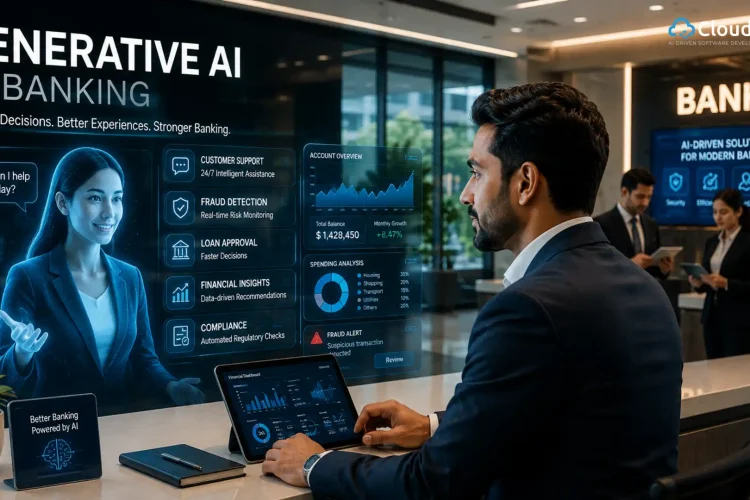
What Is Generative AI in Banking and How Is It Used?
A few years ago, generative AI in banking was a slide in someone’s innovation deck. Now it’s running the chat window, drafting the fraud alert, summarizing the loan file. Three things pushed that shift. Customers stopped tolerating slow answers. Cost pressure never really let up. And the models themselves got good enough, finally, that a […]
Read more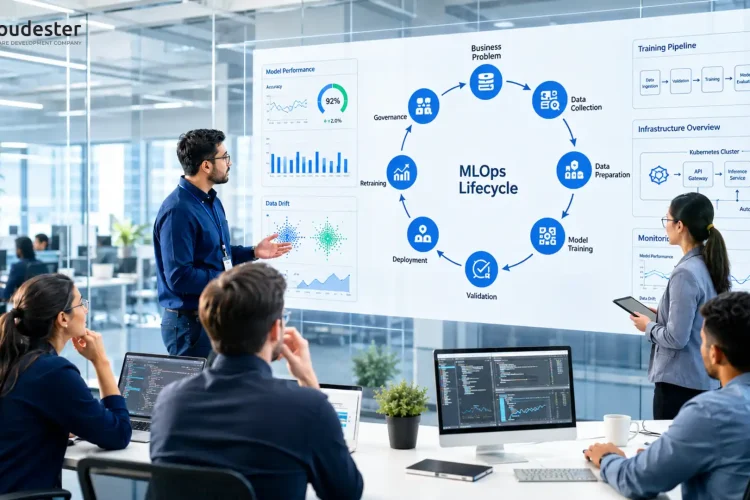
Aug 19, 2026
What Is the MLOps Lifecycle and Why Does It Matter?
In plain terms, the MLOps lifecycle is the set of stages a machine learning model moves through, from the first business question to a model running in production and getting retrained as things change. Most organizations don’t struggle to build a model. They struggle to keep it working once it’s live, since data shifts and […]
Read more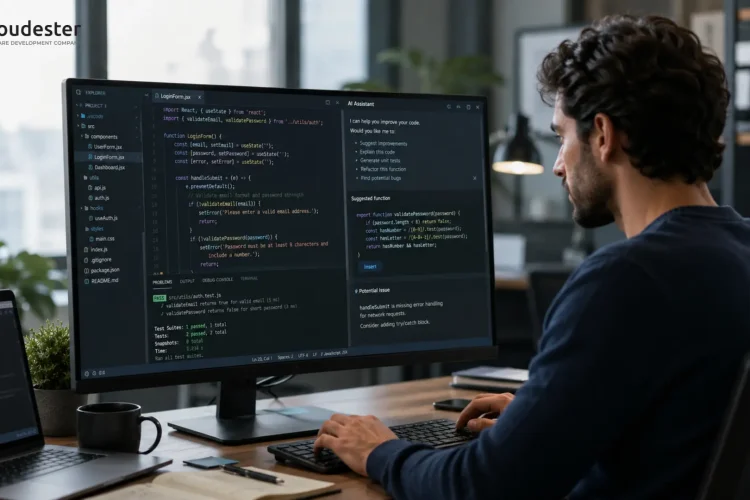
Aug 15, 2026
What Is AI Pair Programming and How Does It Improve Software Development?
Software development has changed more in the last 2 years than in the decade before it, and most of that shift traces back to one thing: AI-assisted software development now happens inside the editor, not just in a browser tab. AI pair programming is the clearest example of that shift. It takes the old practice […]
Read more